

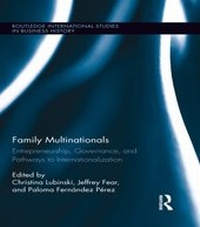
Family Multinationals
Entrepreneurship, Governance, and Pathways to Internationalization
1st Edition
Published on 18. July 2013
286 pages
978-1-135-04493-0 (ISBN)
Description

In contrast to widespread assessments that family enterprises lack sufficient resources and capabilities to go global, many family companies are competing successfully in an increasingly globalized business environment. Worldwide, a large number of thriving multinationals are still family-owned and/or under family control. While there is abundant literature on the phenomenon of globalization from many different disciplines, neither the literature on multinationals nor the growing field of family business studies have systematically investigated family multinationals yet. This volume is one of the first to deal explicitly with family multinationals and the role of the family in internationalization. It situates itself at the crossroads of internationalization studies on the one hand and family business research on the other.
Why do families continue to play such a large role in some of the most prominent firms in emerging and mature economies? How did they manage to maintain ownership control, yet divest of unrelated business ventures? How did they internationalize yet maintain control? This book identifies the idiosyncratic strategies and structures of family multinationals in different countries and at different points in time. A comparative historical and case study approach allows us to explore the role of the family through the firms' various internationalization pathways and understand long-term developments and path dependencies.
Why do families continue to play such a large role in some of the most prominent firms in emerging and mature economies? How did they manage to maintain ownership control, yet divest of unrelated business ventures? How did they internationalize yet maintain control? This book identifies the idiosyncratic strategies and structures of family multinationals in different countries and at different points in time. A comparative historical and case study approach allows us to explore the role of the family through the firms' various internationalization pathways and understand long-term developments and path dependencies.
Reviews / Votes
"A major contribution in the field of business history indispensable to understand the present of family-run multinationals." -- Andrea Colli, Bocconi University, Italy"The volume makes a welcome contribution to our understanding of how families act in the process of internationalisation. The strength is attempt on the part of the contributors to focus on to an interesting and well-defined question, i.e. how families make use of their internal resources and networking capacity to succeed...this book fills a void in management and business history research. It has many potential readers, both inside and outside academia." - - Hans Sjoegren, Linkoeping University and Stockholm School of Economics, Business History
More details
Series
Language
English
Place of publication
London
United Kingdom
Publishing group
Taylor & Francis Ltd
Target group
College/higher education
Illustrations
10 s/w Tabellen, 10 s/w Photographien bzw. Rasterbilder
10 Tables, black and white; 10 Halftones, black and white
File size
3,22 MB
ISBN-13
978-1-135-04493-0 (9781135044930)
Copyright in bibliographic data and cover images is held by Nielsen Book Services Limited or by the publishers or by their respective licensors: all rights reserved.
Schweitzer Classification
Other editions
Additional editions
Christina Lubinski | Jeffrey Fear | Paloma Fernandez Perez
Family Multinationals
Entrepreneurship, Governance, and Pathways to Internationalization
Book
08/2016
1st Edition
Routledge
€83.90
Shipment within 10-20 days
Christina Lubinski | Jeffrey Fear | Paloma Fernandez Perez
Family Multinationals
Entrepreneurship, Governance, and Pathways to Internationalization
Book
05/2013
1st Edition
Routledge
€232.00
Shipment within 15-20 days
Persons
Jeffrey Fear is the newly appointed Professor of International Business History at the University of Glasgow, Centre for Business History. He holds a PhD in history from Stanford University and has previously taught at the University of Pennsylvania, the Harvard Business School, and the University of Redlands. He is on the editorial board of the Business History Review and Essays in Economic and Business History.
Paloma Fernandez Perez is Professor of Economic History at the University of Barcelona and has a PhD in history from the University of California at Berkeley. Her research interests are family business, innovation, entrepreneurial networks, and lobbies. She has published El rostro familiar de la metropolis, and Un siglo y medio de trefileria en Espana, and has edited Del metal al motor with P. Pascual . She is a principal researcher of a project on entrepreneurial networks in Spain and a member of the Centre d'Estudis Antoni de Capmany.
Christina Lubinski is Research Fellow at the German Historical Institute in Washington, DC. Her first book won the Prize for Business History by the Germany Society of Business History and she was a Harvard Business School Newcomen Fellow in 2010-2011. She has published on family business and multinationals in Business History Review, Enterprise & Society, and the Journal of Family Business Strategy. Her most recent research deals with German and U.S. companies in India since 1900 and asks how they dealt with the challenges of political risk.
Paloma Fernandez Perez is Professor of Economic History at the University of Barcelona and has a PhD in history from the University of California at Berkeley. Her research interests are family business, innovation, entrepreneurial networks, and lobbies. She has published El rostro familiar de la metropolis, and Un siglo y medio de trefileria en Espana, and has edited Del metal al motor with P. Pascual . She is a principal researcher of a project on entrepreneurial networks in Spain and a member of the Centre d'Estudis Antoni de Capmany.
Christina Lubinski is Research Fellow at the German Historical Institute in Washington, DC. Her first book won the Prize for Business History by the Germany Society of Business History and she was a Harvard Business School Newcomen Fellow in 2010-2011. She has published on family business and multinationals in Business History Review, Enterprise & Society, and the Journal of Family Business Strategy. Her most recent research deals with German and U.S. companies in India since 1900 and asks how they dealt with the challenges of political risk.
Content
1. Family Multinationals: Entrepreneurship, Governance, and Pathways to Internationalization Christina Lubinski, Jeffrey Fear, and Paloma Fernandez Perez Part 1: Internationalization Pathways and Governance Choices 2. Are Family Firms "Reluctant Internationalizers?": Insights from the History of Indian Family Businesses Vipin Gupta 3. A Family Multinational's Quest for Unity: Siemens's Early Business in India, 1847-1914 Christina Lubinski 4. Family Capitalism and Internationalization: The Case of the Czech Family Firm Bat'a Up to the Early 1940s Susanne Hilger Part 2: The Visible Hand of Governments and Supporting Institutions 5. Globalization from a 17mm-Diameter Cylinder Perspective: Mittelstand Multinationals Jeffrey Fear 6. Fast Learning: Business, Kinship, and Politics as Determinants of the Growth and Internationalization of the Largest Chinese Family Businesses Paloma Fernandez Perez 7. Multinationalization Strategy of Mexican Family Business Taeko Hoshino Part 3: From Local Base to Global Expansion 8. Carving out a Place in International Markets: Success and Failure in European Family Papermaking Firms (1800-2010) Miquel Gutierrez Poch 9. The Feltrinellis - Going Global with the Timber Trade: How to Build a Fortune Using a Scarce Resource (1854-1942)Luciano Segreto 10. Becoming Global, Staying Local: The Internationalization of Bertelsmann, 1962-2010 Hartmut Berghoff Part 4: Inside the Family 11. "This Sad Affair:" Separation, Sentiment, and Familism in a Nineteenth-century Family Multinational Andrew Popp 12. Two Countries, One Home, One Occupation: Italian Ice-Cream Parlors as a Family Business in Germany, 1900-today Anne Overbeck 13. When Du Pont Entered Mexico (1902-1928): How the Network Played the Game Liza Lombardi
