

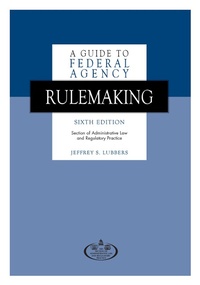
A Guide to Federal Agency Rulemaking, Sixth Edition
Description

More details
Other editions
Additional editions
Person
Jeffrey S. Lubbers was appointed Professor of Practice of Administrative Law at American University's Washington College of Law in 2009, after being a Fellow in Law and Government since 1996. He has also taught at the University of Miami School of Law, and has been a Visiting Professor at Washington and Lee University School of Law, the Georgetown University Law Center, and several overseas law schools. He has an A.B. degree from Cornell University and a J.D. from the University of Chicago Law School.
Prior to joining American University, he served in various positions with the Administrative Conference of the United States (ACUS), the U.S. Government's advisory agency on procedural improvements in federal programs until its closure by the 104th Congress in 1995. From 1982-1995 he was ACUS' Research Director?a position in the Senior Executive Service. Upon its reopening in 2010, he was appointed as a Special Counsel. He served as Team Leader for Vice President Gore's National Performance Review team on Improving Regulatory Systems in 1993. He is the author of the ABA's Guide to Federal Agency Rulemaking (5th ed. 2012), has co-authored the Administrative Procedure Sourcebook (5th ed. 2016), and served as the editor for the ABA's annual Developments in Administrative Law and Regulatory Practice (16 volumes from 1998-2014).
In addition to his teaching, he has served as a consultant to various federal agencies, the ABA, the World Bank, the USAID, the OECD, the Asia Foundation, and the Yale University China Law Center.
Content
TABLE OF CONTENTS
Dedication iii
About the Author xv
Preface xvii
Note about the Administrative Conference of the United States
(1968-1995, 2010- ) xxi
List of Acronyms Used in the Text xxiii
PART I
OVERVIEW OF FEDERAL AGENCY RULEMAKING 1
A. Rulemaking under the Administrative Procedure Act 4
B. Agency Rulemaking and the Courts 6
C. Agency Rulemaking and the Congress 12
D. Agency Rulemaking and the President 18
1. The Development of Presidential Review 19
2. Executive Order 12,866 23
3. Developments in the Bush II Administration 29
4. Developments in the Obama Administration 31
5. Developments in the Trump Administration 33
6. Judicial Reaction to Presidential Review 38
E. Overviews of Rulemaking-Other Views 39
1. The Administrative Conference's Comprehensive Review of the
"State" of Rulemaking 39
2. The "Blackletter Statement" of the ABA Section of Administrative
Law and Regulatory Practice 40
3. Other Overviews of Rulemaking 41
Excerpts from "A Blackletter Statement of Federal Administrative Law" 43
PART II
THE STATUTORY FRAMEWORK FOR RULEMAKING 49
Chapter 1
The Administrative Procedure Act's Rulemaking Provisions 51
A. "Rules" and "Rulemaking" Under the APA 51
B. Formal Rulemaking under the APA 58
C. Informal Rulemaking under Section 553 of the APA 60
vi A Guide to Federal Agency Rulemaking
D. Rules Exempt from All of Section 553's Requirements 61
1. Proprietary Matters: Public Property, Loans, Grants, Benefits, and Contracts 62
2. Agency Management or Personnel 66
3. Military or Foreign Affairs 67
E. Rules Exempt from Notice and Comment 68
1. Rules of Agency Organization, Procedure, or Practice 69
2. Interpretive Rules and Policy Statements (also known as
"Non-Legislative Rules" or "Guidance") 74
a. The agency's label 77
b. Distinguishing between interpretive rules and legislative rules 78
i. The "legal effect" test 79
ii. The "binding norm" test 80
iii. The modern test: Is the rule truly interpretive or does it effect substantive change? 84
iv. Agency modification of prior interpretations of their regulations 88
c. Distinguishing between legislative rules and policy statements 90
i. Case law: true policy statements do not establish a binding norm 91
ii. Importance of agency practice 94
iii. ACUS Recommendations 96
iv. OMB "Good Guidance" Bulletin 98
v. Other agency stratagems 99
d. Summary of the law on the guidance exemption 100
e. The intertwining of procedural claims and finality for the
purposes of judicial review 103
f. Post-promulgation comment period 104
3. "Good Cause" Exemptions 105
a. Emergency health or safety standards 109
b. Congressional deadlines 110
c. "Interim-final" rules 114
d. "Direct-final" rulemaking 116
e. Remedies for violations of the good-cause provision 118
f. Suspension of effective dates and "midnight rules" 119
4. Exemptions from Delayed Effective Date Requirement 125
F. Publication Requirements of Section 552 of the APA 126
Chapter 2
Use of Rulemaking or Adjudication for the Setting of Policy: A Comparison 129
A. Legal Constraints on Choosing Rulemaking or Adjudication 132
1. Statutory Requirements 132
2. Statutory Authority 132
3. Judicial Constraints 136
Contents vii
B. Practical Considerations in Choosing Rulemaking or Adjudication 141
1. Advantages of Rulemaking 141
2. Advantages of Adjudication 144
3. Declaratory Orders 146
4. Summary 146
Chapter 3
Other Procedural Statutes Affecting Rulemaking 149
A. The Federal Register Act 149
B. The National Environmental Policy Act 151
C. The Regulatory Flexibility Act 153
D. The Paperwork Reduction Act 160
1. The OMB Clearance Requirements 162
2. Clearance Procedure 163
3. PRA and the Internet 167
4. Standard of Review 168
5. The Small Business Paperwork Relief Act 169
E. The Federal Advisory Committee Act 170
F. The Negotiated Rulemaking Act 173
G. The Unfunded Mandates Reform Act 177
H. The Information Quality Act 179
I. The E-Government Act of 2002 184
J. Congressional Review of Rules 185
K. Miscellaneous Other Statutes Affecting Rulemaking 193
1. The Trade Agreements Act 193
2. The National Technology Transfer and Advancement Act 194
3. Assessment of Federal Regulations and Policies on Families 194
PART III
INFORMAL RULEMAKING IN PRACTICE 197
Chapter 1
Beginning the Process 199
A. External Considerations 200
1. Congressional and Judicial Pressure 202
2. Public Petitions for Rulemaking 203
3. Agency Priority Setting 206
4. Other Influences on an Agency's Decision to Begin Rulemaking 209
5. Litigation Settlements and Consent Decrees 210
B. Procedural Decisions 215
1. Advance Notice of Proposed Rulemaking (ANPRM) 216
2. Negotiated Rulemaking 217
viii A Guide to Federal Agency Rulemaking
Chapter 2
Electronic Rulemaking 227
A. Potential Benefits 230
B. Legal and Technical Issues 231
1. Questions about the Informational Goal 234
a. How should we best integrate existing sources of information? 234
b. Docketing issues 235
2. Questions Concerning the Participatory Goal 241
a. How can we best reach the goal of better, more targeted notices? 241
b. Can we also provide easier, more convenient comment opportunities? 241
c. What rules should govern rulemaking "chat rooms"? 242
C. The Impact of E-Rulemaking on the Rulemaking Process 243
Chapter 3
Regulatory Analysis and Review 251
A. Executive Order 12,866 252
1. Rules Covered by Executive Order 12,866 Review 253
2. Content of the Regulatory Analysis 255
3. OIRA Review 261
B. The Paperwork Reduction Act 263
1. Coverage 263
2. Content of the Analysis 264
3. OIRA Review 264
C. The Regulatory Flexibility Act 265
1. Coverage 265
2. Content of the Analysis 265
3. Review by the Small Business Administration 266
D. Unfunded Mandates Reform Act (UMRA) 267
1. Coverage 267
2. Content of the Analysis 267
3. Review of the Analyses 268
E. OMB Peer Review Bulletin 269
F. OMB/OSTP Risk Assessment Principles 272
G. Assessment of Federal Regulations and Policies on Families 273
H. Privacy Assessments 274
I. Other Executive Orders 274
J. Coordination of Analysis Requirements 279
Chapter 4
The Notice of Proposed Rulemaking 283
A. Publication Requirements 283
B. Contents of the Notice of Proposed Rulemaking 285
C. Federal Register Requirements and Incorporation by Reference 286
Contents ix
D. Adequacy of the Notice 289
E. Need for a Second Cycle of Notice and Comment ("Logical Outgrowth" Test) 291
1. Formulations of the "Logical Outgrowth" Test 292
2. The Supreme Court Adopts the Test 295
3. Examination of the Comments 296
4. Importance of the Wording of the NPRM 298
5. Voluntary Use of Two Cycles of Notice and Comment 301
F. Dissents 303
Chapter 5
Public Participation 305
A. Opportunity for Written Comment 305
1. Minimum Time 306
2. Agency Disclosure of Important Data or Information 310
3. Open-mindedness 314
B. Special Consultation Requirements 315
C. Oral Hearings in APA Rulemakings 316
1. Formal Rulemaking under the APA 316
2. Hearing Requirements in Hybrid Rulemaking Statutes 319
3. The Position of the Administrative Conference on Hearings in Rulemaking 320
4. Agency Oral Hearing Procedures 321
Chapter 6
The Rulemaking Record 325
A. The Evolution of the "Rulemaking Record" Concept 325
B. The Importance of the Rulemaking Record in Informal Rulemaking 329
1. The Rulemaking Record as an Aid to Public Participation 330
2. The Rulemaking Record as the Basis for the Agency's Rulemaking Decisions 330
3. The Rulemaking Record as the Basis for Judicial Review 332
4. Treatment of "Confidential" Comments 339
Chapter 7
"Off-the-Record" or "Ex Parte" Communications in Rulemaking 343
A. Summary of the Law 343
B. Agency Practices for Handling Ex Parte Communications 346
1. Policy Considerations 346
2. The Administrative Conference's Recommendations 347
3. Agency Practice 348
C. Executive Branch Communications in Rulemaking 350
1. The Administrative Conference's Recommendations 350
x A Guide to Federal Agency Rulemaking
2. The Transparency of OMB's Review of Agency Rules 352
3. The Judicial Perspective 354
D. Congressional Communications in Rulemaking 355
E. Intra-agency Communications in Rulemaking 357
F. Communications with Consultants 359
Chapter 8
The Final Rule 361
A. Issues for Agency Consideration 361
1. Time Limits for Agency Action 361
2. Interagency Coordination and Review 363
3. International Regulatory Cooperation 365
4. The Final Regulatory Analysis and OMB Review 368
5. Legal and Jurisdictional Issues 369
6. Determining the Effective Date and Compliance Date for the Final Rule 370
a. APA requirements; OIRA review 370
b. Congressional review-special impact on major rules 371
c. Retroactivity concerns 372
7. Disqualification of Decisionmakers 377
B. The Statement of Basis and Purpose 379
1. Impact of Judicial Review 380
2. Discussion of Alternatives 384
3. Response to Comments 385
C. Publication of the Final Rule 389
1. Section 552 Requirements 389
2. Federal Register Requirements 390
3. Plain Language Requirements 395
4. "Issuance" and "Promulgation" of the Final Rule 396
5. Dissents 396
Chapter 9
Agency Responsibilities after the Rule Is Issued 399
A. Implementation, Guidance, and Enforcement 399
B. Waivers and Exceptions 400
C. Periodic Review of Existing Regulations 404
1. White House Efforts at "Lookback" 406
2. ACUS Recommendations 409
D. Legal Constraints on Rescinding Existing Rules 412
PART IV
JUDICIAL REVIEW OF AGENCY RULEMAKING 415
Chapter 1
Availability of Judicial Review 417
A. Is the Agency Action Reviewable? 417
B. Who Has Standing to Obtain Judicial Review? 421
1. Under the APA 421
2. Associational or Organizational Standing 423
3. The Injury-in-Fact Test 426
a. Origins 426
b. The Lujan cases 427
c. The pendulum swings back in Akins and Laidlaw 428
d. Massachusetts v. EPA 431
e. Cutting back on "probabilistic injury" 432
f. Special rules for "procedural injuries" or "informational injuries"? 436
g. Proof of injury 439
4. Causation (Traceability and Redressability) 441
5. Other Statutory and Constitutional (But not Prudential) Principles
Governing Standing 444
a. Prudential or not prudential? 444
b. The "zone-of-interests" test 445
C. The Proper Forum for Review: Court of Appeals or District Court? 451
1. Statutory Review 451
2. Non-statutory Review 455
D. The Venue (Location) of Review 456
E. The Appropriate Timing for Judicial Review 458
1. Finality 458
2. Exhaustion 466
3. Ripeness 470
a. Ripeness and pre-enforcement review 472
i. No pre-enforcement review statute 473
ii. Pre-enforcement review statutes and deadlines 478
b. "Reopening" the deadline 483
c. When is the rule "issued" for time-limits purposes? 485
d. Time limits and challenges to non-legislative rules 487
Chapter 2
The Scope of Judicial Review 489
A. Scope of Review-General Provisions 489
1. APA Section 706(1): "agency action unlawfully withheld or unreasonably delayed" 490
xii A Guide to Federal Agency Rulemaking
2. APA Section 706(2)(A): "arbitrary, capricious, an abuse of discretion,
or otherwise not in accordance with law" 491
a. Significant Supreme Court decisions applying the arbitrary and
capricious test 496
b. The "hard look" doctrine 500
c. Scope of review of agency policy changes 509
d. Debate over the proper place for politics 514
e. Summary 515
3. APA Section 706(2)(B): "contrary to constitutional right, power,
privilege, or immunity" . . . . . . . . . . . . . . . . . . . . . . . . . . . . . . . . . . . . . . . . . 517
4. APA Section 706(2)(C): "in excess of statutory jurisdiction,
authority, or limitations, or short of statutory right" . . . . . . . . . . . . . . . . . . 517
a. The Chevron decision . . . . . . . . . . . . . . . . . . . . . . . . . . . . . . . . . . . . . . . 519
b. Step One of Chevron . . . . . . . . . . . . . . . . . . . . . . . . . . . . . . . . . . . . . . . . 521
c. Step Two of Chevron . . . . . . . . . . . . . . . . . . . . . . . . . . . . . . . . . . . . . . . 526
d. When does Chevron apply? . . . . . . . . . . . . . . . . . . . . . . . . . . . . . . . . . . 530
i. Informal issuances . . . . . . . . . . . . . . . . . . . . . . . . . . . . . . . . . . . . . . 536
ii. Jurisdictional determinations . . . . . . . . . . . . . . . . . . . . . . . . . . . . . . 543
iii. "Major questions." . . . . . . . . . . . . . . . . . . . . . . . . . . . . . . . . . . . . . . 545
iv. Previously litigated interpretations . . . . . . . . . . . . . . . . . . . . . . . . . 547
v. Does all this matter? . . . . . . . . . . . . . . . . . . . . . . . . . . . . . . . . . . . . . 549
e. Rising opposition to Chevron . . . . . . . . . . . . . . . . . . . . . . . . . . . . . . . . . 550
f. When Chevron does not apply, what does Skidmore deference mean? . . . . . . . 554
g. Judicial deference to agency interpretations of their own regulations . . . . . . . . 556
5. APA Section 706(2)(D): "without observance of procedure required by law" . . 564
a. The APA . . . . . . . . . . . . . . . . . . . . . . . . . . . . . . . . . . . . . . . . . . . . . . . . . . 566
b. Other statutes . . . . . . . . . . . . . . . . . . . . . . . . . . . . . . . . . . . . . . . . . . . . . . 566
c. The agency's procedural regulations . . . . . . . . . . . . . . . . . . . . . . . . . . . 567
d. Procedural requirements imposed by courts . . . . . . . . . . . . . . . . . . . . . 568
e. Need to decide substantive claims after vacating a rule on procedural grounds . 571
6. APA Section 706(2)(E): "unsupported by substantial evidence in
a case subject to sections 556 and 557 of this title or otherwise
reviewed on the record of an agency hearing provided by statute" . . . . . 571
7. APA Section 706(2)(F): "unwarranted by the facts to the extent
that the facts are subject to trial de novo by the reviewing court" . . . . . . 573
B. Record on Review . . . . . . . . . . . . . . . . . . . . . . . . . . . . . . . . . . . . . . . . . . . . . . . . 574
C. Judicial Remedies . . . . . . . . . . . . . . . . . . . . . . . . . . . . . . . . . . . . . . . . . . . . . . . . . 575
1. Stays . . . . . . . . . . . . . . . . . . . . . . . . . . . . . . . . . . . . . . . . . . . . . . . . . . . . . . . . 575
2. Remand without Vacatur . . . . . . . . . . . . . . . . . . . . . . . . . . . . . . . . . . . . . . . . 577
Contents xiii
Chapter 3
Judicial Review of Agency Failure to Act . . . . . . . . . . . . . . . . . . . . . . . . . . . . . . . . 585
A. General Principles . . . . . . . . . . . . . . . . . . . . . . . . . . . . . . . . . . . . . . . . . . . . . . . . 585
B. Types of Agency Inaction . . . . . . . . . . . . . . . . . . . . . . . . . . . . . . . . . . . . . . . . . . 589
1. Failure to Initiate a Rulemaking . . . . . . . . . . . . . . . . . . . . . . . . . . . . . . . . . . 589
2. Delay in a Rulemaking Proceeding . . . . . . . . . . . . . . . . . . . . . . . . . . . . . . . 596
3. Termination of Rulemaking . . . . . . . . . . . . . . . . . . . . . . . . . . . . . . . . . . . . . 599
C. Summary . . . . . . . . . . . . . . . . . . . . . . . . . . . . . . . . . . . . . . . . . . . . . . . . . . . . . . . . 601
Appendix A: Selected Federal Statutes . . . . . . . . . . . . . . . . . . . . . . . . . . . . . . . . . . . 603
Appendix B: Executive Order No. 12,866: Regulatory Planning and Review . . . 635
Appendix C: Executive Order No. 13,563: Improving Regulation and
Regulatory Review . . . . . . . . . . . . . . . . . . . . . . . . . . . . . . . . . . . . . . . . . . . . . . . . 649
Appendix D: Executive Order No. 13,771: Reducing Regulation and
Controlling Regulatory Costs . . . . . . . . . . . . . . . . . . . . . . . . . . . . . . . . . . . . . . . 653
Table of Cases . . . . . . . . . . . . . . . . . . . . . . . . . . . . . . . . . . . . . . . . . . . . . . . . . . . . . . . 657
Index . . . . . . . . . . . . . . . . . . . . . . . . . . . . . . . . . . . . . . . . . . . . . . . . . . . . . . . . . . . . . . 703
