

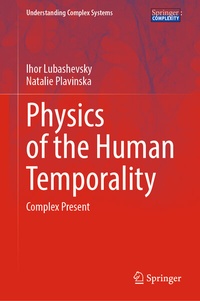
Physics of the Human Temporality
Description

This book presents a novel account of the human temporal dimension called the "human temporality" and develops a special mathematical formalism for describing such an object as the human mind. One of the characteristic features of the human mind is its temporal extent. For objects of physical reality, only the present exists, which may be conceived as a point-like moment in time. In the human temporality, the past retained in the memory, the imaginary future, and the present coexist and are closely intertwined and impact one another.
This book focuses on one of the fragments of the human temporality called the complex present. A detailed analysis of the classical and modern concepts has enabled the authors to put forward the idea of the multi-component structure of the present. For the concept of the complex present, the authors proposed a novel account that involves a qualitative description and a special mathematical formalism. This formalism takes into account human goal-oriented behavior and uncertainty in human perception.
The present book can be interesting for theoreticians, physicists dealing with modeling systems where the human factor plays a crucial role, philosophers who are interested in applying philosophical concepts to constructing mathematical models, and psychologists whose research is related to modeling mental processes.
More details
Other editions
Additional editions
Persons
Ihor Lubashevsky received his Ph.D. degree from the Moscow Institute for Physics and Technology in 1980 and the degree of Doctore of Physics & Mathematics from Moscow State University in 1993. He went on to become a leading staff scientist at the theory department of the A. M. Prokhorov General Physics Institute, Russian Academy of Sciences. Present he is a professor at the Complex Systems Modeling Lab, The University of Aizu, Japan.
Professor Lubashevsky's research experience and interests include statistical physics, non-equilibrium many-particle systems, synergetics, sociophysics, medical physics, and related philosophical issues.
Natalie Plavinska
received her Ph.D. from the Moscow Pedagogical State University in 2012. She went on to become a leading specialist in the educational direction, Ministry of Education of Russian Federation, Moscow.
Doctor Plavinska's research experience and interest include various problems in the psychology of education, self-education, cognitive phenomena, and related philosophical issues.
