

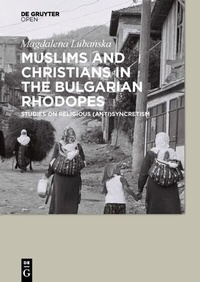
Muslims and Christians in the Bulgarian Rhodopes.
Description

The book by Magdalena Lubanska examines the role of religious syncretism in the social and religious life of Muslim-Christian communities in the Western Rhodopes. The author is interested mainly in the origins and motivations of various beliefs and behaviors which at first sight may appear to be syncretic. She looks at syncretism in the context of anti-syncretic tendencies, particularly pronounced among the Muslim neophytes and young members of the Muslim religious elite, who are not interested in the local forms of post-ottoman Islam ("Adat Islam"), preferring instead a "pure" form of religion, a class of fundamentalist religious movements rooted in orthodox Islam and seeking to remain faithful to mainstream Islamic thought and tradition ("Salafi Islam"). Lubanska findings offer an insight into the fact that although certain actions may appear syncretic in nature, their underlying intentions are often not in fact motivated by syncretic tendencies. This is the first study to look at syncretism in Bulgaria from this perspective.
Reviews / Votes
"Magdalena Lubanska has written the most thorough and wide-ranging study in many decades of the religious beliefs and practices of mixed Muslim and Orthodox Christian communities in the Balkans, based on excellent, detailed ethnography. She has also made an exceptionally important contribution to developing theory on syncretism by seeing it as a cultural strategy that is used by members of religiously mixed communities to both manage and conceal their emotions in interactions with each other's practices and institutions, interactions in which relationships of power and dominance are critical. By analyzing syncretism as a strategy and paying attention to relations of power, Lubanska avoids adhering either to the romanticized models of supposed multiculturalism and traditional tolerance that have driven many recent studies of the region, or to the Orientalist models of earlier times. Muslims and Christians in the Bulgarian Rhodopes should set the parameters of the next generation of scholarship on the local interactions of members of different religious communities, not only in the Balkans, and invigorate the study of syncretism." Prof. Robert Hayden, University of PittsburghMore details
Other editions
Additional editions
Person
Magdalena Lubanska , University of Warsaw, Poland.
