

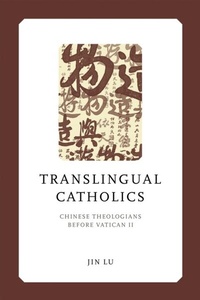
Translingual Catholics
Chinese Theologians Before Vatican II
1st Edition
Published on 15. February 2025
277 pages
978-0-268-20911-7 (ISBN)
Description

Translingual Catholics explores the life experiences and theological writings of twentieth-century Chinese Catholic intellectuals and their impact on global Catholic theology.
Weaving together archival resources in Chinese, French, and English, Translingual Catholics examines the preconciliar theological contribution of Republican-Era Chinese Catholics to global Catholicism and to the dialogue between Christianity and Chinese spiritual traditions. Author Jin Lu sheds light on generations of multilingual Chinese Catholic intellectuals who participated in the elaboration of Catholic theology leading up to the Second Vatican Council. This book situates the lives and works of these theologians in the intersecting global Catholic networks of the time, especially the Jesuit enclave of Xujiahui in Shanghai, the Benedictine Abbey of Saint-Andre in Bruges, Belgium, the Jesuit Theologate in Lyon-Fourviere, and the ecumenical Cercle Saint-Jean-Baptiste in Paris. By studying the interconnectedness of Chinese Catholic theologians working in multiple languages, Lu demonstrates that inculturation is necessarily a translingual process.
Through its groundbreaking archival research, Translingual Catholics tells the story of these underappreciated intellectuals and uncovers significant contributions to Chinese and global Catholic theology.
Weaving together archival resources in Chinese, French, and English, Translingual Catholics examines the preconciliar theological contribution of Republican-Era Chinese Catholics to global Catholicism and to the dialogue between Christianity and Chinese spiritual traditions. Author Jin Lu sheds light on generations of multilingual Chinese Catholic intellectuals who participated in the elaboration of Catholic theology leading up to the Second Vatican Council. This book situates the lives and works of these theologians in the intersecting global Catholic networks of the time, especially the Jesuit enclave of Xujiahui in Shanghai, the Benedictine Abbey of Saint-Andre in Bruges, Belgium, the Jesuit Theologate in Lyon-Fourviere, and the ecumenical Cercle Saint-Jean-Baptiste in Paris. By studying the interconnectedness of Chinese Catholic theologians working in multiple languages, Lu demonstrates that inculturation is necessarily a translingual process.
Through its groundbreaking archival research, Translingual Catholics tells the story of these underappreciated intellectuals and uncovers significant contributions to Chinese and global Catholic theology.
Reviews / Votes
"Rather than confining Chinese Catholicism to its linguistic world and internal issues, Jin Lu considers Chinese Catholic intellectuals as polyglot actors inserted into the epochal change that Catholicism has experienced during the twentieth century. Such a shift of perspective makes this work significant from the start." -Benoit Vermander, author of The Encounter of Chinese and Western Philosophies"Translingual Catholics narrates the overlooked contributions of Catholic intellectuals of twentieth-century China, correcting the unbalanced nature of scholarship on Chinese Christianities, which has hitherto been preoccupied by the Protestant story. Drawing on French, English, and Chinese sources, this book offers a glimpse into World Christianity as seen through the eyes of translingual Chinese Catholics-beyond the limits of the 'Sino-Foreign Protestant Establishment.' Jin Lu has done us a tremendous service." -Alexander Chow, author of Chinese Public Theology
More details
Series
Language
English
Place of publication
Notre Dame IN
United States
Target group
Professional and scholarly
ISBN-13
978-0-268-20911-7 (9780268209117)
Copyright in bibliographic data and cover images is held by Nielsen Book Services Limited or by the publishers or by their respective licensors: all rights reserved.
Schweitzer Classification
Other editions
Additional editions
Book
02/2025
University of Notre Dame Press
€82.90
Shipment within 10-20 days
Person
Jin Lu is a professor of French at Purdue University Northwest. She is the author of Elements d'une enquete sur l'usage d'un mot au siecle des Lumieres.
Content
Acknowledgments
Introduction
1. Republican-era Chinese Catholics at the Crossroads of History: Telling Their Stories to the World
2. Historical Lineage and the Making of Global Catholic Networks (1912-1927)
3. Home Away from Home: The Abbey of Saint-Andre as a Center for Global Chinese Catholic networks (1927-1949)
4. Paths to Faith: Chinese Catholic Conversion Narratives before Vatican II
5. From Pagan Virtues to the Salvation of Non-Christians: Father Wang Changzhi's Contribution to Chinese Christianity
6. Chinese Exodus: Francois Houang (Huang Jiacheng) and Catholicism in France (1932-1965)
7. Chinese Catholicism's Mystic Turn and the French Ressourcement Movement (1940s to 1960s)
Afterword
Notes
Glossary
Bibliography
Index
Introduction
1. Republican-era Chinese Catholics at the Crossroads of History: Telling Their Stories to the World
2. Historical Lineage and the Making of Global Catholic Networks (1912-1927)
3. Home Away from Home: The Abbey of Saint-Andre as a Center for Global Chinese Catholic networks (1927-1949)
4. Paths to Faith: Chinese Catholic Conversion Narratives before Vatican II
5. From Pagan Virtues to the Salvation of Non-Christians: Father Wang Changzhi's Contribution to Chinese Christianity
6. Chinese Exodus: Francois Houang (Huang Jiacheng) and Catholicism in France (1932-1965)
7. Chinese Catholicism's Mystic Turn and the French Ressourcement Movement (1940s to 1960s)
Afterword
Notes
Glossary
Bibliography
Index
