

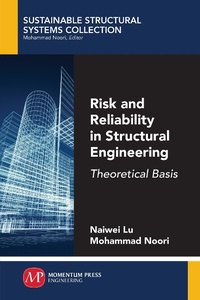
Risk and Reliability in Structural Engineering
Description

A structure should be designed taking into account safety, reliability, and economy. Reliability is the probability of successful function, and risk is the potential for unwanted negative consequence of an event. In structural engineering, risk analysis involves the investigation of the probability of rare events. Risk analyses are typically made on the basis of information, which is subject to uncertainty. These uncertainties may be divided into inherent or natural variability. The objective of a structural design is the assurance of successful performance over the useful life of structures or engineering systems.
The primary purpose of this book is to introduce risk and reliability concept into structural design. It will cover and review reliability theory and risk analysis to solve structural engineering problems. The book was formed from the easy to the difficult and complicated concepts. Content was written from the basic concepts of uncertainties, structural safety analysis, structural reliability under repeated load, and fatigue reliability. Based on the introduction of failure modes and bounds theory, structural system reliability theory is subsequently discussed. Numerical formulation and examples are provided to enhance the study efficiency of students, engineers, and researchers.
This book is suitable for adoption as a textbook or a reference book in a structural reliability analysis course. Furthermore, this book also provides a theoretical foundation for better understanding of the structural safety assessment.
More details
Other editions
Additional editions
Persons
Content
- Cover
- Contents
- List of Figures
- List of Tables
- Acknowledgments
- Chapter 1: Introduction
- Chapter 2: Structural Evaluation
- Chapter 3: Analysis of Structural Safety
- Chapter 4: Structural Reliability Under Repeated Loads
- Chapter 5: Models for Fatigue Reliability
- Chapter 6: Models for Failure and Bounds on Structural Reliability
- Chapter 7: Safety and Reliability of Structural Systems
- About the Authors
- Index
- Adpage
- Backcover
