

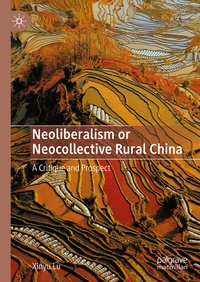
Neoliberalism or Neocollective Rural China
Description

This book presents a groundbreaking critique of neo-liberal interpretations of global agricultural development, challenging dominant narratives with nuanced analyses rooted in historical and theoretical frameworks. It delves into diverse paths of agrarian transformation, from the "American Path" to the "Prussian Path," examining the complexities of state intervention, land ownership, and socio-political dynamics. Furthermore, it introduces an alternative vision for agricultural development: the construction of "Neo-collective Rural China." Through meticulous examination of case studies spanning China, Russia, and beyond, it unveils the intricacies of rural economies, migrant worker trends, and grassroots innovations. Emphasizing the need for inclusive policies and international collaboration, this work reimagines strategies for sustainable growth in the Global South, advocating for sovereignty, equity, and solidarity. A compelling synthesis of scholarship, it offers fresh insights into the multifaceted challenges facing contemporary agricultural development.
More details
Other editions
Additional editions
Persons
Xinyu Lu is one of China's most prominent scholars in the study of rural-urban inequities. She holds degrees from Anhui University, Zhejiang University, and Fudan University. Her research interests encompass media studies, visual culture, sociology, philosophy, and politically-grounded readings of history. Professor Lu spent 20 years on the faculty at the School of Journalism at Fudan University. Currently, she serves as the President of the International Communication Research Institute at East China Normal University. Professor Lu has an extensive publication record, with numerous books and essays in English, Chinese, French, and other languages.
Content
Chapter 1 Lenin's Theory of the "American Path" and Russian/Soviet Capitalist Agriculture.- Chapter 2 The "American Path" and the Global Hegemony of U.S. Capitalist Agriculture.- Chapter 3 The "Prussian" Path, Militarism, and Late Capitalist Agriculture.- Chapter 4 The Importance of Revolutionary Land Reform.- Chapter 5 Marxist Feudal Theory, Qin Hui's Theory of Division of the family assets, and Democracy.- Chapter 6 Agricultural problems in Khrushchev and Brezhnev times: The failure of the Soviet union's "American Path" or State Capitalist Path.- Chapter 7 The "Greek/Roman Path": the Conditions for Democracy and the "Ancient Welfare State"?.- Chapter 8 Asiatic Oriental Despotism and Marxist Thought.- Chapter 9 The Asiatic Mode of Production and Debates On the Chinese and Soviet (Russian) Revolutions and Their Paths in the 20th Century.- Chapter 10 Can China be de-Asianized and Europeanized?.
