

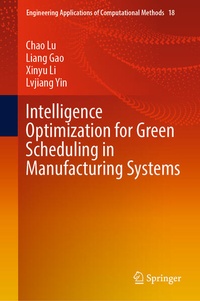
Intelligence Optimization for Green Scheduling in Manufacturing Systems
Description

This book investigates in detail production scheduling technology in different kinds of shop environment to achieve sustainability manufacturing. Studies on shop scheduling have attracted engineers and scientists from various disciplines, such as electrical, mechanical, automation, computer, and industrial engineering. Pursuing a holistic approach, the book establishes a fundamental framework for this topic, while emphasizing the importance of intelligent optimization and the significant influence of production scheduling in the manufacturing systems. The book is intended for undergraduate and graduate students who are interested in intelligent optimization technology, shop scheduling, and green manufacturing systems or other scheduling applications.
More details
Other editions
Additional editions
Persons
Chao Lu is an associate professor and doctoral supervisor of the China University of Geosciences (CUG), Wuhan, China. He has published more than 50 SCI papers, including one ESI Hot Paper and two ESI Highly Cited Papers. He was a recipient of Paper Prize Award 2020-Practice at the 21th IFAC (International Federation of Automatic Control) 2020 World Congress. He has also published one Chinese monograph. He has won the third prize for Science and Technology Award of China Federation of Logistics and Procurement. Additionally, he serves as the editorial board of the SCI Journal Intelligent Automation & Soft Computing and guest editor of the SCI Journal Symmetry. His current research interests include green scheduling, distributed shop scheduling, path planning, etc.
Liang Gao received the B.Sc. degree in mechatronic engineering from Xidian University, Xi'an, China, in 1996, and the Ph.D. degree in mechatronic engineering from the Huazhong University of Science and Technology (HUST), Wuhan, China, in 2002. He is a professor of the Department of Industrial and Manufacturing Systems Engineering and the deputy director of State Key Laboratory of Digital Manufacturing Equipment and Technology. He was supported by the National Science Fund for Distinguished Young Scholars of China in 2018. His research interests include operations research and optimization, big data and machine learning, etc. He has published over 500 papers indexed by SCIE and authored 15 monographs.
Xinyu Li received his Ph.D. degree in industrial engineering from Huazhong University of Science and Technology (HUST), China, 2009. He is a professor of the Department of Industrial and Manufacturing Systems Engineering, State Key Laboratory of Digital Manufacturing Equipment and Technology, and School of Mechanical Science and Engineering, HUST. He had published more than 100 refereed papers. His research interests include intelligent algorithm, scheduling and machinelearning, etc.
Lvjiang Yin is a professor, Master's degree supervisor, and dean of the School of Economics and Management at Hubei University of Automotive Technology. His research interests include green scheduling and intelligent logistics system. He is the first outstanding young social science talent in Hubei Province, the leading talent of science and technology innovation and entrepreneurship in Shiyan City. He has published more than 30 papers, including 11 SCI and SSCI papers and 6 EI indexed papers. He has hosted 1 National Social Science Foundation project, 5 provincial research projects such as the Ministry of Education Fund Project and Hubei Provincial Foundation Project, and has won more than ten provincial and ministerial-level scientific and technological awards and two teaching achievement awards.
Content
1. System overview.- 2. Green scheduling in single machine environment.- 3. Green scheduling in permutation flow shop environment.- 4. Green scheduling in hybrid flow shop environment.- 5. Green scheduling in job shop environment.
