

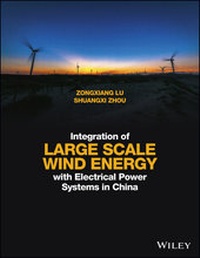
Integration of Large Scale Wind Energy with Electrical Power Systems in China
Description

* Presents the challenges of electrical power system planning, design, operation and control carried out by large scale wind power, from the Chinese perspective
* Focuses on the integration issue of large scale wind power to the bulk power system, probing the interaction between wind power and bulk power systems
* Wind power development is a burgeoning area of study in developing countries, with much interest in offshore wind farms and several big projects under development
* English translation of the Chinese language original which won the "Fourth China Outstanding Publication Award nomination" in March 2013
More details
Other editions
Additional editions
Persons
Zongxiang Lu, Tsinghua University, China
Shuangxi Zhou, Tsinghua University, China
Content
1 Overview 1
1.1 Wind Energy andWind Energy Resources 1
1.2 Characteristics ofWind Power Generation 4
1.3 Present Situation and Development ofWind Power Generation 5
1.4 Wind Power Conversion System and Technical Route 8
1.5 WF-Included Electrical Power System 9
1.6 Outline of the Book 12
References 13
2 Wind Power Generation and Wind Power Generation System 14
2.1 Wind Power Generation System andWFs 14
2.2 Wind Turbine 16
2.3 Wind Turbine Generator System 26
2.4 Power Electronic Technology inWind Power Conversion System 41
References 49
3 Operation of Grid-Connected WTGS 51
3.1 Wind Turbine Grid Connection 51
3.2 Power Regulation ofWind Turbines 57
3.3 Wind Energy Converters and Basic Control Methods 62
3.4 Voltage/Reactive Power Control Characteristics of Three MainstreamWind Turbines 65
References 72
4 Connection of WFs to Power Systems 73
4.1 Requirements of the Power System for Grid Connection ofWFs 73
4.2 Connection ofWFs to Power Distribution Grids or Transmission Grids 75
4.3 Direct Connection to AC grids 76
4.4 WFs Interconnection via Conventional HVDC (PCC-HVDC) 81
4.5 WFs Interconnection via VSC-HVDC 84
4.6 Contrast ofWF Integration Schemes 88
4.7 Integration of Large-ScaleWFs into the Grid 89
4.8 Determination of MaximumWind Power Capacity Allowed to be Integrated into the Grid 90
References 98
5 WF Electrical Systems 100
5.1 Power Collection Systems 100
5.2 WF Grounding Systems 104
5.3 WF Lightning Protection 105
5.4 WF Electrical Protection 109
5.5 WF Reactive Power Compensation 114
5.6 WF Energy Storage Systems 117
References 120
6 OWFs 122
6.1 OWF and Its Characteristics 122
6.2 OWF Electrical System 123
6.3 Redundancy Design of Collection System 129
6.4 OWF Transmission System 129
6.5 A New Type of OffshoreWind Energy Conversion System 147
6.6 OWF Electrical System Optimization Design 149
6.7 Examples of Typical OWF 162
References 169
7 Analysis of Power Systems Containing Wind Power 171
7.1 Overview 171
7.2 MathematicalModels ofWind Power Generation System 172
7.3 Power Flow Analysis of Power System ContainingWind Power 192
7.4 Short-Circuit Analysis of Power Systems ContainingWind Power 202
7.5 Voltage Stability Analysis of Power System ContainingWind Power 211
7.6 Transient Stability Analysis of Power Systems ContainingWind Power 223
7.7 Small Signal Stability Analysis on Power System ContainingWind Power 232
7.8 Frequency Stability Analysis of Power System ContainingWind Turbines 245
References 258
8 WF Power Quality and Its Improvements 263
8.1 Overview 263
8.2 Power Quality and Its Characteristics 265
8.3 Power Quality Problems ofWFs Associated with the Grid 267
8.4 Frequency Quality and Frequency Regulation 268
8.5 Voltage Quality and Voltage Regulation 270
8.6 WF Voltage Flicker 275
8.7 Harmonics and Interharmonics of theWF 283
8.8 Measures to Improve Power Quality ofWFs 290
References 294
9 Wind Velocity and Generated Power Forecasts in WF 295
9.1 Overview 295
9.2 Variability ofWind Power 296
9.3 Wind Power Forecast Model and Method 301
9.4 Wind Velocity Forecast 307
9.5 Generated Power Forecast inWF 314
9.6 Accuracy ofWind Power Forecast 323
9.7 Application and Challenge ofWind Power Forecast 329
References 332
10 WF Control and Protection Technologies 334
10.1 Overview 334
10.2 Active Power and Frequency Control 343
10.3 Reactive Power and Voltage Regulation 345
10.4 Fault Ride-Through (FRT) or Low/High-Voltage Ride-Through (L/HVRT) ofWTGS 350
10.5 AGC of aWind Power Contained Power System 363
10.6 WF Monitoring and Control 364
10.7 Control ofWF Energy Storage System 372
References 378
11 Operation and Dispatch of a Power System Containing Wind Power 380
11.1 Overview 380
11.2 General Requirements forWF Operation 382
11.3 Power Balance and System Reserve Capacity 386
11.4 Optimal Dispatch of Power Systems ContainingWind Power 395
11.5 Wind Power Generation and Power Market 413
11.6 Main Technology ofWFs to be Conventional Power Plants 429
References 438
12 The Evaluation Technology for AnWind Power Integrated Power System 441
12.1 Reliability Evaluation ofWind Power Integrated Power System 441
12.2 Wind Power Generation CC 448
12.3 Wind Power Value Analysis 453
12.4 Analysis of Maximum Penetrating Capacity ofWind Power 461
References 469
Index 471
Chapter 1
Overview
1.1 Wind Energy and Wind Energy Resources
1.1.1 Basic Concepts
Wind energy is the energy of moving air. In a broad sense, wind energy is derived from solar energy. The radiant energy from the sun is constantly transmitted to the earth's surface. Solar radiation does not heat every part of the earth's surface evenly resulting in differences in temperature and pressure and forming the wind.
According to aerodynamic theories, the moving air has energy and the wind energy flowing through the section perpendicular to the wind speed A (m2) per unit time, namely, the wind power [1], is (Formula (1.1))
1.1where E is wind energy with the unit W (kg·m2·/s3); m is air mass (kg/m3); v is air flow speed, namely, wind speed (m/s); A is the area of the section the air passing through that is perpendicular to the direction of the air flow (m2); ? is the density of air (kg/m3).
Wind power is proportional to the square of the wind speed while wind energy (kinetic energy) is proportional to the third power of the wind speed. That is to say, if wind speed doubles, wind power output increases eight times.
Wind energy is a renewable energy source. From a long-term perspective, wind energy is inexhaustible. Meanwhile wind energy is a form of process energy that cannot be directly stored. Instead it has to be converted into other forms of energy in order to be stored.
According to different requirements, wind energy can be converted into a great variety of energy forms, including mechanical, electrical, thermal energy, and so on, in order to achieve pump water irrigation, power generation, sail-assisted navigation, and other functions.
Wind energy resources are kinetic energy resources created by the movement of the air across the surface of the earth. The formation of wind energy resources is affected by multiple natural factors, especially the climate, terrain, and sea and land location. Wind energy is widely distributed in space and meanwhile it is unstable and discontinuous. Since wind is very sensitive to the climate, it is variable and varies from region to region and season to season.
There is an abundance of wind energy resources in nature. According to the World Meteorological Organization (WMO), global wind energy totals 3 × 10¹⁷ kW of which 2 × 10¹⁰ kW is exploitable wind energy, 10 times more than the total amount of exploitable hydro energy on the earth [1]. The amount of technologically exploitable wind energy resources totals about 53 TW·h/year (1 TW = 1015W = 1012kW), equivalent to more than two times the world's total electricity demand in 2020 [2]. China is rich in wind energy resources: the total reserves of wind energy resources at an altitude of 10 m above the land are estimated to be 3,226 GW; the reserves of the exploitable onshore wind energy are 253 GW and the reserves of exploitable offshore wind energy are 750 GW, totaling 1,000 GW [3, 4].
The potential for wind energy resources in a certain area of the earth is expressed by the wind energy density and available hours in this area.
Wind energy density is the kinetic energy of the moving air perpendicularly passing through the unit section per unit time, namely, the wind power density. If the area A = 1 in Formula (1.1), then the wind energy density (Formula 1.2) is shown as
1.2Wind energy density is also changing with time and with the change of wind speed. The average value of the wind energy density over a certain period of time (e.g., one year) is called the average wind energy density that is shown in Formula (1.3):
1.3where is the average wind energy density; T is a certain period of time; v(t) is the wind speed changing with time; dt is the duration of a certain wind speed within T. If in the wind speed measurement the wind speeds v1, v2, ., vn and their corresponding durations t1, t2, ., tn within T can be directly obtained (or after data processing), then the average wind energy density can be calculated by Formula (1.4):
1.4In the actual use of wind energy, wind turbines only work within a certain range of wind speeds. The wind energy density within a certain range of wind speeds is regarded as effective wind energy density. In China the range of wind speeds corresponding to the effective wind energy density is 3-20 m/s [1, 5].
The air density (?) can be calculated by a great variety of formulas that vary in complexity, parameters, and accuracy. Usually the more parameters the formula has, the more accurate it is. It's suggested Formula (1.5) should be used to calculate the values in reference [1].
1.5where ? is the average air density (kg/m3); p is the average air pressure (hPA); e is the average water vapor pressure (hPa); t is the average Celsius temperature (°C).
The air density varies with altitude. At an altitude of below 500 m, that is, at a normal temperature and under standard atmospheric pressure, the air density is 1.225 kg/m3. If the altitude is above 500 m, the relationship between the air density and the altitude can be calculated according to the experience of China's meteorological stations (Formula (1.6)) [5]:
1.6where ?z(kg/m3) is the air density at an altitude of z(m).
Wind speed and wind direction are two important factors in the utilization of wind energy. In order to estimate wind energy resources, we must measure the daily and annual wind speed and wind direction and understand their changing laws. The wind direction in a certain area of the earth is, first of all, related to the atmospheric circulation. Besides, it is also related to the geographical location (its distance from the equator and the south and north poles) and the earth's surface (ocean, land, valley, etc.).
The fundamental basis for the calculation of wind energy resources is the hourly wind speed that can be calculated in three ways: ? average the measured hourly wind speeds; ? average the wind speeds measured in the last 10 minutes of each hour as required in China; ? average the several selected instantaneous wind speeds in each hour.
Wind speed varies with height. From the surface of the earth to the upper air layer at an altitude of 10,000 m, the moving of the air is affected by factors such as the eddy, viscosity, and surface friction. The higher it is above the earth's surface, the higher the wind speed is. In engineering the index method is usually used to express the change of the wind speed with height (Formula (1.7)):
1.7where h, h1 are different heights from the earth's surface; v1 is the wind speed at a height of h1 above the earth's surface; v is the wind speed at a height of h above the earth's surface that is to be calculated; index n is related to the surface evenness (roughness), the stability of the atmosphere and other factors, ranging from one-half to one-eighth and being one-seventh in areas with normal stability. China's meteorological departments measure the wind speeds at various heights and calculate the average value of n to be between 0.16 and 0.20 that can be used to estimate the wind speed at different heights. Obviously, the higher the wind turbines are placed, the more wind energy they can capture.
Wind direction is usually expressed using 16 directions. The diagram based on the frequency of winds blowing from different directions is called wind direction frequency rose diagram. Shown in Figure 1.1 is the wind rose diagram that displays the average wind direction and corresponding average wind speed at Lvsi Ocean Wind Measurement Station (see Table 1.1 for the corresponding data). It can be seen that according to the average annual frequency of wind direction measured over many years, the prevailing wind directions are N, ESE, and SSE and the corresponding frequency is 9%; the secondary prevailing wind directions are NNE, ENE, and E and the corresponding frequency is 8%; the wind direction NW has the greatest average wind speed, 8.1 m/s, followed by the wind direction NNW, which has the average wind speed of 7.9 m/s. It shows that prevailing wind directions are different from strong wind directions, but generally wind directions from NNW to SSE have higher frequency and wind speed, with the frequency and average wind speed being 72% and 6.7 m/s respectively. The wind rose diagram can accurately display the distribution of wind frequency in a certain area so as to determine the overall arrangement of wind turbines in a wind farm (WF) and facilitate WF micro-siting. It plays an important role in the initial design of WF construction and wind power forecasting.
Figure 1.1 Wind direction frequency rose diagram and corresponding average wind speed rose diagram.
Table 1.1 Average perennial wind direction frequency (fw) and corresponding wind speed (v)
Wind...