

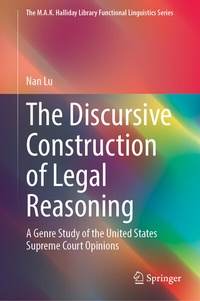
The Discursive Construction of Legal Reasoning
Description

This book presents a fine-grained and dynamic description of the discursive construction of legal reasoning in judicial opinions, drawing upon the Systemic Functional linguistic perspective of language and genre. It aims to explore the discursive resources in constructing legal reasoning across metafunctions, at different levels, and of various sizes.
This book contributes to the linguistic understanding of legal reasoning in judicial opinions and extends genre studies to large texts with complex and hierarchical structures. It presents an applicable model for a deep analysis of relations between legal reasoning and language. The findings of this research may also provide subject-specific knowledge for common law students in case reading and learning.
More details
Other editions
Additional editions
Person
Dr. Lu Nan is currently a lecturer at Guangdong University of Foreign Studies. He has obtained his PhD in linguistics and applied linguistics . His research interests include legal discourse analysis, systemic functional linguistics and genre studies and has published widely in the fields.
Content
Chapter 1: Introduction.- Chapter 2: Literature Review.- Chapter 3: Analytical Framework.- Chapter 4: Methodology.- Chapter 5: Constructing Legal Reasoning: A Particulate Realization.- Chapter 6: Constructing Legal Reasoning: A Periodic Realization.- Chapter 7: Constructing Legal Reasoning: A Prosodic Realization.- Chapter 8: Conclusion.
