

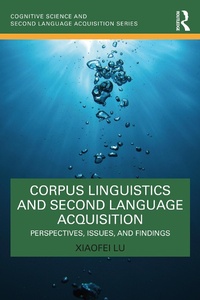
Corpus Linguistics and Second Language Acquisition
Perspectives, Issues, and Findings
1st Edition
Published on 24. October 2022
172 pages
978-1-000-64854-6 (ISBN)
Description

In Corpus Linguistics and Second Language Acquisition, Xiaofei Lu comprehensively reviews empirical studies that employ corpus linguistic methods to investigate issues in second language variation, processing, production, and development. These methods enable advanced students and researchers to:
Examine learner and task variables that condition variation in second language use
Understand the effects of various input factors on second language processing and production
Track group longitudinal trajectories of second language development and the input, learner, and task factors that affect such trajectories
Profile inter- and intra-learner variability and individual variation in second language longitudinal development
This book will serve as an excellent resource for students and researchers with interests in corpus linguistics and second language acquisition.
Examine learner and task variables that condition variation in second language use
Understand the effects of various input factors on second language processing and production
Track group longitudinal trajectories of second language development and the input, learner, and task factors that affect such trajectories
Profile inter- and intra-learner variability and individual variation in second language longitudinal development
This book will serve as an excellent resource for students and researchers with interests in corpus linguistics and second language acquisition.
Reviews / Votes
"Corpus linguistics is one of the fastest-growing areas of second language acquisition research. In this timely and compelling overview, Xiaofei Lu shows us why. He illustrates the use of native and learner corpora as objective, sharable evidence of patterns of language uniformity, variation, and growth, and he explains the methods, measures, and tools for analyzing corpus data. An excellent source for researchers and students alike."Nick Ellis, University of Michigan, USA
"This book is a must-read for both beginning and experienced researchers who are interested in corpus-based explorations of second language acquisition. It offers a comprehensive and accessible review and discussion on a wealth of carefully chosen topics that may help unravel the mysteries of second language acquisition."
Lei Lei, Professor of Applied Linguistics, Shanghai Jiao Tong University, China
"This volume is an excellent resource for those who want to apply corpus methods to the study of second language acquisition. Importantly, the text covers both relevant theoretical constructs (from a range of perspectives) and ways in which these theoretical constructs have and can be operationalized when studying learner language. This book is a must read for SLA researchers, and I look forward to using it in both graduate classes devoted to SLA more generally and those that focus on learner corpus research."
Kristopher Kyle, Assistant Professor of Linguistics, University of Oregon, USA
"This book differs from the existing literature in its unified theoretical and practical perspective, which incorporates
relevant theoretical constructs and ways how the researchers can operationalize the constructs when studying learner language in four core areas of inquiry. It is an excellent resource for corpus-based SLA research. The relationship between SLA and corpus linguistics requires a framework. By describing usage-based approaches and the development of second language constructions, Lu provides valuable and accessible instructions to various learner language corpora and programs available for analyzing these corpora. This includes Lu's own Syntactic Complexity Analyzer. The issues and analytical measures described in the book are essential for researchers to comprehend current and future SLA and task variation research. For second language acquisition researchers and teachers with varying degrees of familiarity with these theories, this is a must-read book."
Qiuying Zhao, Associate Professor and Doctoral Candidate, Xi'an International Studies University, China.
More details
Series
Edition
1. Auflage
Language
English
Place of publication
London
United Kingdom
Publishing group
Taylor & Francis Ltd
Target group
College/higher education
Product notice
Reflowable
Illustrations
2 Tables, black and white
ISBN-13
978-1-000-64854-6 (9781000648546)
Copyright in bibliographic data and cover images is held by Nielsen Book Services Limited or by the publishers or by their respective licensors: all rights reserved.
Schweitzer Classification
Other editions
Additional editions
Book
10/2022
1st Edition
Routledge
€185.60
Shipment within 15-20 days
Book
10/2022
1st Edition
Routledge
€59.80
Shipment within 15-20 days
Person
Xiaofei Lu is Professor of Applied Linguistics and Asian Studies at The Pennsylvania State University. His research specializations include corpus linguistics, second language acquisition, second language writing, English for Academic Purposes, and computer-assisted language learning. He is the author of Computational Methods for Corpus Annotation and Analysis (2014).
Content
CONTENTS
List of Tables
Series Editor's Preface
Preface
1 Introduction
Corpus Linguistics Meets Second Language Acquisition
Overview of the Book
References
2 Variation in Second Language Use
Introduction
Measuring Variation in Second Language Use
Learner-Related Variables and Variation in Second Language Use
Task-Related Variables and Variation in Second Language Use
Summary
References
3 Factors Influencing Second Language Processing and Production
Introduction
Usage-Based Approaches to Second Language Acquisition
Frequency and Contingency
Other Factors
Summary
References
4 Second Language Development Trajectories and Influential Factors
Introduction
L2 Development of Complexity, Accuracy, and Fluency
L2 Development of Lexical Knowledge
L2 Phraseological Development
L2 Development of Grammatical and Morphosyntactic Constructions
L2 Development of Stance
Summary
References
5 Variability and Variation in Second Language Development
Introduction
A Complex Dynamic Systems Approach to Second Language Acquisition
Inter- and Intra-Learner Variability in Second Language Development
Individual Variation in Second Language Development
Summary
References
6 Conclusion
Introduction
Summary of the Book
Reflections and Future Research Directions
References
Index
List of Tables
Series Editor's Preface
Preface
1 Introduction
Corpus Linguistics Meets Second Language Acquisition
Overview of the Book
References
2 Variation in Second Language Use
Introduction
Measuring Variation in Second Language Use
Learner-Related Variables and Variation in Second Language Use
Task-Related Variables and Variation in Second Language Use
Summary
References
3 Factors Influencing Second Language Processing and Production
Introduction
Usage-Based Approaches to Second Language Acquisition
Frequency and Contingency
Other Factors
Summary
References
4 Second Language Development Trajectories and Influential Factors
Introduction
L2 Development of Complexity, Accuracy, and Fluency
L2 Development of Lexical Knowledge
L2 Phraseological Development
L2 Development of Grammatical and Morphosyntactic Constructions
L2 Development of Stance
Summary
References
5 Variability and Variation in Second Language Development
Introduction
A Complex Dynamic Systems Approach to Second Language Acquisition
Inter- and Intra-Learner Variability in Second Language Development
Individual Variation in Second Language Development
Summary
References
6 Conclusion
Introduction
Summary of the Book
Reflections and Future Research Directions
References
Index
