

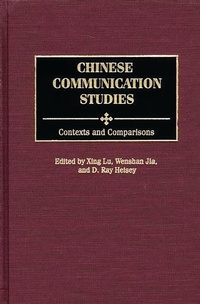
Chinese Communication Studies
Contexts and Comparisons
1st Edition
Published on 30. June 2002
288 pages
978-0-313-01189-4 (ISBN)
Description

Many varying factors contribute to the dynamics of Chinese communication, which both resembles and differs from its Western counterparts. In this provocative new collection of essays, an international group of scholars challenges the conventional notion of Chinese culture as static, recognizing the causes of cultural change and strategies of resistance. Examining communication contexts in mainland China, Hong Kong, and Taiwan, Chinese Communication Studies: Context and Comparisons considers the relationship between culture and communication in Chinese political, gender, family, and media contexts, providing the reader with insight both into how enduring Chinese cultural values are, and how they are being appropriated to meet political and economic goals.
Moreover, comparisons and distinctions are made between Chinese and Western communication concepts and practices on the issues of human rights, world opinions, pedagogical approaches, and instruction of rhetoric. In a work sure to be of value to many disciplines, the authors trace the historical development of ideas and value systems of both cultures, rendering an understanding of similarities and differences in both communication and cultural mindsets.
Moreover, comparisons and distinctions are made between Chinese and Western communication concepts and practices on the issues of human rights, world opinions, pedagogical approaches, and instruction of rhetoric. In a work sure to be of value to many disciplines, the authors trace the historical development of ideas and value systems of both cultures, rendering an understanding of similarities and differences in both communication and cultural mindsets.
More details
Series
Edition
1. Auflage
Language
English
Place of publication
New York
United States
Publishing group
Bloomsbury Publishing Plc
Target group
Interest Age: From 7 to 17 years
ISBN-13
978-0-313-01189-4 (9780313011894)
Copyright in bibliographic data and cover images is held by Nielsen Book Services Limited or by the publishers or by their respective licensors: all rights reserved.
Schweitzer Classification
Other editions
Additional editions
Book
06/2002
Praeger Publishers Inc
€99.00
Shipment within 3-4 weeks
Persons
XING LU is Associate Professor in the Department of Communications at DePaul University. The author of Rhetoric in Ancient China: Fifth to Third Century B.C.E.: A Comparison with Classical Greek Rhetoric, Lu has also published many journal articles and book chapters on the subjects of Chinese rhetoric and Chinese communication studies.
WENSHAN JIA is Assistant Professor of Communication in the Department of Communication and Media at the State University of New York, New Paltz. A scholar of intercultural communication theory, he is the author of The Remaking of Chinese Character and Identity in the 21st Century: The Chinese Face Practices (Ablex, 2001).
D. RAY HEISEY is Professor and Director Emeritus at the School of Communication Studies at Kent State University. The author of many journal articles and book chapters, he is also the editor of Chinese Perspectives in Rhetoric and Communication (Ablex, 2000).
WENSHAN JIA is Assistant Professor of Communication in the Department of Communication and Media at the State University of New York, New Paltz. A scholar of intercultural communication theory, he is the author of The Remaking of Chinese Character and Identity in the 21st Century: The Chinese Face Practices (Ablex, 2001).
D. RAY HEISEY is Professor and Director Emeritus at the School of Communication Studies at Kent State University. The author of many journal articles and book chapters, he is also the editor of Chinese Perspectives in Rhetoric and Communication (Ablex, 2000).
Content
Introduction: Chinese Culture and Communication: Diverse Contexts and Comparison with the West by Xing Lu
Chinese Culture and Modernization
Revolution and Us: A Cultural Rendition of Political Movements in Contemporary China by Ling Chen
Culture and Modernization: The Case of the People's Republic of China by Rita Mei-Ching Ng
The Problem of the Public: John Dewey's Theory of Communication and Its Influence on Modern Chinese Communication by Changfu Chang
Chinese Culture and Its (Post) Modern Fate: Three Debates and One Critique by Changfu Chang
Chinese Communication in Gender, Family, and Media Contexts
Women and the Rhetorical Tradition in Pre-Modern China: A Preliminary Sketch by Mary Garrett
Creating a Female Language: Symbolic Transformation Embedded in Nushu by Lin-Lee Lee
Hierarchy Is Not Harmony: A View of the Traditional Chinese Family by Omar Swartz
Chinese Family Consumer Socialization: A Study of Chinese Urban Adolescents' Involvement in Family Purchasing Activities by Qingwen Dong
Karaoke as A Form of Communication in the Public and Interpersonal Contexts of Taiwan by Ringo Ma and Rueyling Chuang
Market and Politics: Hong Kong Press During Sovereignty Transfer by Anthony Y.H. Fung and Chin-Chuan Lee
Comparison between Chinese and Western Communication
Humanism and Human Rights: A Comparison between the Occidental and Oriental Traditions by Mei-Ling Wang
Talking Cultures: A Comparative Analysis of Chinese and U.S. American Stories about Human Rights by Jing Yin and Bradford "J" Hall
Comparison of Chinese and American Views on World Opinion: A Rhetorical Study of Media Reports by Minmin Wang
Pan Gu's Paradigm: Chinese Education's Return to Holistic Communication in Learning by Scott S. Hammond and Hongmei Gao
Chinese Rhetoric through Chinese Textbooks: Uniquely Chinese? by Andy Kirkpatrick
Author Index
Subject Index
Chinese Culture and Modernization
Revolution and Us: A Cultural Rendition of Political Movements in Contemporary China by Ling Chen
Culture and Modernization: The Case of the People's Republic of China by Rita Mei-Ching Ng
The Problem of the Public: John Dewey's Theory of Communication and Its Influence on Modern Chinese Communication by Changfu Chang
Chinese Culture and Its (Post) Modern Fate: Three Debates and One Critique by Changfu Chang
Chinese Communication in Gender, Family, and Media Contexts
Women and the Rhetorical Tradition in Pre-Modern China: A Preliminary Sketch by Mary Garrett
Creating a Female Language: Symbolic Transformation Embedded in Nushu by Lin-Lee Lee
Hierarchy Is Not Harmony: A View of the Traditional Chinese Family by Omar Swartz
Chinese Family Consumer Socialization: A Study of Chinese Urban Adolescents' Involvement in Family Purchasing Activities by Qingwen Dong
Karaoke as A Form of Communication in the Public and Interpersonal Contexts of Taiwan by Ringo Ma and Rueyling Chuang
Market and Politics: Hong Kong Press During Sovereignty Transfer by Anthony Y.H. Fung and Chin-Chuan Lee
Comparison between Chinese and Western Communication
Humanism and Human Rights: A Comparison between the Occidental and Oriental Traditions by Mei-Ling Wang
Talking Cultures: A Comparative Analysis of Chinese and U.S. American Stories about Human Rights by Jing Yin and Bradford "J" Hall
Comparison of Chinese and American Views on World Opinion: A Rhetorical Study of Media Reports by Minmin Wang
Pan Gu's Paradigm: Chinese Education's Return to Holistic Communication in Learning by Scott S. Hammond and Hongmei Gao
Chinese Rhetoric through Chinese Textbooks: Uniquely Chinese? by Andy Kirkpatrick
Author Index
Subject Index
