

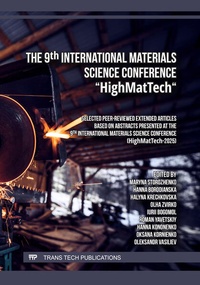
The 9th International Materials Science Conference "HighMatTech"
Published on 8. April 2026
322 pages
978-3-0364-1766-0 (ISBN)
Description

This proceedings volume compiles selected research papers from the IXth International Materials Science Conference, HighMatTech 2025 (6-10 October 2025, Ukraine). The book's scope is multidisciplinary, integrating insights from solid-state physics, chemistry, and materials engineering to explain the behaviour of modern materials. The aim is to facilitate the exchange of ideas within the scientific community and to document significant progress in modern engineering. The edition is intended for a wide range of engineers and academic researchers.
More details
Other editions
Additional editions

Trans Tech Publications Ltd | Maryna Storozhenko | Hanna Borodianska
The 9th International Materials Science Conference "HighMatTech"
Book
04/2026
Trans Tech Publications Ltd
€334.53
Shipment within 10-20 days
Persons
Content
Preface
Chapter 1: Metallurgy and Processing of Steel and Alloys
On the Formation of Martensite in Low-Carbon Alloy Steel Wire Rod for Welding Applications during Slow Continuous Cooling
New Electroslag Technology for Producing Manganese-Containing Titanium Alloys
The Interaction of the Components of the Injected Two-Phase Flow with Hot Metal during Injection Desulphurization in the Ladle
The Micromechanical Properties of CoCrFeNiMnVx (? = 0-2) High-Entropy Alloys
Effect of Chemical Composition and Heat Treatment on the Mechanical Properties and Electrical Conductivity of Al-Mg-Si Alloys with a Mg/Si Ratio of 1
Thermodynamic Study and Predicted Amorphization Composition Range of the Co-Ni-Ti Liquid Alloys
Phase Composition, Microhardness, Mechanical and Acoustic Properties of Nonequiatomic Medium-Entropy Alloys FexMn80-xCo10Cr10 (x = 40 and 50) in Different Structural States
Study of Temperature Dependence of the Contact Angle in the Liquid Tin-Tungsten Substrate System
Energy Implications of Switching to Surfactant-Modified Concentrate in Iron Ore Pellet Induration
Effect of Power and Scanning Speed on the Morphology of a Single Track Melt Pool under Dynamic Laser Beam Focusing in Additive Manufacturing
Features of the Formation of the Structure of Welded Joints of Structural Steels during Underwater Welding with Filler Wire 12X18N9T Using External Electromagnetic Influence
Studying the Effect of Scandium on the Formation of a Quasicrystalline Phase in Al-Cu-Fe Ingots
Structure and Properties of Experimental Low-Cost Titanium Alloys
Structure and Properties of Heat-Resistant FeNiCrCuAl High-Entropy Alloys
Chapter 2: Corrosion and Tribological Properties of Structural Materials
Corrosion Durability of the Deposited Layer on the Thin-Walled Base of Structural Elements Produced by Laser Radiation
Investigation of Stress Concentrators in Welds on Stress-Corrosion Cracking of X70 Steel Welded Joints in Near-Neutral pH Solution
Influence of Chemical Carbon Microheterogeneity on Fatigue Crack Growth Parameters in Railway Wheel Steel
Improvement of Tribological Properties of Steel by Femtosecond Laser-Inductive Microstructuring
Wear Behavior of Detonation-Sprayed (Ti,Cr)C-Ni Coatings under Dry and Lubricating Environment
Chapter 3: Plasma Sprayed Coatings
The Influence of Plasma Spraying Process Parameters on Microstructure and Selected Properties of Novel NiCrAl-Cr3C2 Composite Coating
Determination of the Temperature Dependence of the Thermal Conductivity Coefficient of Plasma-Sprayed Coatings Based on Zirconium Dioxide in the Temperature Range up to 1100 degreesC
Abradable Plasma Coatings from Mechanochemically Alloyed Aluminum Powder for Gas Turbine Engines
Chapter 4: Foams and Porous Materials
Electrical Properties of Aluminium Foam
Mathematical Modelling of Structurally Inhomogeneous Porous Materials Forming Processes
Mechanical Performance of Aluminium Foam Fabricated by Melt Processing with Addition of Boron Carbide
Chapter 5: Advanced Ceramics
DFT Study of Point Defects in Y2O3 Doped with Zirconium
Electronic Structure of Triclinic Tungstate CuWO4: Experiment and Theory
Tungsten Scraps and Graphite Foil Waste as Precursors for Manufacturing W-C-Co Materials: Carbidization of Tungsten Compounds in Presence of Graphene Oxides
Using Thermomechanical Treatment to Improve the Mechanical Properties of Silicon and Silicon-Based Ceramics
Chapter 6: Functional Materials
Binary and Ternary Optical Crystals ZnSe:Fe2+ and ZnMgSe:Fe2+ for Mid-IR Applications
The Impact of Silver Nanoparticles on Small Intestine Cells and Oocytes Follicular Environment Cells in Female Mice
Photoluminescent Registration of New Substances Based on Fullerite C60 Obtained by Chemical Interaction with H2 and N2 Molecules
Optical and Structural Microstriation of Sapphire Grown by Different Methods
Four Types of Magnetic Subsystems in Dilute Magnetic Semiconductors Based on A4B6 and A3B6 Compounds
Peculiarities of the Mechanical Response of Sapphire under Nanoindentation
Chapter 1: Metallurgy and Processing of Steel and Alloys
On the Formation of Martensite in Low-Carbon Alloy Steel Wire Rod for Welding Applications during Slow Continuous Cooling
New Electroslag Technology for Producing Manganese-Containing Titanium Alloys
The Interaction of the Components of the Injected Two-Phase Flow with Hot Metal during Injection Desulphurization in the Ladle
The Micromechanical Properties of CoCrFeNiMnVx (? = 0-2) High-Entropy Alloys
Effect of Chemical Composition and Heat Treatment on the Mechanical Properties and Electrical Conductivity of Al-Mg-Si Alloys with a Mg/Si Ratio of 1
Thermodynamic Study and Predicted Amorphization Composition Range of the Co-Ni-Ti Liquid Alloys
Phase Composition, Microhardness, Mechanical and Acoustic Properties of Nonequiatomic Medium-Entropy Alloys FexMn80-xCo10Cr10 (x = 40 and 50) in Different Structural States
Study of Temperature Dependence of the Contact Angle in the Liquid Tin-Tungsten Substrate System
Energy Implications of Switching to Surfactant-Modified Concentrate in Iron Ore Pellet Induration
Effect of Power and Scanning Speed on the Morphology of a Single Track Melt Pool under Dynamic Laser Beam Focusing in Additive Manufacturing
Features of the Formation of the Structure of Welded Joints of Structural Steels during Underwater Welding with Filler Wire 12X18N9T Using External Electromagnetic Influence
Studying the Effect of Scandium on the Formation of a Quasicrystalline Phase in Al-Cu-Fe Ingots
Structure and Properties of Experimental Low-Cost Titanium Alloys
Structure and Properties of Heat-Resistant FeNiCrCuAl High-Entropy Alloys
Chapter 2: Corrosion and Tribological Properties of Structural Materials
Corrosion Durability of the Deposited Layer on the Thin-Walled Base of Structural Elements Produced by Laser Radiation
Investigation of Stress Concentrators in Welds on Stress-Corrosion Cracking of X70 Steel Welded Joints in Near-Neutral pH Solution
Influence of Chemical Carbon Microheterogeneity on Fatigue Crack Growth Parameters in Railway Wheel Steel
Improvement of Tribological Properties of Steel by Femtosecond Laser-Inductive Microstructuring
Wear Behavior of Detonation-Sprayed (Ti,Cr)C-Ni Coatings under Dry and Lubricating Environment
Chapter 3: Plasma Sprayed Coatings
The Influence of Plasma Spraying Process Parameters on Microstructure and Selected Properties of Novel NiCrAl-Cr3C2 Composite Coating
Determination of the Temperature Dependence of the Thermal Conductivity Coefficient of Plasma-Sprayed Coatings Based on Zirconium Dioxide in the Temperature Range up to 1100 degreesC
Abradable Plasma Coatings from Mechanochemically Alloyed Aluminum Powder for Gas Turbine Engines
Chapter 4: Foams and Porous Materials
Electrical Properties of Aluminium Foam
Mathematical Modelling of Structurally Inhomogeneous Porous Materials Forming Processes
Mechanical Performance of Aluminium Foam Fabricated by Melt Processing with Addition of Boron Carbide
Chapter 5: Advanced Ceramics
DFT Study of Point Defects in Y2O3 Doped with Zirconium
Electronic Structure of Triclinic Tungstate CuWO4: Experiment and Theory
Tungsten Scraps and Graphite Foil Waste as Precursors for Manufacturing W-C-Co Materials: Carbidization of Tungsten Compounds in Presence of Graphene Oxides
Using Thermomechanical Treatment to Improve the Mechanical Properties of Silicon and Silicon-Based Ceramics
Chapter 6: Functional Materials
Binary and Ternary Optical Crystals ZnSe:Fe2+ and ZnMgSe:Fe2+ for Mid-IR Applications
The Impact of Silver Nanoparticles on Small Intestine Cells and Oocytes Follicular Environment Cells in Female Mice
Photoluminescent Registration of New Substances Based on Fullerite C60 Obtained by Chemical Interaction with H2 and N2 Molecules
Optical and Structural Microstriation of Sapphire Grown by Different Methods
Four Types of Magnetic Subsystems in Dilute Magnetic Semiconductors Based on A4B6 and A3B6 Compounds
Peculiarities of the Mechanical Response of Sapphire under Nanoindentation
