

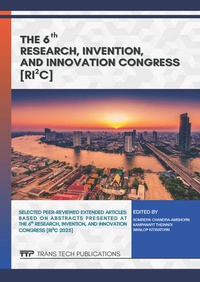
The 6th Research, Invention, and Innovation Congress (RI2C)
Published on 27. February 2026
206 pages
978-3-0364-1765-3 (ISBN)
Description

This book is a collection of the selected peer-reviewed papers presented at the 2025 6th Research, Invention, and Innovation Congress (RI2C), organised by the Science and Technology Research Institute (STRI), King Mongkut's University of Technology North Bangkok, during August 19-20, 2025. The selected articles delve into various facets of recent materials science and processing technologies and will be helpful to engineers and researchers in the fields of engineering mentioned.
More details
Other editions
Additional editions

Trans Tech Publications Ltd | Somrerk Chandra-Ambhorn | Kampanart Theinnoi
The 6th Research, Invention, and Innovation Congress (RI2C)
Book
02/2026
Trans Tech Publications Ltd
€222.84
Shipment within 10-20 days
Persons
Content
Preface
Chapter 1: Steel and Alloys
Fracture Evaluation of Anisotropically Deformed Advanced High-Strength Sheet Steel through Stress-Based Forming Limit Curves and Fracture Loci
Simulative Study on Anisotropic Deformation of a Large Sheet-Hydroformed Motorcycle Fuel Tank
Scanning Strategy Effects on Melt Pool Dynamics and Surface Quality in Selective Laser Melting of Ti-6Al-4V
Multi-Stage Forming Process Design through an Innovative, Iterative Full-Cycle Simulation with Automatic Springback Compensation for an Aluminum Hood Outer Panel
Study on Microstructure Evolution and Wear Resistance Properties of Laser Cladding Applied on R900A Rail Steel
Study of Die Deformation Influence on Part Springback of an Automotive Chassis Component
Chapter 2: Welding
Hardness Reduction in SA-335 P11 Welds by GTAW Using Controlled Interpass Temperature and the Temper Bead Technique without Post Weld Heat Treatment
Enhanced Weldability and Microstructural Characteristics of A536-A36 Dissimilar Joints Using Buttering and Preheating Techniques
Development of Geopolymer-Based Weld Backing Using Recycled Industrial Waste for A36 Steel Welding Using GMAW Process
Effect of Post Weld Heat Treatment and Filler Metal on the Microstructure, Mechanical Properties, and Corrosion Resistance of Dissimilar Welds between Carbon Steel and Stainless Steel
Chapter 3: Polymers and Composites
Rice Husk Fiber-Based Polishing Pad for Chemical Mechanical Polishing (CMP) of Sapphire
Influence of Filler on the Interfacial Strength between TPE and PP Composites
A Preliminary Investigation on Recycled PET-Derived Polyurethane Films: Role of NCO/OH Ratio in Film Development
Structural Study of Modified-Recycled PET from Drinking Bottle Waste by Using Multifunctional Chain Extenders
Effects of Plasticizers on Physical and Mechanical Properties of Tamarind Kernel Powder-Gelatin Film
TiO2-Chitosan Functionalized Polypropylene Nonwovens for Air Filtration Applications
Chapter 4: Functional Materials
Development of a Self-Healing Coating by Microencapsulation Technique
Development of an Electrochemical Sensor for On-Site Detection of Perfluorooctane Sulfonic Acid (PFOS)
Effect of Hydrazine Hydrate on Reduced Graphene Oxide for Enhanced Electrochemical Sensing of Pb(II)
Study of Silver Supported on Zinc Oxide Catalyst for the Oxidation of Diesel Particulate Matter
Effect of Metal Cation Composition in Magnesium-Aluminum Layered Double Hydroxide during Adsorptive Removal of Cr(VI) from Aqueous Solution
Chapter 1: Steel and Alloys
Fracture Evaluation of Anisotropically Deformed Advanced High-Strength Sheet Steel through Stress-Based Forming Limit Curves and Fracture Loci
Simulative Study on Anisotropic Deformation of a Large Sheet-Hydroformed Motorcycle Fuel Tank
Scanning Strategy Effects on Melt Pool Dynamics and Surface Quality in Selective Laser Melting of Ti-6Al-4V
Multi-Stage Forming Process Design through an Innovative, Iterative Full-Cycle Simulation with Automatic Springback Compensation for an Aluminum Hood Outer Panel
Study on Microstructure Evolution and Wear Resistance Properties of Laser Cladding Applied on R900A Rail Steel
Study of Die Deformation Influence on Part Springback of an Automotive Chassis Component
Chapter 2: Welding
Hardness Reduction in SA-335 P11 Welds by GTAW Using Controlled Interpass Temperature and the Temper Bead Technique without Post Weld Heat Treatment
Enhanced Weldability and Microstructural Characteristics of A536-A36 Dissimilar Joints Using Buttering and Preheating Techniques
Development of Geopolymer-Based Weld Backing Using Recycled Industrial Waste for A36 Steel Welding Using GMAW Process
Effect of Post Weld Heat Treatment and Filler Metal on the Microstructure, Mechanical Properties, and Corrosion Resistance of Dissimilar Welds between Carbon Steel and Stainless Steel
Chapter 3: Polymers and Composites
Rice Husk Fiber-Based Polishing Pad for Chemical Mechanical Polishing (CMP) of Sapphire
Influence of Filler on the Interfacial Strength between TPE and PP Composites
A Preliminary Investigation on Recycled PET-Derived Polyurethane Films: Role of NCO/OH Ratio in Film Development
Structural Study of Modified-Recycled PET from Drinking Bottle Waste by Using Multifunctional Chain Extenders
Effects of Plasticizers on Physical and Mechanical Properties of Tamarind Kernel Powder-Gelatin Film
TiO2-Chitosan Functionalized Polypropylene Nonwovens for Air Filtration Applications
Chapter 4: Functional Materials
Development of a Self-Healing Coating by Microencapsulation Technique
Development of an Electrochemical Sensor for On-Site Detection of Perfluorooctane Sulfonic Acid (PFOS)
Effect of Hydrazine Hydrate on Reduced Graphene Oxide for Enhanced Electrochemical Sensing of Pb(II)
Study of Silver Supported on Zinc Oxide Catalyst for the Oxidation of Diesel Particulate Matter
Effect of Metal Cation Composition in Magnesium-Aluminum Layered Double Hydroxide during Adsorptive Removal of Cr(VI) from Aqueous Solution
