

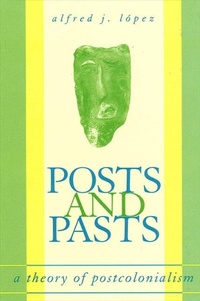
Posts and Pasts
Description

Deconstructs the field of postcolonial studies.
In Posts and Pasts: A Theory of Postcolonialism, Alfred J. Lopez argues for a formulation of postcolonial studies which diverges in three significant ways from current academic and institutional practices: 1) the postcolonial as diasporic, constituted by a series of dispersed and irregular criticisms not at all containable within a single set of parameters, whether historical, geographical, or socioeconomic; 2) the postcolonial as a distinct ontological moment in the life of a nation or people, in which it conceives itself as doubly haunted-on the one hand by the "memory in advance" of a collective national future and on the other by its colonial past; and 3) the postcolonial as a distinct phenomenological moment, a radical break in the history of a relation between lords and bonds-women and -men.
Going further than previous studies to address the postcolonial as a diasporic body of texts and discourses, it looks at a remarkable variety of writers-Joseph Conrad, Wilson Harris, Jose Marti, Edward Kamau Brathwaite, Michelle Cliff, J. M. Coetzee, Franz Fanon, Gabriel Marcia Marquez, and Salman Rushdie.
More details
Other editions
Additional editions
Person
Alfred J. Lopez is Assistant Professor of English at Florida International University.
Content
Acknowledgments
Introduction Posts and Pasts
Chapter One
"The Other! The Other!": Conrad,Wilson Harris, and the Postcolonial "Threshold of Capacity"
Chapter Two
Specters of the Nation: Resistance, Criollismo, and the Ambivalence of the "Neo-"
Chapter Three
Whiteness and the Colonial Unconscious
Chapter Four
"Toward a New Humanism....": Fanon, Hegel, and the Crisis of Mastery
Chapter Five
Reason, "the Native," and Desire: A Theory of "Magical Realism"
Conclusion
Magic, "Realism," and the "Post-"
Notes
Biblography
Index
