

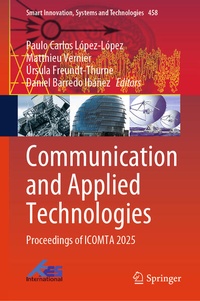
Communication and Applied Technologies
Description

This book features selected papers from the International Conference on Communication and Applied Technologies (ICOMTA 2025), Universidad Austral de Chile, Valdivia, Chile, during 2-4 September 2025. It covers recent advances in the field of digital communication and processes, digital social media, software, big data, data mining, and intelligent systems.
More details
Other editions
Additional editions
Persons
Paulo Carlos López-López is Associate Professor in the Department of Political Science and Sociology at the University of Santiago de Compostela and researcher in the Political Research Team. His research interests are political communication, technology, emotions and political behaviour. He has more than 150 published papers (of which 53 are in Scopus), presented more than 50 papers in National and International Congresses, participated in more than 35 Scientific Committees and was a reviewer for more than 20 scientific journals, most of them indexed in Scopus or Web of Science. He is academic secretary of the international network XESCOM (ED341R 2016/2019). Associate editor or member of the Editorial Board of several journals in Ibero-America. He holds a PhD in Political Science from the University of Valencia and a PhD in Communication from the University of Santiago de Compostela, with a thesis on communication and electoral processes. He holds a Diploma in Advanced Studies. He holds a degree in Journalism in the field of electronic journalism (2003-2007) and a degree in Political Science and Administration in the field of International Relations (2007-2011) from the same University.
Matthieu Vernier did his undergraduate studies in Computer Science at the University of Caen (France) between 2002 and 2007, then a PhD in Computer Science at the University of Nantes (France) during which he developed a thesis on the analysis of subjective discourse with automatic language processing algorithms (2007-2011) and finally a Master in Business Administration (2012-2013) at the University of Nantes. Between 2011 and 2015, he initiated entrepreneurial activities and non-profit projects in France, New-Zelanda and Chile having as a common thread the construction of a democratic society based on social and environmental justice. Since 2016, he is an academic at the Universidad Austral de Chile. His areas of interest focus on Human-Computer interactions and unstructured data analysis for the exploration of social phenomena and the design of new uses and interactions between humans and technologies.
Úrsula Freundt Thurne is Doctorate in Business Administration and Management. Polytechnic University of Catalonia, Barcelona Spain/UPC. (2016)- MS in Higher Education - Universidad Andrés Bello, Chile (2012). Dean of the Faculty of Communications (6 Majors); Former Head of the Communication and Journalism Department; Director UPCTV Chanel; Former Director of the University Editorial Fund; Member of the Latin American Council of Accreditation of Education in Journalism and Communication (CLAEP), Program run by the Inter-American Press Association (IAPA); Member of the International Council of Scientific Reviewers of the Scientific Journal "Comunicar" (First world journal in Spanish language in the Scopus ranking in Education, Communication and Cultural Studies).
Daniel Barredo Ibáñez is an Associate Professor at the University of Seville (Spain). His interdisciplinary work explores three research lines: studies on public opinion, technology, and media; studies on violence against journalists or vulnerable groups; and international studies from a comparative perspective. He obtained his Ph.D. in Journalism from the University of Malaga in 2013, as well as a master's and an expert degree in Communication, and a bachelor's degree in Hispanic Philology and Audiovisual Communication from the University of Granada. He also co-created and is President of the International Conference on Communication and Applied Technologies (ICOMTA). He co-leads the "Spanish Universities in the Media (MECU-ESP)" project, funded by the Spanish Ministry of Science.
Content
RFID-Smart Access: Integrated System for Automated Access Management through Credential Decoding.- Hyperparameter Optimization of GPT-2 for Enhanced Text Generation.- Using Virtual Reality to Improve Visualization and Comprehension Skills in a Multivariable Calculus Course.- A Real-Time Political Sentiment Analysis System Using DeepSeek-R1 on Multiplatform Social Media Data.- Robertiño: A Low-Cost Robot for Executing Large Language Models and Convolutional Networks to En-hance Early Education in Underserved Communities.- Impact of Visual Merchandising on Promotional Strategies: A Neuromarketing Analysis with Eye Tracking at the Point-of-Sale.- Regulatory Frameworks for Digital Information Transparency: A Comparative Analysis Between Ecuador and Spain.- Adoption of Augmented Reality in Digital Commerce: Effect of Experience and Technological Attitude on Centennials' Purchase Intention.- China's Roadmap for Developing a Successful Innovation Ecosystem.- Look-up, Use and Emotions (LUE) Methodology: Technological Hybridization for Active Learning in Higher Education.
