

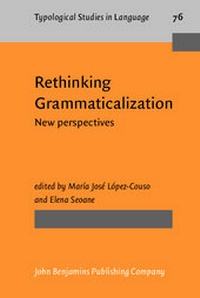
Rethinking Grammaticalization
New perspectives
1st Edition
Published on 9. July 2008
X, 355 pages
978-90-272-9022-9 (ISBN)
Description

This volume and its companion one Theoretical and empirical issues in grammaticalization offer a selection of papers from the Third International Conference New Reflections on Grammaticalization, held in Santiago de Compostela in July 2005. From the rich programme of the conference (over 120 papers), the twelve contributions included in this volume were carefully selected to reflect the state of current research in grammaticalization and suggest possible directions for future investigations in the field. Combining theoretical discussions with the analysis of particular test cases from a wide range of languages from various language families, the selected papers focus on such central questions as the need for a broader notion of grammaticalization, the distorting effects of grammaticalization on grammar, the areal perspective in grammaticalization and the relevance of contact-induced change to grammaticalization. Other topics discussed include the development of markers of textual connectivity and the emergence of cardinal numerals and numeral systems.
More details
Other editions
Additional editions
Book
07/2008
John Benjamins Publishing Co
€116.60
Shipment within 10-15 days
Persons
Content
- Rethinking Grammaticalization
- Editorial page
- Title page
- LCC data
- Table of contents
- Address list
- Preface
- Introduction: New perspectives on grammaticalization
- References
- 1. Grammaticalization and the areal factor: The perspective of East and mainland Southeast Asian languages
- 1. Introduction: Properties of grammaticalization in East and mainland Southeast Asia
- 2. Examples
- 2.1 Inference of several different grammatical functions: The case of Khmer ba?n 'come to have'
- 2.2 Inference of different grammatical functions depending on the constructional context: The case of classifiers in Thai
- 2.3 The existence of rigid syntactic patterns
- 3. Approaches to grammaticalization in the light of data from East and mainland Southeast Asia
- 3.1 Lehmann (1995)
- 3.2 Heine, Claudi and Hünnemeyer (1991)
- 3.3 Bybee, Perkins and Pagliuca (1994)
- 3.4 Hopper and Traugott (2003)
- 3.5 Summary
- 4. Areality and why grammaticalization is special in East and mainland Southeast Asia
- 4.1 An areal type of grammaticalization
- 4.2 How to account for the situation in East and mainland Southeast Asia: On the lack of paradigms
- 5. Outlook: Why is research on grammaticalization interesting?
- Abbreviations
- References
- 2. On the grammaticalization of 'come' and 'go' into markers of textual connectivity
- 1. From motion in space to textual connectivity
- 2. The crosslinguistic scope of the phenomenon
- 3. The grammaticalization cline
- 3.1 Semantic aspects
- 3.2 Morphosyntactic aspects
- 4. Possible triggers for grammaticalization
- 4.1 The role of deicticity
- 4.2 Non-deictic scenarios
- 4.2.1 The iteration scenario
- 4.2.2 The futurity scenario
- 5. Concluding observations
- Abbreviations
- References
- 3. Grammaticalization, typology and semantics: Expanding the agenda
- 1. Introduction
- 1.1 Goal, scope and organization of the paper
- 1.2 Terminology
- 1.3 Major concerns of the lexical item to grammatical morpheme approach
- 1.4 Criticisms of the traditional approach to grammaticalization
- 2. The content of the expanded model: Means and functions
- 3. Theoretical questions in the expanded model
- 4. The motivations for grammaticalization
- 4.1 The principle of functional transparency
- 4.2 The principle of indirect means
- 4.3 The initial state
- 5. The grammaticalization of means
- 5.1 The grammaticalization of phonological means
- 5.2 The grammaticalization of linear order
- 5.3 Repetition
- 5.4 The grammaticalization of lexical categories
- 5.4.1 The grammaticalization of nouns, verbs and adjectives
- 5.4.2 The grammaticalization of the locative predicator
- 6. A case study: The principle of functional transparency and grammatical relations
- 6.1 Relative clauses in Wandala
- 6.2 Coding grammatical relations in a simple clause
- 6.2.1 Word order and the coding of grammatical relations
- 6.2.2 Two arguments in a pragmatically neutral clause
- 6.2.3 The role of the single argument
- 6.2.4 Coding the role of arguments in fronting operations
- 7. The choice of formal means
- 8. Grammaticalization and language change
- 9. Grammaticalization as a research tool: Methodological considerations
- 10. Conclusions
- Abbreviations
- References
- 4. Mismatch: Grammar distortion and grammaticalization
- 1. Introduction
- 2. Mismatch and grammaticalization
- 3. Mismatch and the unchanged residue of grammaticalization
- 3.1 Mismatch and inertia
- 3.2 Mismatch as a side effect of grammaticalization
- 3.3 Mismatch and language contact
- 4. Conclusion
- Abbreviations
- References
- 5. Areal convergence in grammaticalization processes
- 1. Preliminaries
- 2. The areality issue or areal grammaticalization
- 3. 'Have'-perfects: Grammaticalization in steps
- 3.1 Origin and diffusion of the 'have'-perfects
- 3.2 A further step: Perfects as pasts
- 4. Some reflections on articles in Slavic languages
- 5. The renewal of the relative pronoun paradigm in European languages
- 6. Reflexives and middle forms from an areal perspective
- 7. Conclusions
- Abbreviations
- References
- 6. The grammaticalization of nominalizers in Japanese and Korean: A contrastive study
- 1. Introduction
- 2. Nominalization in Japanese: Historical background
- 2.1 Nominalization in Classical Japanese
- 3. Grammaticalization of nominalizers in Japanese and Korean
- 3.1 Grammaticalization of overt nominalizers in Japanese
- 3.2 Grammaticalization of overt nominalizers in Korean
- 3.3 Theoretical implications of the Japanese-Korean contrast
- 4. Conclusion
- Abbreviations
- References
- 7. On the frills of grammaticalization
- 1. Introduction
- 2. Contact-induced grammaticalization
- 3. Elaborateness of marking in high-contact varieties
- 4. Contact-induced grammaticalization and bulking of material
- 4.1 A more elaborate expression from the model language replaces a less elaborate one in the replica language
- 4.2 Coexistence of two expressions for the same function, one from the model language and one from the replica language
- 4.3 A caveat
- 5. Accretion in contact-induced grammaticalization: An explanation
- 5.1 Diachronic overlap stage
- 5.2 Synchronic buffer zone
- 6. Conclusions
- Abbreviations
- References
- 8. Nominalizations in Bodic languages
- 1. Introduction
- 2. The areal context
- 3. Additional features of the nominalization-relativization syncretism in Bodic
- 4. Sources of nominalizers
- 5. Relativization with the genitive
- 6. Innovations in the system of nominalizations
- 7. Summary
- Abbreviations
- References
- 9. On the rise and fall of Korean nominalizers
- 1. Introduction
- 2. Nominalizers in history
- 3. The grammaticalization of Korean nominalizers
- 3.1 Sources
- 3.2 Uses of nominalizers
- 3.3 Semantic change
- 4. Specialization of nominalizers in Modern Korean
- 4.1 Differential levels of abstraction
- 4.2 Differential levels of morphosyntactic bondedness
- 4.3 Affirmative vs. negative specialization
- 4.4 Adnominalizer vs. nominalizer specialization
- 4.5 Sentential end-marking functions
- 5. Conclusion
- Abbreviations
- References
- 10. The grammaticalization of clausal nominalizers in Burmese
- 1. Introduction
- 2. Nominalizers and their common and divergent properties: A brief overview
- 2.1 What are nominalizers and what sources do they develop from?
- 2.2 Is nominalization a lexical or a syntactic process?
- 2.3 Nominalizers and verbalizers
- 2.4 Nominalization and compounding
- 3. Nominalization in Burmese
- 3.1 Sentential nominalizers in Literary Burmese: The elements thii and mii
- 3.2 Sentential nominalizers in Colloquial Burmese
- 4. Summary of conclusions and consequences for further work
- Abbreviations
- References
- 11. The grammaticalization cline of cardinal numerals and numeral systems
- 1. Introduction
- 2. Quantification
- 2.1 Numerically specific vs. numerically unspecific
- 2.2 Systemic vs. non-systemic
- 3. Numeral systems
- 3.1 Simple and complex numerals
- 3.2 Variant forms
- 4. The emergence of numeral systems
- 4.1 Methodology
- 4.2 Step 1: Subitizing
- 4.3 Step 2: Beyond subitizing: The emergence of numeracy in language
- 4.3.1 Step 2a: Additional lexemes
- 4.3.2 Step 2b: Sporadic complex forms
- 4.4 Step 3: Serialization
- 4.5 Step 4: Functional elements within numeral systems
- 4.6 Step 5: Higher bases
- 5. Conclusion and outlook
- References
- 12. The development of nominalizers in East Asian and Tibeto-Burman languages
- 1. Introduction
- 2. Nominalization in Asian languages
- 2.1 Tibeto-Burman perspectives
- 2.2 East Asian perspectives
- 2.2.1 Japanese nominalizers
- 2.2.2 Korean nominalizers
- 2.2.3 Chinese nominalizers
- 2.2.4 Summary
- 3. Issues related to the grammaticalization of East Asian and Tibeto-Burman nominalizers
- 3.1 The relationship between nominalization, tense/aspect and evidentiality/mood
- 3.2 The relationship between nominalization and copula usage
- 3.3 Forgotten or residual nominalizers
- 4. Conclusion
- Abbreviations
- References
- Index of names
- Index of languages
- Index of subjects
- The series Typological Studies in Language
