

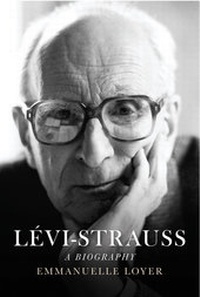
Lévi-Strauss
Description

More details
Other editions
Additional editions
Persons
Content
Foreword Adam Kuper
Introduction. The Worlds of Claude Lévi-Strauss
Part I Yesterday's Worlds (É-1935)
Chapter 1 The Name of the Father
Chapter 2 Revelations (1908-1924)
Chapter 3 Revolutions (1924-1931): Politics vs. Philosophy
Chapter 4 Redemption: Anthropology (1931-1935)
Chapter 5 The Enigma of the World
Part II New Worlds (1935-1947)
Chapter 6 France in São Paulo
Chapter 7 In the Heart of Brazil
Chapter 8 Massimo Lévi with the Nambikwara
Chapter 9 Crisis (1939-1941)
Chapter 10 A Frenchman in New York City: Exile and Intellectual Invention (1941-1944)
Chapter 11 Structuralism D the American Years
Part III The Old World (1947-1971)
Chapter 12 The Ghosts of Marcel Mauss
Chapter 13 Manhood
Chapter 14 The Confessions of Claude Lévi-Strauss
Chapter 15 Structuralist Crystallization (1958-1962)
Chapter 16 The Manufacture of Science
Chapter 17 The Scholarly Life
Chapter 18 The Politics of Discretion
Part IV The World (1971-2009)
Chapter 19 Immortal
Chapter 20 Metamorphoses
Chapter 21 Claude Lévi-Strauss, our Contemporary
Notes
Works by Lévi-Strauss
Archives consulted
Abbreviations of Works by Lévi-Strauss
Illustration credits
Index
Introduction: The Worlds of Claude Lévi-Strauss
I would have liked, once in my lifetime, to communicate fully with an animal. It is an unattainable goal. It is almost painful for me to know that I will never be able to find out what the matter and structure of the universe is made of. This would have meant being able to talk to a bird. But this is the line that cannot be crossed. Crossing this line would be a great joy for me. If you could bring me a good fairy who would grant me one wish, this is the one I would choose.
Claude Lévi-Strauss, Interview with F. Raddatz1
Around the world
For a long time, Claude Lévi-Strauss would spend his afternoons in his study at home on the fifth floor of 2 rue des Marronniers in the 16th arrondissement of Paris. This magisterial space - with its encyclopedic library, its carefully chosen objects, minerals, 'curiosities' and works of art - recomposed the world in miniature and ordered form.
Let us enter the sanctuary. A large rectangular room with a rounded wall on the window side, surrounded by shelves filled with books, bound journals, encyclopedias and dictionaries. The desk itself - of dark wood in the Spanish style acquired in New York - stood aslant, at the far end; Lévi-Strauss would sit at it to write, or to read or edit, in an armchair on casters so that he could move easily between a cylinder desk filled with stationery and a small steel table on which was perched a typewriter (with German keyboard). From the radio would flow an indispensable stream of classical music. Settled at his desk, sometimes leaning back with his feet up, Lévi-Strauss faced an enormous representation of Tara, the green asexual divinity from Nepal - an image of serenity and calm, purchased at Paris's Drouot auction house in the 1950s. A Thai crocodile, a giant carved tree root from China, and Japanese prints and sword guards rounded out the presence of the Far East. A few rare ethnographic objects, including the cedar-wood haida mace for bludgeoning fish that figures in one of the aesthetic meditations in The Savage Mind, further intensified the otherworldly atmosphere. On the desk were a few stones, and among them a cube of lapis lazuli and a dagger. No plants. Somewhere between a cabinet of curiosities and an artist's studio, the room was an ode to beauty, a visual and aural environment where, in the muffled afternoon quiet, all the elements could find harmony, coming together in the utopia of an enclosed space containing a world in microcosm: the library. Indeed, following Xavier de Maistre in A Journey Around My Room, Lévi-Strauss could travel the world without leaving the confines of his office, contemplating this paper edifice: on the wall to his left, Africa, Oceania and Asia; directly opposite, periodicals and index card files; to his right, South America; behind him, in the corner, North America, with the remainder of that wall devoted to encyclopedias and dictionaries - all within reach of a single turn on his rolling armchair. 'My library was a marvel', he would later say.2 Indeed, the entire world was represented within its walls, and each book was placed where the population with which it dealt would have been situated on a map. This geographical classification (by continent) thus achieved a kind of anamorphosis of map and library - two homologous representations attesting to the fullness and richness of the world.
The sophisticated ordering of this circumnavigating library should not distract us from its essential components: the 12,000 books and, above all, the complete series of international journals, notably Man and American Anthropologist, as well as thousands of offprints, supplied the material necessary for scholarly endeavour. There could be no knowledge without the capillaries through which this data circulated, regularly indexed on cards. Like all scholars of his generation, Lévi-Strauss was an avid user of the index card, which had become, by the early twentieth century, an indispensable tool for all comparative study. He owned a piece of furniture designed to store these cards, which held summaries of all the books he had read at the New York Public Library during the war years - i.e., several thousand works. 'For a period, in the 1940s-1950s, I could say that nothing published in the field of anthropology escaped my attention.'3 Lévi-Strauss's library encompassed the entire world and the full range of knowledge, constituting an archive for a kind of scholarly practice in which the impulse to exhaustiveness was still very much the order of the day. At the beginning of the 1960s, several uncaged parrots would fly about this den of erudition, having just arrived from Amazonia thanks to a complicated series of ploys contrived, at the limits of legality, by Isac Chiva, Lévi-Strauss's assistant at the Laboratory of Social Anthropology at the Collège de France. Chiva was well aware of his colleague and friend's love of animals, and that he had lived with some monkeys brought back from Brazil. Chiva knew that, if left to his own devices, Lévi-Strauss would have allowed dogs, cats and all manner of creature to find shelter in his study, transforming the office into a menagerie. Indeed, something of the sort did come to pass: the parrots would regularly make off with the anthropologist's glasses and soil the floor and furniture. Lévi-Strauss ultimately had to give up the birds, as well as his dream of a human existence at one with the animal world. He would manage, however, to revive this chimera by immersing himself in a world that suited him perfectly: that of Amerindian myth, in which animals and humans partook of the same universe.
The mystery of Lévi-Strauss
The Renaissance studiolo that served as Claude Lévi-Strauss's office is both revealing and surprising: it does not 'square' with the avant-garde persona of this pioneer of structuralism - that high-flying theory, often associated with the modernist context of the 1950s-1960s. Structuralism aimed to map the operations of symbolic thought through a new technique of comparison. It was not, as is often thought, a quest for invariants across the societies studied, but rather a method for identifying their differences, understood as variations, with an emphasis on the relations that allow for the passage from one to another. The theory, which was originally developed in the field of linguistics and then spread not only to anthropology but also to other fields (literary criticism, psychoanalysis, history, etc.), arose in connection with the triumph of science, as well as that of the anthropological discipline that Lévi-Strauss helped bring into the mainstream of social science in France during the second half of the twentieth century. So goes the standard story of the adventure of structuralism conjured up by his name, a story some of whose fundamental episodes, we discover to our surprise, took place in the study of a . Renaissance man.
Who, then, was Claude Lévi-Strauss? A child of the twentieth century, he was born in Brussels in 1908 and died in Paris more than a hundred years later, in 2009. He grew up in a Jewish family that had earlier enjoyed the classic French experience of upward mobility, from Alsace to Paris. In this bourgeois world, deeply rooted in the nineteenth century, Lévi-Strauss blossomed as a beloved only child, on whom rested all the hopes of a somewhat down-at-heel family. His father was an artist, as were two of his uncles. Those who did not dedicate themselves to the arts went into business. A large, warm and close-knit extended family, perfectly coherent in its secular and patriotic Judaism, peopled the childhood of the young Claude. A star pupil, he pursued his studies in the literary classes préparatoires at Paris's prestigious Lycée Condorcet, and yet decided against sitting the entrance exam to the highly selective École normale supérieure, in the first of what would become characteristic existential turns. He became something of a student dilettante, pursuing a double degree in law and philosophy, which led him to sit the competitive agrégation exam in 1931 in order to qualify as a professor. In these years, he was, above all, a committed socialist who, under the auspices of Karl Marx and the SFIO (the French section of the Workers' International), was keen to change the world. However, unlike many of his comrades, such as his cousin's husband Paul Nizan, he never became a communist. Rather than change the world, in 1935, he chose to leave the one in which he had grown up. An offer to teach in Brazil presented an opportunity to study Amerindians - who, from the perspective of Paris, were thought to be living in the suburbs of São Paulo. This personal and intellectual turn - he abandoned the old world of philosophy for the young world of anthropology - was of course decisive, and marked the beginning of a second period in his life, set in the new worlds of Brazil and, later, during the Second World War, the United States.
These biographical elements distinguish Lévi-Strauss's path through the twentieth century. Yet what weight are we to give to the two detours he took in the first half of his life? The first was his decision to distance himself from his family's Judaism. In the history of the social sciences, Lévi-Strauss is hardly the only intellectual to have broken with the synagogue, yet...
