

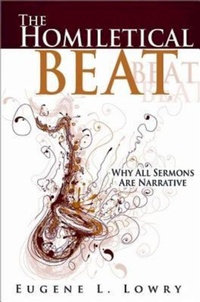
The Homiletical Beat
Description

Sermons are, by definition, narratives and as such, they have plots. At the same time, the sermon is not a story. While similar in many ways, narratives and stories are distinct. Therefore, to think of narrative preaching as merely one of many homiletical styles is to misunderstand and reduce the nature of the sermon. The sermon is more than just an option for the preacher; rather, it is, by definition, a narrative because it happens in time, not in space.
This changes everything because the sermon ceases to be something a preacher constructs, like a thesis or even a painting. Instead, it is more like a piece of music - something a preacher plays within intuitively, to a constant beat - time after time, week after week.
In light of this revelation, what are new strategic aims for sermon preparation and delivery?
More details
Other editions
Additional editions
Person
Rev. Dr. Eugene L. Lowry served as professor of preaching for over 30 years at Saint Paul School of Theology in Kansas City, MO. Now that he is no longer actively serving as the William K. McElvaney Professor of Preaching, his travels as preacher, teacher and pianist have broadened in scope.
Ordained a United Methodist minister, Dr. Lowry's academic preparation includes four degrees, culminating with a doctorate ineducation from the University of Kansas.
He was Senior Scholar in Residence at Drew University Theological School fall 2003 and fall 2004; in the spring of 1999 he was aguest professor at Princeton Theological Seminary. Lowry has been featured in the Great Preachers series on the Odyssey Television Channel. He delivered the 2009 Lyman Beecher Lectures on Preaching at Yale Divinity School and the 2011 William L. Self Lectureship on preaching at McAfee Theological Seminary. These lectures form the basis for this book.
Through the years he has pre
Content
- Cover
- Half title
- Title
- Copyright
- Dedication
- Contents
- Preface
- 1. Introduction
- 2. The Three Levels of Narrativity
- Level One: Narrative as Temporal Modality
- Level Two: Narrative as Strategic Aim
- Level Three: Narrative as Embodied Form
- 3. Encountering the Aristotle Blues
- 4. Recovering the Voice of Orality
- Notes
