

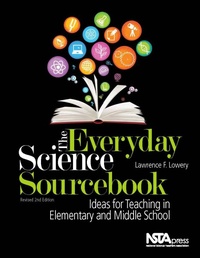
The Everyday Science Sourcebook, Revised 2nd Edition
Ideas for Teaching in Elementary and Middle School
Published on 16. May 2012
537 pages
978-1-936959-84-6 (ISBN)
Description

?This sourcebook was created because science should be memorable, not memorizable.? ? from the Introduction to The Everyday Science Sourcebook, Revised 2nd Edition
Think of this unique reference book as Inspiration Central for elementary and middle school science teachers. Fully updated with content selected to build on the AAAS and National Science Education Standards, this new edition is full of hundreds of entries that can spark your thinking the next time you need to fill in a gap in your curriculum, add a fresh element to your textbook lessons, or extend and enrich hands-on activities.
The Everyday Science Sourcebook is structured like an easy-to-use thesaurus. Just look up a topic in the Index, note the reference number, and then use that number to find a wealth of related activities in the Entry section. For example, looking up meteorology can lead you to notes on the Earth's temperature. From there, you'll see entries on how students can make a liquid thermometer, graph air temperatures, and measure the conversion of solar energy to heat energy.
Six broad content categories provide the framework for the main body of this book, the Entry section:
• Inorganic matter
• Organic matter
• Energy
• Inference models
• Technology
• Instructional apparatus, materials, and systems
The Everyday Science Sourcebook deserves a prominent spot on your bookshelf. Refer to it daily as a springboard for ideas that make science memorable.
Think of this unique reference book as Inspiration Central for elementary and middle school science teachers. Fully updated with content selected to build on the AAAS and National Science Education Standards, this new edition is full of hundreds of entries that can spark your thinking the next time you need to fill in a gap in your curriculum, add a fresh element to your textbook lessons, or extend and enrich hands-on activities.
The Everyday Science Sourcebook is structured like an easy-to-use thesaurus. Just look up a topic in the Index, note the reference number, and then use that number to find a wealth of related activities in the Entry section. For example, looking up meteorology can lead you to notes on the Earth's temperature. From there, you'll see entries on how students can make a liquid thermometer, graph air temperatures, and measure the conversion of solar energy to heat energy.
Six broad content categories provide the framework for the main body of this book, the Entry section:
• Inorganic matter
• Organic matter
• Energy
• Inference models
• Technology
• Instructional apparatus, materials, and systems
The Everyday Science Sourcebook deserves a prominent spot on your bookshelf. Refer to it daily as a springboard for ideas that make science memorable.
More details
Other editions
Additional editions
Lawrence F. Lowery
The Everyday Science Sourcebook
Ideas for Teaching in Elementary and Middle School
Book
07/2012
2nd Edition
National Science Teachers Association
€69.46
Article exhausted; check different version
Person
Lawrence Lowery taught in the Oakland, CA, public schools before becoming a professor of science education at the University of California, Berkeley. He has more than 40 years' experience creating science activities and programs, developing curricula, and writing articles and books, including the NSTA Press publication The Everyday Science Sourcebook and the I Wonder Why series.
Content
- Cover (front)
- Chart 1. Science Process/Knowledge and Developmental Stages
- Table of Contents
- Preface
- How to Use This Sourcebook
- Features of This Sourcebook
- Acknowledgments
- References
- 100-199 Inorganic Matter
- 110 Solids
- 120 Liquids
- 130 Gases
- 140 Earth Science
- 150 Oceans
- 160 Weather
- 200-299 Organic Matter
- 210 Zoology
- 220 Botany
- 230 Other Organisms
- 240 Ecology
- 300-399 Energy
- 310 Motion
- 320 Sound
- 330 Light
- 340 Heat
- 350 Electricity
- 360 Magnetism
- 400-499 Inference Models
- 410 Atoms and Molecules
- 420 Astronomy
- 500-599 Technology and Engineering
- 510 Machines
- 520 Communications
- 530 Transportation
- 600-699 Instructional Apparatus, Materials, and Systems
- 610 Safety Precautions
- 620 General Equipment
- 630 Measuring Systemsand Instruments
- 640 Plant and AnimalContainers
- 650 Equipment for Collecting
- Index Guide
- Index
- Cover (back)
