

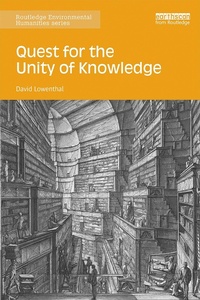
Quest for the Unity of Knowledge
1st Edition
Published on 1. November 2018
232 pages
978-0-429-87643-1 (ISBN)
Description

Is unity of knowledge possible? Is it desirable? Two rival visions clash. One seeks a single way of explaining everything known and knowable about ourselves and the universe. The other champions diverse modes of understanding served by disparate kinds of evidence. Contrary views pit science against the arts and humanities. Scientists generally laud and seek convergence. Artists and humanists deplore amalgamation as a threat to humane values.
These opposing perspectives flamed into hostility in the 1950s "Two Cultures" clash. They culminate today in new efforts to conjoin insights into physical nature and human culture, and new fears lest such syntheses submerge what the arts and humanities most value.
This book, stemming from David Lowenthal's inaugural Stockholm Archipelago Lectures, explores the Two Cultures quarrel's underlying ideologies. Lowenthal shows how ingrained bias toward unity or diversity shapes major issues in education, religion, genetics, race relations, heritage governance, and environmental policy.
Aimed at a general academic audience, Quest for the Unity of Knowledge especially targets those in conservation, ecology, history of ideas, museology, and heritage studies.
These opposing perspectives flamed into hostility in the 1950s "Two Cultures" clash. They culminate today in new efforts to conjoin insights into physical nature and human culture, and new fears lest such syntheses submerge what the arts and humanities most value.
This book, stemming from David Lowenthal's inaugural Stockholm Archipelago Lectures, explores the Two Cultures quarrel's underlying ideologies. Lowenthal shows how ingrained bias toward unity or diversity shapes major issues in education, religion, genetics, race relations, heritage governance, and environmental policy.
Aimed at a general academic audience, Quest for the Unity of Knowledge especially targets those in conservation, ecology, history of ideas, museology, and heritage studies.
Reviews / Votes
"No surer guide to the genealogy of this complex landscape of ideas." - David N. Livingstone, Professor of Geography and History, Queen's University Belfast, UK"In this absorbing and wide-ranging book, David Lowenthal explores the centuries-old dialogue between ideas of the unity and diversity of knowledge, as expressed in debates over science and the humanities, humanity and nature, place and space, identity and difference, heritage and history. For its remarkable scope, telling insights and sheer wit, this book will be warmly welcomed by scholars across the disciplines." - Felix Driver, Professor of Human Geography, Royal Holloway, University of London, UK
"Makes fundamental tensions in science and the humanities relevant to problems of heritage and conservation studies. The Quest for the Unity of Knowledge combines scientific understanding with voices of disenfranchised communities." - Glenn Wharton, Clinical Professor, Museum Studies, New York University, USA
"A work of stunning erudition, lucid presentation, and judicious even-handedness. It should be of interest to anyone interested in the past - and the future - of knowledge and scholarship." - John Torpey, Presidential Professor of Sociology and History, Director, Institute for International Studies, Graduate Center, City University of New York, USA
"David Lowenthal's sweeping synthesis of Western thought provides strategies for addressing our grandest challenges. "The mutual interdependence of apparently unrelated knowledges", declares Lowenthal, may be the single most important message of this book. Here is a roadmap of one of the most exciting intellectual journeys of our time." - Marcus Hall, Professor of Environmental Studies, University of Zurich, Switzerland
"Brilliantly charts the history of envisioning intellectual life as a great supercontinent of ideas versus a mental tectonics of many islands. Lowenthal counsels us to welcome both modes of thought, appreciating how supercontinents and islands form from each other, in our ideas no less than in geology. A graceful, learned, and sage work by one of our deepest thinkers." - Michael Bell, Professor of Sociology, University of Wisconsin-Madison, USA
"An exhilarating intellectual journey across place and time, crafting a shimmering history of ideas. This masterful scholar weaves a lifetime of learning and wisdom into a timely and urgent exploration of the changing contours of knowledge itself." - Tom Griffiths, Professor of History, Australian National University
"This magisterial synthesis navigates skilfully between the totalising and universalising quests for knowledge on the one hand, and the disparate and particularistic accounts of understanding on the other, opting instead for something more fruitful: the creative tension between the two and their dialectic interweaving, beyond any disciplinary straitjackets. Along the way, Lowenthal gathers a plethora of wonderful actors, facts, ideas, and anecdotes, from the history of science, environmental studies, heritage and the politics of the past." - Yannis Hamilakis, Professor of Archaeology and Modern Greek Studies, Brown University, USA
Lowenthal's book forces us to think, hard, about the respective merits of lumping and splitting knowledge. - Graeme Wynn,University of British Columbia, Canada "Every academic should read this remarkable book. It serves to remind us in the most readable and thought-provoking way of the critical approach we should bring to our disciplines and to scholarship in general." - Jane Carruthers, Professor Emeritus, Department of History, University of South Africa in Transactions of the Royal Society of South Africa, 2019, DOI: 10.1080/0035919X.2018.1563001
More details
Series
Edition
1. Auflage
Language
English
Place of publication
London
United Kingdom
Publishing group
Taylor & Francis Ltd
Target group
College/higher education
Professional and scholarly
Adult education
File size
4,91 MB
ISBN-13
978-0-429-87643-1 (9780429876431)
Copyright in bibliographic data and cover images is held by Nielsen Book Services Limited or by the publishers or by their respective licensors: all rights reserved.
Schweitzer Classification
Other editions
Additional editions
David Lowenthal
Quest for the Unity of Knowledge
Book
11/2018
1st Edition
Routledge
€206.30
Shipment within 10-20 days
David Lowenthal
Quest for the Unity of Knowledge
Book
11/2018
1st Edition
Routledge
€63.60
Shipment within 10-20 days
Person
David Lowenthal, Emeritus Professor of Geography and Honorary Research Fellow at University College London, was an American historian and geographer. He was a renowned authority on heritage and conservation history, who died just days after he received the proofs. In 2016 he received the British Academy Medal for The Past Is a Foreign Country-Revisited. The medal honors "a landmark academic achievement which has transformed understanding in the humanities and social sciences" in a book exploring "the manifold ways in which history engages, illuminates and deceives us."
Content
Foreword: Environmental Humanities, the Stockholm Archipelago Lectures, and David Lowenthal. Sverker Soerlin, Libby Robin, and Marco Armiero
Introduction
1. Unifying Knowledge-Miracle or Mirage?
2. Man and Nature
3. Island Polymaths
4. Purity and Mixture
5. Heritage Universal and Divisive
6. Past into Present
Conclusion
Introduction
1. Unifying Knowledge-Miracle or Mirage?
2. Man and Nature
3. Island Polymaths
4. Purity and Mixture
5. Heritage Universal and Divisive
6. Past into Present
Conclusion
