

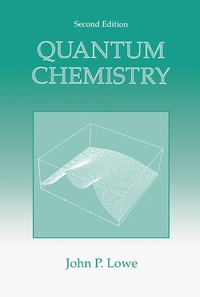
Quantum Chemistry
2nd Edition
Published on 2. December 2012
711 pages
978-0-08-051554-0 (ISBN)
Description

Praised for its appealing writing style and clear pedagogy, Lowe's Quantum Chemistry is now available in its Second Edition as a text for senior undergraduate- and graduate-level chemistry students. The book assumes little mathematical or physical sophistication and emphasizes an understanding of the techniques and results of quantum chemistry, thus enabling students to comprehend much of the current chemical literature in which quantum chemical methods or concepts are used as tools. The book begins with a six-chapter introduction of standard one-dimensional systems, the hydrogen atom, many-electron atoms, and principles of quantum mechanics. It then provides thorough treatments of variation and perturbation methods, group theory, ab initio theory, Huckel and extended Huckel methods, qualitative MO theory, and MO theory of periodic systems. Chapters are completed with exercises to facilitate self-study. Solutions to selected exercises are included.
- Assumes little mathematical or physical sophistication
- Emphasizes understanding of the techniques and results of quantum chemistry
- Includes improved coverage of time-dependent phenomena, term symbols, and molecular rotation and vibration
- Provides a new chapter on molecular orbital theory of periodic systems
- Features new exercise sets with solutions
- Includes a helpful new appendix that compiles angular momentum rules from operator algebra
More details
Other editions
Additional editions
John P. Lowe
Quantum Chemistry
Book
06/1993
2nd Edition
Academic Press
€80.59
Article exhausted; check for reprint
Previous edition

E-Book
10/2013
1st Edition
Academic Press
€70.95
Available for download
Content
1. Classical Waves and the Time-Independent Schridinger Wave Equation2. Quantum Mechanics of Some Simple Systems3. The One-Dimensional Harmonic Oscillator4. The Hydrogenlike Ion, Angular Momentum, and the Rigid Rotor5. Many-Electron Atoms6. Postulates and Theorems of Quantum Mechanics7. The Variation Method8. The Simple Huckel Method and Applications9. Matrix Formulation of the Linear Variation Method10. The Extended Huckel Method. 11. The SCF-LCAO-MO Method and Extensions12. Time-Independent Rayleigh-Schridinger Perturbation Theory13. Group Theory14. Qualitative Molecular Orbital Theory15. Molecular Orbital Theory of Periodic SystemsAppendixes:1. Useful Integrals2. Determinants3. Evaluation of the Coulomb Repulsion Integral over 1s AOs4. Angular Momentum Rules from Operator Algebra. 5. The Pairing Theorem6. Huckel Molecular Orbital Energies, Coefficients, Electron Densities, and Bond Orders for Some Simple Molecules7. Derivation of the Hartree-Fock Equation8. The Virial Theorem for Atoms and Diatomic Molecules9. Bra-Ket Notation10. Values of Some Useful Constants and Conversion Factors11. Group Theoretical Charts and Tables12. Hints for Solving Selected Problems13. Answers to Selected Problems
