

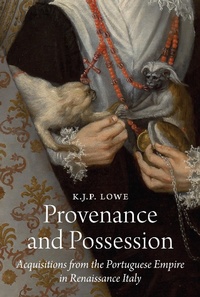
Provenance and Possession
Acquisitions from the Portuguese Empire in Renaissance Italy
1st Edition
Published on 9. April 2024
408 pages
978-0-691-24689-5 (ISBN)
Description

A thought-provoking study of how knowledge of provenance was not transferred with enslaved people and goods from the Portuguese trading empire to Renaissance Italy
In the fifteenth and sixteenth centuries, Renaissance Italy received a bounty of "goods" from Portuguese trading voyages-fruits of empire that included luxury goods, exotic animals and even enslaved people. Many historians hold that this imperial "opening up" of the world transformed the way Europeans understood the global. In this book, K.J.P. Lowe challenges such an assumption, showing that Italians of this era cared more about the possession than the provenance of their newly acquired global goods. With three detailed case studies involving Florence and Rome, and drawing on unpublished archival material, Lowe documents the myriad occasions on which global knowledge became dissociated from overseas objects, animals and people. Fundamental aspects of these imperial imports, including place of origin and provenance, she shows, failed to survive the voyage and make landfall in Europe. Lowe suggests that there were compelling reasons for not knowing or caring about provenance, and concludes that geographical knowledge, like all knowledge, was often restricted and not valued.
Examining such documents as ledger entries, journals and public and private correspondence as well as extant objects, and asking previously unasked questions, Lowe meticulously reconstructs the backstories of Portuguese imperial acquisitions, painstakingly supplying the context. She chronicles the phenomenon of mixed-ancestry children at Florence's foundling hospital; the ownership of inanimate luxury goods, notably those possessed by the Medicis; and the acquisition of enslaved people and animals. How and where goods were acquired, Lowe argues, were of no interest to fifteenth- and sixteenth-century Italians; possession was paramount.
In the fifteenth and sixteenth centuries, Renaissance Italy received a bounty of "goods" from Portuguese trading voyages-fruits of empire that included luxury goods, exotic animals and even enslaved people. Many historians hold that this imperial "opening up" of the world transformed the way Europeans understood the global. In this book, K.J.P. Lowe challenges such an assumption, showing that Italians of this era cared more about the possession than the provenance of their newly acquired global goods. With three detailed case studies involving Florence and Rome, and drawing on unpublished archival material, Lowe documents the myriad occasions on which global knowledge became dissociated from overseas objects, animals and people. Fundamental aspects of these imperial imports, including place of origin and provenance, she shows, failed to survive the voyage and make landfall in Europe. Lowe suggests that there were compelling reasons for not knowing or caring about provenance, and concludes that geographical knowledge, like all knowledge, was often restricted and not valued.
Examining such documents as ledger entries, journals and public and private correspondence as well as extant objects, and asking previously unasked questions, Lowe meticulously reconstructs the backstories of Portuguese imperial acquisitions, painstakingly supplying the context. She chronicles the phenomenon of mixed-ancestry children at Florence's foundling hospital; the ownership of inanimate luxury goods, notably those possessed by the Medicis; and the acquisition of enslaved people and animals. How and where goods were acquired, Lowe argues, were of no interest to fifteenth- and sixteenth-century Italians; possession was paramount.
More details
Language
English
Place of publication
Princeton, NJ
United States
Publishing group
De Gruyter
Target group
Professional and scholarly
Edition type
Digital original
Product notice
Reflowable
Illustrations
41 color plates. 10 b/w illus.
ISBN-13
978-0-691-24689-5 (9780691246895)
Schweitzer Classification
Other editions
Additional editions
Book
04/2024
Princeton University Press
€47.50
Shipment within 10-20 days
Person
K.J.P. Lowe is associate fellow at the Warburg Institute, University of London. Her many books and edited volumes include Cultural Links between Portugal and Italy in the Renaissance, Black Africans in Renaissance Europe and The Global City: On the Streets of Renaissance Lisbon, the basis for a major exhibition at the Museu de Arte Antiga in Lisbon.
Content
- Cover
- Contents
- Illustrations
- Preface
- Acknowledgements
- Abbreviations
- 1. Provenance and Its Discontents. Evidence, Relevance, Language, Knowledge
- 2. The World beyond Italy. Keeping Up-to-date with Portuguese Overseas Expansion: Tracking and Assimilating the New Global Realities in Fifteenth- and Sixteenth-Century Italy
- 3. Florence's 'Black' Babies. Renaissance Florence Meets Sub-Saharan Africa: Mixed-Ancestry Children at the Ospedale degli Innocenti
- 4. Inanimate Global Goods. Buying for the Medici Collection on the Iberian Peninsula in the 1540s
- 5. Living Global Goods. The Acquisition of Living Goods for the Medici from the Portuguese Trading Empire: Provenance and Possession of Flesh and Blood
- Color Plates
- 6. Global Sensibilities. Possessing Consciousness of the Global World in Renaissance Italy: A Papal Official's Experience in 1590s Lisbon
- Parting Thoughts: Knowledge, Ignorance and Non-knowledge
- Bibliography
- Name Index
- Subject Index
- A
- B
- C
- D
- E
- F
- G
- I
- J
- K
- L
- M
- N
- O
- P
- R
- S
- T
- V
- W
- Z
