

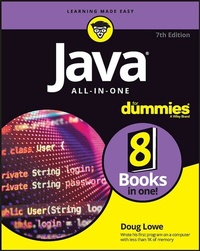
Java All-in-One For Dummies
Description

With Java All-in-One For Dummies, you get 8 books in one, for the most well-rounded Java knowledge on the market. Updated for Java 19, this book includes all the major changes to the programming language, so you won't fall behind. Start by learning the basics of Java--you can do it, even if you've never written a line of code in your life. Then go in-depth, with all the info you need on object-oriented programming, Java FX, Java web development, and beyond. Grab a hot cup of java and settle in to learn some Java, with friendly For Dummies guidance!
* Learn the basics of computer programming and get started with the Java language
* Master strings, arrays, and collections
* Discover the most recent Java updates and the latest in programming techniques
* Launch or further your career as a coder with easy-to-follow instruction
This is the go-to Dummies guide for future and current coders who need an all-inclusive guide Java to take their knowledge to the next level.
More details
Other editions
Additional editions
Person
Doug Lowe is an accomplished technology writer of more than 30 books. He is a tech guru on all things computer programming. His expertise covers networking, Microsoft® Office, programming, and computer building. He is the author of the previous edition of Java All-in-One For Dummies.
Content
Introduction 1
Book 1: Java Basics 5
Chapter 1: Welcome to Java 7
Chapter 2: Installing and Using Java Tools 17
Chapter 3: Working with TextPad 31
Book 2: Programming Basics 37
Chapter 1: Java Programming Basics 39
Chapter 2: Working with Variables and Data Types 59
Chapter 3: Working with Numbers and Expressions 97
Chapter 4: Making Choices 127
Chapter 5: Going Around in Circles (or, Using Loops) 149
Chapter 6: Pulling a Switcheroo 177
Chapter 7: Adding Some Methods to Your Madness 195
Chapter 8: Handling Exceptions 215
Book 3: Object-Oriented Programming 237
Chapter 1: Understanding Object-Oriented Programming 239
Chapter 2: Making Your Own Classes 253
Chapter 3: Working with Statics 273
Chapter 4: Using Subclasses and Inheritance 283
Chapter 5: Using Abstract Classes and Interfaces 305
Chapter 6: Using the Object and Class Classes 327
Chapter 7: Using Inner Classes and Anonymous Classes 355
Chapter 8: Working with Packages and the Java Module System 365
Book 4: Strings and Other Data Types 387
Chapter 1: Working with Strings 389
Chapter 2: Using Regular Expressions 411
Chapter 3: Working with Dates and Times 429
Chapter 4: Using the BigDecimal Class 451
Book 5: Data Structures 471
Chapter 1: Introducing Data Structures 473
Chapter 2: Using Arrays 503
Chapter 3: Using the ArrayList Class 535
Chapter 4: Using the LinkedList Class 549
Chapter 5: Creating Generic Collection Classes 561
Chapter 6: Using Maps and Trees 575
Book 6: Algorithms 595
Chapter 1: Introducing Algorithms 597
Chapter 2: Using Recursion 613
Chapter 3: Sorting 625
Chapter 4: Searching 637
Book 7: Programming Techniques 657
Chapter 1: Programming Threads 659
Chapter 2: Using Functional Programming and Lambda Expressions 689
Chapter 3: Consuming Web Services with HttpClient 705
Book 8: JavaFX 727
Chapter 1: Hello, JavaFX! 729
Chapter 2: Handling Events 751
Chapter 3: Setting the Stage and Scene Layout 769
Chapter 4: Using Layout Panes to Arrange Your Scenes 791
Chapter 5: Getting Input from the User 825
Chapter 6: Choosing from a List 841
Index 869
