

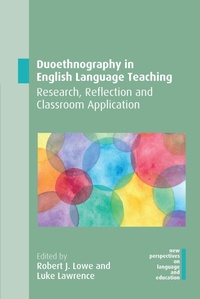
Duoethnography in English Language Teaching
Research, Reflection and Classroom Application
Published on 5. February 2020
240 pages
978-1-78892-720-8 (ISBN)
Description

This book sets out duoethnography as a method of research, reflective practice and as a pedagogical approach in English Language Teaching (ELT). The book provides an introduction to the history of duoethnography and lays out its theoretical foundations. The chapters then address duoethnography as a research method which can be used to explore critical and personal issues among ELT teachers, discuss how duoethnography as a reflective practice can aid teachers in understanding themselves, their colleagues or their context, and demonstrate how duoethnography can be used as a pedagogical tool in ELT classrooms. The chapters are a range of duoethnographies from established and emerging researchers and teachers, which explore the interplay between cultural discourses and life histories with a focus on ELT in Japan.
Reviews / Votes
Lowe and Lawrence have curated a fabulous collection of duoethnographies. The book is informative, readable, and very useful - for both researchers and teachers. This theoretically and methodologically complex and challenging area of research, reflection and pedagogy is narrated in an accessible, composed style. The book serves as an authoritative and convincing introduction to duoethnography in applied linguistics and ELT. * Gary Barkhuizen, University of Auckland, New Zealand * This is an important addition to our understanding of how duoethnographies relate to the cultural and discursive contexts of language. The book articulates pedagogical implications of duoethnography for language development and is an expertly crafted collection of voices, narratives, and reflections. It provides an excellent touchstone for a reflective exploration of the values of dialogue and difference. * Steve Mann, University of Warwick, UK * This collection of chapters is a timely and important contribution to the growing field of duoethnography. Meticulously researched and compellingly written, it is a must-read for anyone wanting to understand what duoethnography is, how it can be related to reflective practice, and how it can be applied to the classroom. * Diane Hawley Nagatomo, Ochanomizu University, Japan *More details
Series
Language
English
Place of publication
Bristol
United Kingdom
Target group
College/higher education
Product notice
Reflowable
ISBN-13
978-1-78892-720-8 (9781788927208)
Copyright in bibliographic data and cover images is held by Nielsen Book Services Limited or by the publishers or by their respective licensors: all rights reserved.
Schweitzer Classification
Other editions
Additional editions
Robert J. Lowe | Luke Lawrence
Duoethnography in English Language Teaching
Research, Reflection and Classroom Application
Book
02/2020
Multilingual Matters
€55.90
Shipment within 3-4 weeks
Persons
Robert J. Lowe is a Lecturer in the Department of English Communication, Tokyo Kasei University, Japan. His research interests include native-speakerism, critical applied linguistics and qualitative research methodology.
Luke Lawrence is a Lecturer in the Department of Social Psychology, Toyo University, Japan. His research interests include native-speakerism, group dynamics and teacher identity.
Luke Lawrence is a Lecturer in the Department of Social Psychology, Toyo University, Japan. His research interests include native-speakerism, group dynamics and teacher identity.
Content
Richard D. Sawyer: Foreword
Chapter 1. Luke Lawrence and Robert J. Lowe: An Introduction to Duoethnography
Part 1: Duoethnography for ELT Research
Chapter 2. Daniel Hooper, Momoko Oka and Aya Yamazawa: Not all Eikaiwas (or Instructors) are Created Equal: A Trioethnography of 'Native Speaker' and 'Non-Native Speaker' Perspectives on English Conversation Schools in Japan
Chapter 3. Yuzuko Nagashima and Chris Hunter: Critical ELT in Japan: A Duoethnographic Exploration of Origins, Identities, Obstacles, and Concerns
Chapter 4. Richard Pinner and Ema Ushioda: Personalisation and Professionalism: Managing the Relationship between Teacher and Learner as People
Part 2: Duoethnography for Reflection and Teacher Education
Chapter 5. Ben Smart and Charles Cook: Professional Development through Duoethnography: Reflecting on Dialogues between an Experienced and Novice Teacher
Chapter 6. Nick Kasparek and Matthew W. Turner: Puzzling about Special Educational Needs in EFL Teacher Development: A Duoethnographic Inquiry
Chapter 7. Matthew Schaefer and Peter Brereton: Developing Understandings of Reflective Practice and Teacher Training
Part 3: Duoethnography for Language Teaching
Chapter 8. Robert J. Lowe and Luke Lawrence: Duoethnography in the Language Class
Chapter 9. Robert J. Lowe: Language Development though Duoethnographic Peer Interaction
Chapter 10. Luke Lawrence: Collaboration and Cohesion: Using Duoethnography to Enhance Group Dynamics and Pair Relationship Building in a University Speaking Class
Chapter 1. Luke Lawrence and Robert J. Lowe: An Introduction to Duoethnography
Part 1: Duoethnography for ELT Research
Chapter 2. Daniel Hooper, Momoko Oka and Aya Yamazawa: Not all Eikaiwas (or Instructors) are Created Equal: A Trioethnography of 'Native Speaker' and 'Non-Native Speaker' Perspectives on English Conversation Schools in Japan
Chapter 3. Yuzuko Nagashima and Chris Hunter: Critical ELT in Japan: A Duoethnographic Exploration of Origins, Identities, Obstacles, and Concerns
Chapter 4. Richard Pinner and Ema Ushioda: Personalisation and Professionalism: Managing the Relationship between Teacher and Learner as People
Part 2: Duoethnography for Reflection and Teacher Education
Chapter 5. Ben Smart and Charles Cook: Professional Development through Duoethnography: Reflecting on Dialogues between an Experienced and Novice Teacher
Chapter 6. Nick Kasparek and Matthew W. Turner: Puzzling about Special Educational Needs in EFL Teacher Development: A Duoethnographic Inquiry
Chapter 7. Matthew Schaefer and Peter Brereton: Developing Understandings of Reflective Practice and Teacher Training
Part 3: Duoethnography for Language Teaching
Chapter 8. Robert J. Lowe and Luke Lawrence: Duoethnography in the Language Class
Chapter 9. Robert J. Lowe: Language Development though Duoethnographic Peer Interaction
Chapter 10. Luke Lawrence: Collaboration and Cohesion: Using Duoethnography to Enhance Group Dynamics and Pair Relationship Building in a University Speaking Class
