

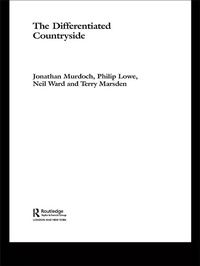
The Differentiated Countryside
Published on 8. July 2005
192 pages
978-1-135-35813-6 (ISBN)
Description

In the wake of BSE, the threat to ban fox hunting and Foot and Mouth disease, the English countryside appears to be in turmoil. Long-standing uses of rural space are in crisis and, unsurprisingly, political processes in rural areas are marked by conflicts between groups, such as farmers, environmentalists, developers and local residents.
Using an innovative theoretical approach based on 'networks of conventions', this book investigates the 'regionalisation' of the English countryside through a series of case-studies. These studies are based on a set of 'ideal types': 'the preserved' countryside, where environmental pressures are strongly expressed; the 'contested' countryside, where development processes are shaped by disputes between agrarian and environmental interests; and the 'paternalistic' countryside, where large landowners continue to oversee patterns of land development. It looks in detail at landowners, residents, politicians, planners, farmers, and environmentalists and shows how these groups compete.
The Differentiated Countryside argues that the countryside is increasingly governed by regional policies. It becomes hard to discern a single English countryside; we see the emergence of multiple countrysides, places where diverse modes of identity are expressed and differing forms of development take place. Such diversity, it is argued, now lies at the heart of rural England.
Using an innovative theoretical approach based on 'networks of conventions', this book investigates the 'regionalisation' of the English countryside through a series of case-studies. These studies are based on a set of 'ideal types': 'the preserved' countryside, where environmental pressures are strongly expressed; the 'contested' countryside, where development processes are shaped by disputes between agrarian and environmental interests; and the 'paternalistic' countryside, where large landowners continue to oversee patterns of land development. It looks in detail at landowners, residents, politicians, planners, farmers, and environmentalists and shows how these groups compete.
The Differentiated Countryside argues that the countryside is increasingly governed by regional policies. It becomes hard to discern a single English countryside; we see the emergence of multiple countrysides, places where diverse modes of identity are expressed and differing forms of development take place. Such diversity, it is argued, now lies at the heart of rural England.
Reviews / Votes
'A useful reference book for researchers in related fields.' - GeographyMore details
Series
Language
English
Place of publication
London
United Kingdom
Publishing group
Taylor & Francis Ltd
Target group
College/higher education
Product notice
Reflowable
File size
0,28 MB
ISBN-13
978-1-135-35813-6 (9781135358136)
Copyright in bibliographic data and cover images is held by Nielsen Book Services Limited or by the publishers or by their respective licensors: all rights reserved.
Schweitzer Classification
Other editions
Additional editions
Philip Lowe | Terry Marsden and | Jonathan Murdoch
The Differentiated Countryside
Book
01/2012
1st Edition
Routledge
€70.80
Shipment within 15-20 days
Philip Lowe | Terry Marsden and | Jonathan Murdoch
The Differentiated Countryside
Book
01/2003
1st Edition
Routledge
€206.00
Shipment within 3-4 weeks
Persons
Jonathan Murdoch is Professor of Environmental Planning in the Department of City and Regional Planning, Cardiff University.
Philip Lowe is the Duke of Northumberland Professor of Rural Economy in the Department of Agricultural Economics and Food Marketing at the University of Newcastle.
Neil Ward is Professor of Rural Policy in the School of Geography at the University of Leeds.
Terry Marsden is Professor and Head of Department in the Department of City and Regional Planning, Cardiff University.
Philip Lowe is the Duke of Northumberland Professor of Rural Economy in the Department of Agricultural Economics and Food Marketing at the University of Newcastle.
Neil Ward is Professor of Rural Policy in the School of Geography at the University of Leeds.
Terry Marsden is Professor and Head of Department in the Department of City and Regional Planning, Cardiff University.
Content
Introduction 1. A Differentiated Countryside? 2. Regionalising the Rural 3. Theorising Differentiation 4. The 'Preserved' Countryside 5. The 'Contested' Countryside 6. The 'Paternalistic' Countryside 7. The Differentiated Polity 8. The Dynamics of Differentiation
