

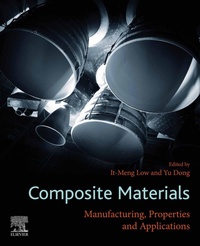
Composite Materials
Manufacturing, Properties and Applications
Published on 18. June 2021
688 pages
978-0-12-820879-3 (ISBN)
Description

Composite materials have been well developed to meet the challenges of high-performing material properties targeting engineering and structural applications. The ability of composite materials to absorb stresses and dissipate strain energy is vastly superior to that of other materials such as polymers and ceramics, and thus they offer engineers many mechanical, thermal, chemical and damage-tolerance advantages with limited drawbacks such as brittleness.
Composite Materials: Manufacturing, Properties and Applications presents a comprehensive review of current status and future directions, latest technologies and innovative work, challenges and opportunities for composite materials. The chapters present latest advances and comprehensive coverage of material types, design, fabrication, modelling, properties and applications from conventional composite materials to advanced composites such as nanocomposites, self-healing and smart composites. The book targets researchers in the field of advanced composite materials and ceramics, students of materials science and engineering at the postgraduate level, as well as material engineers and scientists working in industrial R& D sectors for composite material manufacturing.
- Comprehensive coverage of material types, design, fabrication, modelling, properties and applications from conventional composite materials to advanced composites such as nanocomposites, self-healing and smart composites
- Features latest advances in terms of mechanical properties and other material parameters which are essential for designers and engineers in the composite and composite reinforcement manufacturing industry, as well as all those with an academic research interest in the subject
- Offers a good platform for end users to refer to the latest technologies and topics fitting into specific applications and specific methods to tackle manufacturing or material processing issues in relation to different types of composite materials
More details
Other editions
Additional editions
Book
06/2021
Elsevier
€301.50
Shipment within 15-20 days
Content
Manufacturing
1. Futuristic synthesis strategies for aluminum-based metal-matrix composites2. Geopolymer composites modified with nanomaterials3. Advanced hybrid fiber-reinforced composites for high material performance4. 3-D printing composite materials: A comprehensive review5. Fiber composites of inorganic polymers (geopolymers) reinforced with natural fibers
Properties
6. Interphase and interfacial properties of composite materials7. Durability and life prediction of fiber-reinforced polymer composites8. Composites for structural strengthening, repair, rehabilitation, and retrofit9. Vinyl-ester composites reinforced with natural fibers and nanofillers10. Fracture mechanics of composites: Reinforcement of short carbon and glass fibers11. Mechanical properties of recycled polyethylene terephthalate (PET) fiber-reinforced fly ash geopolymer and fly ash-slag-blended geopolymer composites12. Thermal damage in carbon-fiber-reinforced polymer composites: A critical review13. Self-healing and self-sensing smart polymer composites14. Lightning strike damage on carbon fiber-reinforced composites: Prediction and protection15. Fire behavior and flame-retardant properties of application-oriented fiber-reinforced polymers (FRPs)
Applications
16. Advances in multistable composite structures and their applications17. Intelligent composite materials for use as sensors and actuators18. High-temperature superlubricity behaviors of ¿-Fe2O3@SiO2 nanocomposite coatings19. Polymeric composites for X-ray shielding applications20. Synthesis of nuclear-grade nano-sized boron carbide powders and its application in LDPE matrix composites for neutron shielding21. Shape memory polymer composites and their smart structural applications22. Analysis of architecture and performance of three-dimensional braided composites23. Biomass-derived porous carbon nanostructures for supercapacitor applications
