

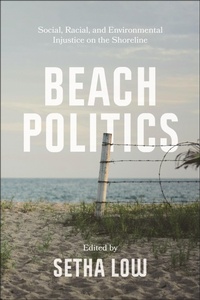
Beach Politics
Social, Racial, and Environmental Injustice on the Shoreline
Published on 21. January 2025
277 pages
978-1-4798-2196-9 (ISBN)
Description

Explores how elites restrict access to public beaches around the globe
Beaches are a beloved form of public space. Yet there has been an alarming global trend of restricting access to public sections of beaches to ensure that waterfront property owners can enjoy the shoreline exclusively or develop the land for commercial use.
Beach Politics examines how over the past forty years, privatization of public space has accelerated with the help of both local governments and national corporations. On a local level, this can entail a group of wealthy neighbors purposely blocking off public beach access in their neighborhood: hiring security guards, building fences, or putting up "No Trespassing" signs to turn away members of the public who have every right to be there. On a state or national level, it can manifest as gated communities owned by private corporations sectioning off huge swaths of land, limiting access, or governments promoting private, rather than public, development along the shoreline. Whenever disputes about land use arise, the powers that be often side with private interests and the wealthy over those with fewer resources and, frequently, people of color. With the continuing threat of climate change, decisions about how and where to harden or protect the shoreline often limits public use.
Focused on beaches, access to public space, and social justice, this book brings together powerful contributions illustrating how these issues are inextricably bound with socioeconomic status, racial segregation, and climate justice. Together they highlight how, through illegal actions and exclusionary legislation, the beach can be transformed from "a strip of nature" into a palimpsest of greed, racism, ecological disregard, and socioeconomic discrimination.
Beaches are a beloved form of public space. Yet there has been an alarming global trend of restricting access to public sections of beaches to ensure that waterfront property owners can enjoy the shoreline exclusively or develop the land for commercial use.
Beach Politics examines how over the past forty years, privatization of public space has accelerated with the help of both local governments and national corporations. On a local level, this can entail a group of wealthy neighbors purposely blocking off public beach access in their neighborhood: hiring security guards, building fences, or putting up "No Trespassing" signs to turn away members of the public who have every right to be there. On a state or national level, it can manifest as gated communities owned by private corporations sectioning off huge swaths of land, limiting access, or governments promoting private, rather than public, development along the shoreline. Whenever disputes about land use arise, the powers that be often side with private interests and the wealthy over those with fewer resources and, frequently, people of color. With the continuing threat of climate change, decisions about how and where to harden or protect the shoreline often limits public use.
Focused on beaches, access to public space, and social justice, this book brings together powerful contributions illustrating how these issues are inextricably bound with socioeconomic status, racial segregation, and climate justice. Together they highlight how, through illegal actions and exclusionary legislation, the beach can be transformed from "a strip of nature" into a palimpsest of greed, racism, ecological disregard, and socioeconomic discrimination.
Reviews / Votes
"There is no other book like Beach Politics, a welcome and long overdue contribution to scholarship on the politics and inequities of public space. Expansively interdisciplinary and global in scope, the chapters across this volume provide an unmatched exploration of the histories and political economies that shape, limit, privatize, regulate, racialize, and surveil transnational seashores from Argentina's urban beaches to South Africa's waterfront vacation spaces to Albuquerque's recreational lakes." - Karla Slocum, author of Black Towns, Black Futures: The Enduring Allure of a Black Place in the American West "Setha Low poignantly shows how beaches have often become terrains for confrontations over ownership and usage, inclusion or exclusion, and publicness versus privatization. Beach Politics tells a fascinating story: how abutting property owners, beach goers, community groups and planners, in the US and around the world, often tussle for control of "their" beach and how these "beach politics" truly represent struggles over democracy." - Anastasia Loukaitou-Sideris, Distinguished Professor of Urban Planning, UCLAMore details
Language
English
Place of publication
New York
United States
Target group
Professional and scholarly
Illustrations
26 b/w figures
ISBN-13
978-1-4798-2196-9 (9781479821969)
Copyright in bibliographic data and cover images is held by Nielsen Book Services Limited or by the publishers or by their respective licensors: all rights reserved.
Schweitzer Classification
Other editions
Additional editions
Book
01/2025
New York University Press
€36.00
Shipment within 10-20 days
Person
Setha Low is Distinguished Professor of Environmental Psychology, Geography, Anthropology, and Women's Studies, and Director of the Public Space Research Group at The Graduate Center, City University of New York.
She has been awarded a Getty Fellowship, a NEH fellowship, a Fulbright Senior Fellowship, a Future of Places Fellowship and a Guggenheim for her ethnographic research on public space in Latin America and the United States. Her most recent books are Spatializing Culture: The Ethnography of Space and Place, Anthropology and the City, Spaces of Security (with M. Maguire), and Why Public Space Matters.
She has been awarded a Getty Fellowship, a NEH fellowship, a Fulbright Senior Fellowship, a Future of Places Fellowship and a Guggenheim for her ethnographic research on public space in Latin America and the United States. Her most recent books are Spatializing Culture: The Ethnography of Space and Place, Anthropology and the City, Spaces of Security (with M. Maguire), and Why Public Space Matters.
