

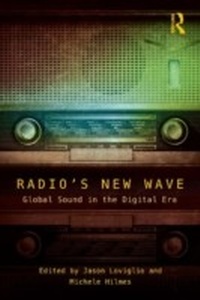
Radio's New Wave
Global Sound in the Digital Era
1st Edition
Published on 19. June 2013
232 pages
978-1-136-44631-3 (ISBN)
Description

Radio's New Wave explores the evolution of audio media and sound scholarship in the digital age. Extending and updating the focus of their widely acclaimed 2001 book The Radio Reader, Hilmes and Loviglio gather together innovative work by both established and rising scholars to explore the ways that radio has transformed in the digital environment. Contributors explore what sound looks like on screens, how digital listening moves us, new forms of sonic expression, radio's convergence with mobile media, and the creative activities of old and new audiences. Even radio's history has been altered by research made possible by digital and global convergence. Together, these twelve concise chapters chart the dissolution of radio's boundaries and its expansion to include a wide-ranging universe of sound, visuals, tactile interfaces, and cultural roles, as radio rides the digital wave into its second century.
Reviews / Votes
"With its lineup of first-rate scholars, Radio's New Wave provocatively explores how digital technologies, from podcasts to web-based radio to listening in on one's cell phone, have transformed radio, sound, and the very act of listening itself-indeed our aural environment-in the 2.0 era. Radio's New Wave argues, wonderfully, that we move beyond the notion of radio as a device, or a national industry, and instead conceive of it as producing and requiring 'soundwork' across a wide range of platforms, boundaries, and eras. Smart, sophisticated, and cutting edge, Radio's New Wave further establishes radio studies as absolutely central to 21st century scholarship." -Susan J. Douglas, The University of Michigan, author of Listening In: Radio and the American Imagination"Once bound by a clearly delineated set of devices, industries and practices, radio has proliferated across platforms, standards, and devices. Taking advantage of radio's new digital condition, Jason Loviglio and Michele Hilmes have assembled an impressive collection of essays by leading scholars in the field. Imaginative and ambitious in its conception, mindful of radio's intellectual history but unburdened by it, Radio's New Wave takes advantage of newly available digital resources and new contexts to tell radio's past and retell its present. Transnational, transhistorical, and transdisciplinary in scope, Radio's New Wave is essential reading for scholars in radio studies, sound studies, and media and cultural studies." -Jonathan Sterne, McGill University, author of MP3: The Meaning of a Format and editor of The Sound Studies Reader
"This stimulating and provocative collection of essays shows brilliantly why radio continues to be relevant, not just to our study of media and communication but for our broader understanding of the events and trends of contemporary history. Through a careful balance of 'big picture' analyses of radio's ever-changing landscape and smaller, more-focused case-studies, it demonstrates the enormous variety and vitality of radio, allowing us to think about it afresh. Radio's New Wave shatters once and for all those old notions of radio as an ephemeral, non-visual, and nation-bound medium. It replaces them with a sense of something more protean and strange-a cultural phenomenon that's now searchable, utterly material, and constantly challenging geographical and definitional boundaries." -David Hendy, University of Sussex, author of Noise: A Human History of Sound and Listening
More details
Language
English
Place of publication
London
United Kingdom
Publishing group
Taylor & Francis Ltd
Target group
College/higher education
File size
6,40 MB
ISBN-13
978-1-136-44631-3 (9781136446313)
Copyright in bibliographic data and cover images is held by Nielsen Book Services Limited or by the publishers or by their respective licensors: all rights reserved.
Schweitzer Classification
Other editions
Additional editions
Book
05/2013
1st Edition
Routledge
€76.80
Shipment within 15-20 days
Book
05/2013
1st Edition
Routledge
€241.80
Shipment within 15-20 days
Persons
Michele Hilmes is Professor of Media and Cultural Studies at the University of Wisconsin, Madison. She is the author or editor of several books on broadcasting, including Radio Voices: American Broadcasting 1922 to 1952, Network Nations: A Transnational History of British and American Broadcasting, and The Radio Reader: Essays in the Cultural History of Radio (with Jason Loviglio).
Jason Loviglio is Associate Professor and Director of Media and Communication Studies at the University of Maryland, Baltimore County. He is the author of Radio's Intimate Public: Network Broadcasting and Mass-Mediated Communication and co-editor (with Michele Hilmes) of The Radio Reader: Essays in the Cultural History of Radio.
Jason Loviglio is Associate Professor and Director of Media and Communication Studies at the University of Maryland, Baltimore County. He is the author of Radio's Intimate Public: Network Broadcasting and Mass-Mediated Communication and co-editor (with Michele Hilmes) of The Radio Reader: Essays in the Cultural History of Radio.
Content
"Introduction: Making Radio Strange" Jason Loviglio and Michele Hilmes Section 1: The Digital Soundscape 1. "Listening in the Digital Age" Kate Lacey 2. "Public Radio in Crisis" Jason Loviglio 3. "The New Materiality of Radio: Sound on Screens" Michele Hilmes 4. "The Past and Future of Music Listening: Between Freeform DJs and Recommendation Algorithms" Elena Razlogova Section 2: Radio's New Sounds 5. "Youth, New Media, and Radio: Mobile Phone and Local Radio Convergence in Turkey" Ece Algan 6. "Listening to Race and Migration on Contemporary U.S. Spanish-language Radio" Dolores Ines Casillas 7. "Voices Made For Print": Crip Voices on the Radio" Bill Kirkpatrick 8. "'Your Ears are a Portal to Another World': The New Radio Documentary Imagination and the Digital Domain" Virginia Madsen Section 3: Radio's New Histories 9. "El Octopus Acustico: Broadcasting and Empire in the Caribbean" Alejandra Bronfman 10. "Portia Faces the World: Rewriting and Revoicing American Radio for an International Market" Susan Smulyan and David Goodman 11. "Sounds from the Life of the Future: Making Sense of U.S. Radio Broadcasting in France, 1921-1940" Derek Vaillant 12. "Tick Tock Goes the Musical Clock: Time Discipline and Early Morning Radio Programs" Alexander Russo
