

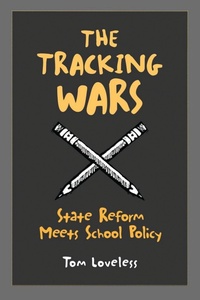
The Tracking Wars
State Reform Meets School Policy
1st Edition
Published on 1. October 2011
194 pages
978-0-8157-2021-8 (ISBN)
Description

In the 1980s, a nationwide reform movement sprang up in opposition to ""tracking,"" the controversial practice of schools grouping students by ability and organizing curriculum by level of difficulty. Officials in two states, Massachusetts and California, adopted policies urging middle schools to reduce or abandon tracking. In this book, Tom Loveless describes how schools reacted to these recommendations and discusses why some schools went along with detracking while others bitterly resisted the reform. Loveless explains that the state policies were adopted without strict mandates, financial incentives, legal threats, or new bureaucratic structures. They were also adopted without convincing evidence that detracking brings lasting benefits to students. But advocates framed tracking reform as a policy supporting greater educational equity. In response, urban schools, low-achieving schools, and schools serving disadvantaged children have reacted sympathetically to the reform. Suburban schools, high-achieving schools, and schools serving wealthier families have been less willing to detrack. Drawing on extensive survey and case study data, Loveless concludes that this reform's fate is in the hands of local decisionmakers. Schools formulate tracking policy based on their own institutional, organizational, political, and technical considerations. All school reform entails risks. One troubling implication of this study is that the risks of detracking are being assumed by schools with some of society's most vulnerable youngsters.
More details
Edition
1. Auflage
Language
English
Place of publication
DC
United States
ISBN-13
978-0-8157-2021-8 (9780815720218)
Copyright in bibliographic data and cover images is held by Nielsen Book Services Limited or by the publishers or by their respective licensors: all rights reserved.
Schweitzer Classification
Other editions
Additional editions
Book
07/1999
Brookings Institution
€75.74
Article exhausted; check different version
Person
Tom Loveless is director of the Brown Center on Education Policy and senior fellow in the Governance Studies program at the Brookings Institution. He is the author of the annual Brown Center Reports on American Education.
Content
- Cover
- Contents
- 1. Implementing Tracking Reform
- 2. The Origins of Tracking Reform
- Conflicting Orientations
- What Is the Evidence?
- Agenda Setting
- Keeping Track
- Antitracking Politics and Detracking Policies
- Summary and Conclusion
- 3. The Schools Respond
- Data
- Untracking in the Schools
- Why Some Schools Track and Others Detrack: The UCLA Project's Explanation
- An Alternative Framework
- Summary and Conclusion
- 4. Influences on Tracking Policy
- Comparing Tracked and Untracked Schools
- Modeling the Influences on Tracking Policy
- Institutional Characteristics of Schools
- The Technical Challenge of Heterogeneity
- The Organizational Characteristics of Schools
- Political Influences
- Summary and Conclusion
- 5. Governing Reform
- Educational Governance in the Two States: A Brief History
- The State Role in Tracking Policy
- Districts and Schools Sharing Authority
- Modeling the Source of Tracking Policy
- When Policies Collide: Creekside and Parkview Schools
- Summary and Conclusion
- 6. Tracking and the Subject Area
- Subject Area Subsystems
- Subject Areas and Tracking
- Tracking in English and Math
- Middle School Subjects as Part of a Discipline
- Middle School Subjects as Part of a K-12 Curricular System
- Middle School Departments as Bureaucratic Actors
- A Math Department Rebellion: Hillcrest Middle School
- Summary and Conclusion
- 7. The Classroom, the Teacher, and Tracking Reform
- Sifting Reform
- What Is Different about Untracked Classes?
- Alternative Instructional Strategies
- Unanswered Questions from the Classroom
- Different Philosophies, Different Policies: Meadowview Middle School
- Summary and Conclusion
- 8. The Fate of Reform
- Implementing Tracking Reform
- Casting Doubt on the Prevailing Explanation of Tracking
- The Future of Tracking Policy and Research
- Appendixes
- A. The Study's Methods and Data
- B. Statistical Issues in Chapter 4
- Notes
- Index
- A
- B
- C
- D
- E
- F
- G
- H
- I
- J
- K
- L
- M
- N
- O
- P
- R
- S
- T
- U
- V
- W
- Y
