

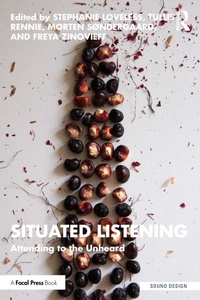
Situated Listening
Attending to the Unheard
1st Edition
Published on 4. June 2025
316 pages
978-1-040-36000-2 (ISBN)
Description

Grounded in a conviction that how we listen matters deeply in the context of ongoing social, political, and ecological crises, Situated Listening: Attending to the Unheard sets forth a collection of methodologies and creative proposals for listening, advancing the framework of situated listening as both a theoretical concept and a methodological practice that investigates relationships between the listening body and the politics of place, space, and culture.
Drawing from an array of scholarship that engages sound studies broadly, this 15-chapter book is written entirely collaboratively and from a multidisciplinary perspective. Each section includes scores for situated listening, which take the form of diagrams, instructions, exercises, images, and meditations. The scores offer alternate modes of sharing the central ideas of the associated chapters, inviting the reader to shift from theory into practice. This book contributes to decolonial, feminist, anti-racist, and anti-capitalist scholarship in the field of sound studies, by centering listening as a relational practice.
This book brings together a roster of accomplished, international contributors, making it essential supplementary reading for advanced undergraduates and researchers in sound studies. It will be of interest to faculty and students in the fields of Sound Studies, Music, Feminist Science and Technology Studies, Urban Design, and Sound Art.
Drawing from an array of scholarship that engages sound studies broadly, this 15-chapter book is written entirely collaboratively and from a multidisciplinary perspective. Each section includes scores for situated listening, which take the form of diagrams, instructions, exercises, images, and meditations. The scores offer alternate modes of sharing the central ideas of the associated chapters, inviting the reader to shift from theory into practice. This book contributes to decolonial, feminist, anti-racist, and anti-capitalist scholarship in the field of sound studies, by centering listening as a relational practice.
This book brings together a roster of accomplished, international contributors, making it essential supplementary reading for advanced undergraduates and researchers in sound studies. It will be of interest to faculty and students in the fields of Sound Studies, Music, Feminist Science and Technology Studies, Urban Design, and Sound Art.
Reviews / Votes
'Situated Listening is a robust theoretical and methodological guide for building situated sonic knowledges. Through diverse and collaborative conversations and co-narratives, the volume offers new insights on the listening body, the sonic politics of place, space, and culture, and how human and technological biases inform what is heard and unheard.'Milena Droumeva, Glenfraser Endowed Professor in Sound Studies, SFU
'This book writes listening in collective but myriad lines that challenge us not to hear but to imagine within its plural and collaborative approach a future of infinite voices, in contradictory co-presence, without chapter breaks, making the indivisible simultaneity of sound heard.'
Salome Voegelin, Professor of Sound, University of the Arts London
'Spanning a range of cultural contexts and epistemic concerns, Situated Listening convincingly argues for greater critical engagement with listening. This includes an examination of the structural inequalities often impacting aurality as well as how listening itself may impose forms of harm. Through an emphasis on collaborative writing from a diversity of contributors, Situated Listening raises the volume on the importance of listening studies.'
Brandon LaBelle, Artistic Director, The Listening Biennial
More details
Series
Edition
1. Auflage
Language
English
Place of publication
Oxford
United Kingdom
Publishing group
Taylor & Francis Ltd
Target group
College/higher education
Illustrations
2 Tables, black and white; 6 Line drawings, black and white; 12 Halftones, black and white; 18 Illustrations, black and white
File size
5,53 MB
ISBN-13
978-1-040-36000-2 (9781040360002)
Copyright in bibliographic data and cover images is held by Nielsen Book Services Limited or by the publishers or by their respective licensors: all rights reserved.
Schweitzer Classification
Other editions
Additional editions
Book
06/2025
1st Edition
Focal Press
€63.80
Shipment within 10-20 days
Book
06/2025
1st Edition
Focal Press
€208.20
Shipment within 10-20 days
Persons
Stephanie Loveless is a media artist whose research centres on practices of listening. She is senior lecturer in Arts, Director of the Center for Deep Listening at Rensselaer Polytechnic Institute, and editor of A Year of Deep Listening: 365 Text Scores for Pauline Oliveros.
Tullis Rennie is a composer, improviser, recordist, and researcher in socially engaged sound practices. His creative work encompasses audio composition, installation, participative community projects, and live/improvised performances presented in over 20 countries. He is senior lecturer in Music at City St George's, University of London.
Morten Sondergaard is an internationally acclaimed curator and Associate Professor at Aalborg University, Denmark. He is the head curator at Momentum Biennial 2025 and founder of the conference series POM - Politics of the Machines. He has published on sound- and media art and curated exhibitions including ZKM, Eyebeam, and Roskilde.
Freya Zinovieff is a sound artist, researcher, and curator. Freya's research covers the intersections of sound, violence, ethics, and activism. Freya holds a PhD from Simon Fraser University, a First-Class Honours degree from Cambridge School of Art at Anglia Ruskin University, and an MFA from the University of New South Wales, Sydney.
Tullis Rennie is a composer, improviser, recordist, and researcher in socially engaged sound practices. His creative work encompasses audio composition, installation, participative community projects, and live/improvised performances presented in over 20 countries. He is senior lecturer in Music at City St George's, University of London.
Morten Sondergaard is an internationally acclaimed curator and Associate Professor at Aalborg University, Denmark. He is the head curator at Momentum Biennial 2025 and founder of the conference series POM - Politics of the Machines. He has published on sound- and media art and curated exhibitions including ZKM, Eyebeam, and Roskilde.
Freya Zinovieff is a sound artist, researcher, and curator. Freya's research covers the intersections of sound, violence, ethics, and activism. Freya holds a PhD from Simon Fraser University, a First-Class Honours degree from Cambridge School of Art at Anglia Ruskin University, and an MFA from the University of New South Wales, Sydney.
Content
Part 1: Methodologies of Listening 1. Listening to Noise: Lines of Affinity and Feminist Sono-Techno-Political artivisms from the South 2. Listening to our Listening: Deep Listening in Critical Sites 3. Unlistening 4. Listening With, or the Impossibility of Inhabiting Another's Ears 5. The weak power of listening: a conversation between Ayreen Anastas, Rene Gabri and Rolando Vazquez Part 2: Apparatuses of Listening 6. Audible Ghosts 7. Technologies, Precariousness and Coloniality 8. Addressing Deep Code Problems: Listening to Opera Through the World's Liveness 9. Endarkened Listening 10. Amplified States: Listening as Coming to Know Part 3: Cultures of Situated Listening 11. The Sound of Hate: White Nationalist Epistemology and Neo Nazi Nation Building on Telegram 12. Mythic Sonic Beings: A Multitrack Conversation 13. The Sonic Sensorium. Listening with the un(der)heard 14. Transperceptive Listening: Sonic Meditations for a Pluriverse 15. Collaborative composition: An exchange of sounding
