

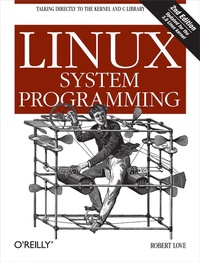
Linux System Programming
Talking Directly to the Kernel and C Library
Published on 14. May 2013
456 pages
978-1-4493-4153-4 (ISBN)
Description

Write software that draws directly on services offered by the Linux kernel and core system libraries. With this comprehensive book, Linux kernel contributor Robert Love provides you with a tutorial on Linux system programming, a reference manual on Linux system calls, and an insiders guide to writing smarter, faster code.Love clearly distinguishes between POSIX standard functions and special services offered only by Linux. With a new chapter on multithreading, this updated and expanded edition provides an in-depth look at Linux from both a theoretical and applied perspective over a wide range of programming topics, including:A Linux kernel, C library, and C compiler overviewBasic I/O operations, such as reading from and writing to filesAdvanced I/O interfaces, memory mappings, and optimization techniquesThe family of system calls for basic process managementAdvanced process management, including real-time processesThread concepts, multithreaded programming, and PthreadsFile and directory managementInterfaces for allocating memory and optimizing memory accessBasic and advanced signal interfaces, and their role on the systemClock management, including POSIX clocks and high-resolution timers
More details
Other editions
Additional editions
Book
07/2013
2nd Edition
O'Reilly
€69.50
Shipment within 10-20 days
Content
- Intro
- Copyright
- Table of Contents
- Foreword
- Preface
- Audience and Assumptions
- Contents of This Book
- Versions Covered in This Book
- Conventions Used in This Book
- Using Code Examples
- Safari® Books Online
- How to Contact Us
- Acknowledgments
- Chapter 1. Introduction and Essential Concepts
- System Programming
- Why Learn System Programming
- Cornerstones of System Programming
- System Calls
- The C Library
- The C Compiler
- APIs and ABIs
- APIs
- ABIs
- Standards
- POSIX and SUS History
- C Language Standards
- Linux and the Standards
- This Book and the Standards
- Concepts of Linux Programming
- Files and the Filesystem
- Processes
- Users and Groups
- Permissions
- Signals
- Interprocess Communication
- Headers
- Error Handling
- Getting Started with System Programming
- Chapter 2. File I/O
- Opening Files
- The open() System Call
- Owners of New Files
- Permissions of New Files
- The creat() Function
- Return Values and Error Codes
- Reading via read()
- Return Values
- Reading All the Bytes
- Nonblocking Reads
- Other Error Values
- Size Limits on read()
- Writing with write()
- Partial Writes
- Append Mode
- Nonblocking Writes
- Other Error Codes
- Size Limits on write()
- Behavior of write()
- Synchronized I/O
- fsync() and fdatasync()
- sync()
- The O_SYNC Flag
- O_DSYNC and O_RSYNC
- Direct I/O
- Closing Files
- Error Values
- Seeking with lseek()
- Seeking Past the End of a File
- Error Values
- Limitations
- Positional Reads and Writes
- Error Values
- Truncating Files
- Multiplexed I/O
- select()
- poll()
- poll() Versus select()
- Kernel Internals
- The Virtual Filesystem
- The Page Cache
- Page Writeback
- Conclusion
- Chapter 3. Buffered I/O
- User-Buffered I/O
- Block Size
- Standard I/O
- File Pointers
- Opening Files
- Modes
- Opening a Stream via File Descriptor
- Closing Streams
- Closing All Streams
- Reading from a Stream
- Reading a Character at a Time
- Reading an Entire Line
- Reading Binary Data
- Writing to a Stream
- Writing a Single Character
- Writing a String of Characters
- Writing Binary Data
- Sample Program Using Buffered I/O
- Seeking a Stream
- Obtaining the Current Stream Position
- Flushing a Stream
- Errors and End-of-File
- Obtaining the Associated File Descriptor
- Controlling the Buffering
- Thread Safety
- Manual File Locking
- Unlocked Stream Operations
- Critiques of Standard I/O
- Conclusion
- Chapter 4. Advanced File I/O
- Scatter/Gather I/O
- readv() and writev()
- Event Poll
- Creating a New Epoll Instance
- Controlling Epoll
- Waiting for Events with Epoll
- Edge- Versus Level-Triggered Events
- Mapping Files into Memory
- mmap()
- munmap()
- Mapping Example
- Advantages of mmap()
- Disadvantages of mmap()
- Resizing a Mapping
- Changing the Protection of a Mapping
- Synchronizing a File with a Mapping
- Giving Advice on a Mapping
- Advice for Normal File I/O
- The posix_fadvise() System Call
- The readahead() System Call
- Advice Is Cheap
- Synchronized, Synchronous, and Asynchronous Operations
- Asynchronous I/O
- I/O Schedulers and I/O Performance
- Disk Addressing
- The Life of an I/O Scheduler
- Helping Out Reads
- Selecting and Configuring Your I/O Scheduler
- Optimzing I/O Performance
- Conclusion
- Chapter 5. Process Management
- Programs, Processes, and Threads
- The Process ID
- Process ID Allocation
- The Process Hierarchy
- pid_t
- Obtaining the Process ID and Parent Process ID
- Running a New Process
- The Exec Family of Calls
- The fork() System Call
- Terminating a Process
- Other Ways to Terminate
- atexit()
- on_exit()
- SIGCHLD
- Waiting for Terminated Child Processes
- Waiting for a Specific Process
- Even More Waiting Versatility
- BSD Wants to Play: wait3() and wait4()
- Launching and Waiting for a New Process
- Zombies
- Users and Groups
- Real, Effective, and Saved User and Group IDs
- Changing the Real or Saved User or Group ID
- Changing the Effective User or Group ID
- Changing the User and Group IDs, BSD Style
- Changing the User and Group IDs, HP-UX Style
- Preferred User/Group ID Manipulations
- Support for Saved User IDs
- Obtaining the User and Group IDs
- Sessions and Process Groups
- Session System Calls
- Process Group System Calls
- Obsolete Process Group Functions
- Daemons
- Conclusion
- Chapter 6. Advanced Process Management
- Process Scheduling
- Timeslices
- I/O- Versus Processor-Bound Processes
- Preemptive Scheduling
- The Completely Fair Scheduler
- Yielding the Processor
- Legitimate Uses
- Process Priorities
- nice()
- getpriority() and setpriority()
- I/O Priorities
- Processor Affinity
- sched_getaffinity() and sched_setaffinity()
- Real-Time Systems
- Hard Versus Soft Real-Time Systems
- Latency, Jitter, and Deadlines
- Linux's Real-Time Support
- Linux Scheduling Policies and Priorities
- Setting Scheduling Parameters
- sched_rr_get_interval()
- Precautions with Real-Time Processes
- Determinism
- Resource Limits
- The Limits
- Setting and Retrieving Limits
- Chapter 7. Threading
- Binaries, Processes, and Threads
- Multithreading
- Costs of Multithreading
- Alternatives to Multithreading
- Threading Models
- User-Level Threading
- Hybrid Threading
- Coroutines and Fibers
- Threading Patterns
- Thread-per-Connection
- Event-Driven Threading
- Concurrency, Parallelism, and Races
- Race Conditions
- Synchronization
- Mutexes
- Deadlocks
- Pthreads
- Linux Threading Implementations
- The Pthread API
- Linking Pthreads
- Creating Threads
- Thread IDs
- Terminating Threads
- Joining and Detaching Threads
- A Threading Example
- Pthread Mutexes
- Further Study
- Chapter 8. File and Directory Management
- Files and Their Metadata
- The Stat Family
- Permissions
- Ownership
- Extended Attributes
- Extended Attribute Operations
- Directories
- The Current Working Directory
- Creating Directories
- Removing Directories
- Reading a Directory's Contents
- Links
- Hard Links
- Symbolic Links
- Unlinking
- Copying and Moving Files
- Copying
- Moving
- Device Nodes
- Special Device Nodes
- The Random Number Generator
- Out-of-Band Communication
- Monitoring File Events
- Initializing inotify
- Watches
- inotify Events
- Advanced Watch Options
- Removing an inotify Watch
- Obtaining the Size of the Event Queue
- Destroying an inotify Instance
- Chapter 9. Memory Management
- The Process Address Space
- Pages and Paging
- Memory Regions
- Allocating Dynamic Memory
- Allocating Arrays
- Resizing Allocations
- Freeing Dynamic Memory
- Alignment
- Managing the Data Segment
- Anonymous Memory Mappings
- Creating Anonymous Memory Mappings
- Mapping /dev/zero
- Advanced Memory Allocation
- Fine-Tuning with malloc_usable_size() and malloc_trim()
- Debugging Memory Allocations
- Obtaining Statistics
- Stack-Based Allocations
- Duplicating Strings on the Stack
- Variable-Length Arrays
- Choosing a Memory Allocation Mechanism
- Manipulating Memory
- Setting Bytes
- Comparing Bytes
- Moving Bytes
- Searching Bytes
- Frobnicating Bytes
- Locking Memory
- Locking Part of an Address Space
- Locking All of an Address Space
- Unlocking Memory
- Locking Limits
- Is a Page in Physical Memory?
- Opportunistic Allocation
- Overcommitting and OOM
- Chapter 10. Signals
- Signal Concepts
- Signal Identifiers
- Signals Supported by Linux
- Basic Signal Management
- Waiting for a Signal, Any Signal
- Examples
- Execution and Inheritance
- Mapping Signal Numbers to Strings
- Sending a Signal
- Permissions
- Examples
- Sending a Signal to Yourself
- Sending a Signal to an Entire Process Group
- Reentrancy
- Guaranteed-Reentrant Functions
- Signal Sets
- More Signal Set Functions
- Blocking Signals
- Retrieving Pending Signals
- Waiting for a Set of Signals
- Advanced Signal Management
- The siginfo_t Structure
- The Wonderful World of si_code
- Sending a Signal with a Payload
- Signal Payload Example
- A Flaw in Unix?
- Chapter 11. Time
- Time's Data Structures
- The Original Representation
- And Now, Microsecond Precision
- Even Better: Nanosecond Precision
- Breaking Down Time
- A Type for Process Time
- POSIX Clocks
- Time Source Resolution
- Getting the Current Time of Day
- A Better Interface
- An Advanced Interface
- Getting the Process Time
- Setting the Current Time of Day
- Setting Time with Precision
- An Advanced Interface for Setting the Time
- Playing with Time
- Tuning the System Clock
- Sleeping and Waiting
- Sleeping with Microsecond Precision
- Sleeping with Nanosecond Resolution
- An Advanced Approach to Sleep
- A Portable Way to Sleep
- Overruns
- Alternatives to Sleeping
- Timers
- Simple Alarms
- Interval Timers
- Advanced Timers
- Appendix A. GCC Extensions to the C Language
- GNU C
- Inline Functions
- Suppressing Inlining
- Pure Functions
- Constant Functions
- Functions That Do Not Return
- Functions That Allocate Memory
- Forcing Callers to Check the Return Value
- Marking Functions as Deprecated
- Marking Functions as Used
- Marking Functions or Parameters as Unused
- Packing a Structure
- Increasing the Alignment of a Variable
- Placing Global Variables in a Register
- Branch Annotation
- Getting the Type of an Expression
- Getting the Alignment of a Type
- The Offset of a Member Within a Structure
- Obtaining the Return Address of a Function
- Case Ranges
- Void and Function Pointer Arithmetic
- More Portable and More Beautiful in One Fell Swoop
- Appendix B. Bibliography
- Books on the C Programming Language
- Books on Linux Programming
- Books on the Linux Kernel
- Books on Operating System Design
- Index
- About the Author
