

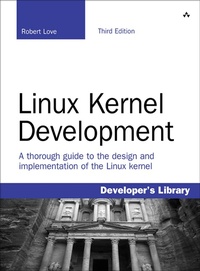
Linux Kernel Development
3rd Edition
Published on 14. December 2018
480 pages
978-0-7686-9678-3 (ISBN)
Description

Linux Kernel Development details the design and implementation of the Linux kernel, presenting the content in a manner that is beneficial to those writing and developing kernel code, as well as to programmers seeking to better understand the operating system and become more efficient and productive in their coding.
The book details the major subsystems and features of the Linux kernel, including its design, implementation, and interfaces. It covers the Linux kernel with both a practical and theoretical eye, which should appeal to readers with a variety of interests and needs.
The author, a core kernel developer, shares valuable knowledge and experience on the 2.6 Linux kernel. Specific topics covered include process management, scheduling, time management and timers, the system call interface, memory addressing, memory management, the page cache, the VFS, kernel synchronization, portability concerns, and debugging techniques. This book covers the most interesting features of the Linux 2.6 kernel, including the CFS scheduler, preemptive kernel, block I/O layer, and I/O schedulers.
The third edition of Linux Kernel Development includes new and updated material throughout the book:
An all-new chapter on kernel data structures
Details on interrupt handlers and bottom halves
Extended coverage of virtual memory and memory allocation
Tips on debugging the Linux kernel
In-depth coverage of kernel synchronization and locking
Useful insight into submitting kernel patches and working with the Linux kernel community
The book details the major subsystems and features of the Linux kernel, including its design, implementation, and interfaces. It covers the Linux kernel with both a practical and theoretical eye, which should appeal to readers with a variety of interests and needs.
The author, a core kernel developer, shares valuable knowledge and experience on the 2.6 Linux kernel. Specific topics covered include process management, scheduling, time management and timers, the system call interface, memory addressing, memory management, the page cache, the VFS, kernel synchronization, portability concerns, and debugging techniques. This book covers the most interesting features of the Linux 2.6 kernel, including the CFS scheduler, preemptive kernel, block I/O layer, and I/O schedulers.
The third edition of Linux Kernel Development includes new and updated material throughout the book:
An all-new chapter on kernel data structures
Details on interrupt handlers and bottom halves
Extended coverage of virtual memory and memory allocation
Tips on debugging the Linux kernel
In-depth coverage of kernel synchronization and locking
Useful insight into submitting kernel patches and working with the Linux kernel community
More details
Series
Edition
3rd edition
Language
English
Place of publication
United States
Publishing group
Pearson Education (US)
Target group
Professional and scholarly
File size
3,51 MB
ISBN-13
978-0-7686-9678-3 (9780768696783)
Copyright in bibliographic data and cover images is held by Nielsen Book Services Limited or by the publishers or by their respective licensors: all rights reserved.
Schweitzer Classification
Other editions
Additional editions
Robert Love
Linux Kernel Development
Book
07/2010
3rd Edition
Addison Wesley
€49.49
Shipment within 10-20 days
Person
Robert Love is an open source programmer, speaker, and author who has been using and contributing to Linux for more than 15 years. He is currently senior software engineer at Google, where he was a member of the team that developed the Android mobile platform's kernel. Prior to Google, he was Chief Architect, Linux Desktop, at Novell. Before Novell, he was a kernel engineer at MontaVista Software and Ximian.
?
Love's kernel projects include the preemptive kernel, the process scheduler, the kernel events layer, inotify,VM enhancements, and several device drivers.
?
He has given numerous talks on and has written multiple articles about the Linux kernel and is a contributing editor for Linux Journal. His other books include Linux System Programming and Linux in a Nutshell.
?
Love's kernel projects include the preemptive kernel, the process scheduler, the kernel events layer, inotify,VM enhancements, and several device drivers.
?
He has given numerous talks on and has written multiple articles about the Linux kernel and is a contributing editor for Linux Journal. His other books include Linux System Programming and Linux in a Nutshell.
Content
1 Introduction to the Linux Kernel
2 Getting Started with the Kernel
3 Process Management
4 Process Scheduling
5 System Calls
6 Kernel Data Structures
7 Interrupts and Interrupt Handlers
8 Bottom Halves and Deferring Work
9 An Introduction to Kernel Synchronization
10 Kernel Synchronization Methods
11 Timers and Time Management
12 Memory Management
13 The Virtual Filesystem
14 The Block I/O Layer
15 The Process Address Space
16 The Page Cache and Page Writeback
17 Devices and Modules
18 Debugging
19 Portability
20 Patches, Hacking, and the Community
2 Getting Started with the Kernel
3 Process Management
4 Process Scheduling
5 System Calls
6 Kernel Data Structures
7 Interrupts and Interrupt Handlers
8 Bottom Halves and Deferring Work
9 An Introduction to Kernel Synchronization
10 Kernel Synchronization Methods
11 Timers and Time Management
12 Memory Management
13 The Virtual Filesystem
14 The Block I/O Layer
15 The Process Address Space
16 The Page Cache and Page Writeback
17 Devices and Modules
18 Debugging
19 Portability
20 Patches, Hacking, and the Community
