

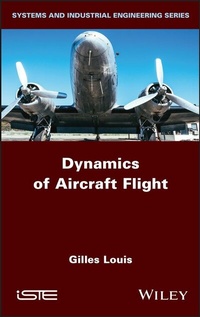
Dynamics of Aircraft Flight
Description

The corresponding consumption must then be defined. Performance specifications for customer aircraft, such as manoeuvrability, fuel consumption, maintenance, safety and testability, have become ever more demanding with each generation of equipment. Major technical advances have been required: wing profiles, engines, materials to reduce mass, etc. This book presents a theoretical approach to flight mechanics that makes it possible to grasp the subject and links it with the empirical approach of manufacturers.
Gilles Louis is an engineer at Polytech Nancy, France, and currently works for Thalès AVS.
More details
Other editions
Additional editions
Person
Content
Foreword xi
Serge ZANINOTTI
Introduction xiii
Chapter 1 Use of Aerodynamic Forces to Control the Trajectory of an Aircraft 1
1.1 Definitions 1
1.1.1 Lift 3
1.1.2 Drag 4
1.1.3 Equilibrium in horizontal flight 7
1.1.4 Aerodynamic moments8
1.1.5 Center of gravity8
1.1.6 Aerodynamic center9
1.1.7 Center of thrust 10
1.1.8 Centering and stability 10
1.1.9 Lateral stability 11
1.1.10 Turn and roll 11
1.1.11 Load factor 12
1.2 Pitch control 13
1.3 Yaw control 15
1.4 Roll control 17
1.5 The Mach: subsonic, transonic and supersonic speeds 18
Chapter 2 Aerodynamic Forces and Moments and their Derivatives 21
2.1 Definitions 21
2.2 Aerodynamic forces 22
2.2.1 Drag expression 22
2.2.2 Expression of lateral lift24
2.2.3 Expression of lift25
2.3 Aerodynamic moments 25
2.4 Major aerodynamic derivatives26
Chapter 3 Wind Tunnel 27
3.1 Description of wind tunnel tests27
3.2 Stall 28
3.3 Calculation of the maximum stress applied to an aircraft wing in a wind tunnel 30
3.3.1 Definition of the drag coefficient from the flow tables 30
3.3.2 Calculation of the maximum stress applied to an aircraft wing in a wind tunnel 31
Chapter 4 Trihedron 33
4.1 Writing convention 33
4.2 Definitions of trihedrons33
4.2.1 Definition of a trihedron or frame of reference 33
4.2.2 Galilean trihedron34
4.2.3 Absolute trihedron 34
4.2.4 Local geographic trihedron35
4.2.5 Terrestrial trihedron35
4.2.6 Aircraft trihedron35
4.2.7 Aircraft aerodynamic speed trihedron (G, Xvae, Yvae, Zvae) 36
4.2.8 Balance trihedron36
4.3 Change of reference 36
4.4 Relation between trihedra 39
4.4.1 Aircraft trihedron (G, X1, Y1, Z1) with respect to the reference trihedron (G, X0, Y0, Z0) 39
4.4.2 Aerodynamic trihedron of the aircraft (G, Xva, Yva, Zva) with respect to the aircraft trihedron (G, Xe, Ye, Ze) 40
4.5 Relative positions of the various trihedra40
4.5.1 Position of the aircraft trihedron with respect to the local geographical trihedron 40
4.5.2 Position of the aerodynamic trihedron with respect to the terrestrial trihedron 43
4.5.3 Position of the aircraft trihedron in relation to the aerodynamic speed trihedron 46
4.5.4 Position of the aircraft trihedron in relation to the balance trihedron 48
4.5.5 Position of the terrestrial trihedron in relation to the local geographic trihedron 50
Chapter 5 Movement of a Solid 53
5.1 Rotation of a solid around a fixed point 53
5.2 Kinematics of a solid57
5.3 Reference framework60
5.3.1 Absolute reference 60
5.3.2 Relative reference60
5.3.3 Drive movement61
5.3.4 Goal 61
5.3.5 Change of reference framework 61
5.3.6 Change of reference: conclusion and summary 67
5.4 Components of the instantaneous velocity vector of the aircraft reference (O, ie, je, ke)E with respect to the local geographic reference (O, ilgt, jlgt, klgt)LGT in the aircraft reference 70
5.5 Equations of accelerations and forces in the aircraft frame (O, ie, je, ke)E 74
5.6 Determination of load factors in the aircraft reference (O, ie, je, ke)E 77
5.7 Case where the speeds and accelerations are provided at a point other than G77
5.8 Coordinates of the aerodynamic speed in aircraft axes 79
5.9 Equations of moments in the aircraft frame (O, ie, je, ke)E 80
5.10 Forces and moments applied to the aircraft85
5.10.1 Force of gravity85
5.10.2 Forces and moments of propulsion 86
5.10.3 Aerodynamic forces and moments 86
5.10.4 Forces and inertia torques86
Chapter 6 Aircraft Characteristics 87
6.1 Aerodynamics problems posed by aircraft 87
6.1.1 Drag 87
6.1.2 Lift 89
6.1.3 Reynolds number90
6.1.4 Flow velocity 90
6.1.5 Stability of an aircraft 91
6.1.6 Resistance of structures92
6.1.7 Sizing of an aircraft 93
6.2 Load factor 93
6.2.1 Definition of the load factor93
6.2.2 Definition of load factor requirements 93
Chapter 7 Aircraft Simulation Model95
7.1 Simulation model of the atmosphere 96
7.2 Propulsive coefficients 96
7.3 Mass coefficients 96
7.4 Aerodynamic coefficients 97
7.5 Equations of motion 98
7.6 Introduction of wind104
Chapter 8 Processing of Trajectography Information 107
8.1 Telemeasured parameters 107
8.2 Smoothing, first derivation and second derivation 107
8.3 Performance calculation108
8.3.1 Change of coordinates to move from the trihedron (O, Xc, Yc, Zc) to the trihedron (O, X0, Y0, Z0)108
8.3.2 Aircraft speed relative to the ground109
8.3.3 Aerodynamic speed and Mach number 109
8.4 Aerodynamic route and slope 111
8.5 Determination of the angle ¿ 114
8.6 Load factors in the aerodynamic trihedron (O, Xa, Yaf, Zr) 114
8.7 Processing of data from the inertial unit (in the aircraft frame) 115
8.7.1 Load factor conversion 116
8.7.2 Calculation of accelerations at the center of gravity 118
8.7.3 Speed conversion118
8.7.4 Calculation of ¿120
8.7.5 Recomposition of the trajectory 120
8.8 Determination of some aerodynamic parameters 120
8.8.1 Determination of the incidence a and sideslip ß 120
8.8.2 Determination of ¿ac121
8.8.3 Determination of ¿ 128
8.9 Determination of load factors (nx1, ny1, nz1) in the aircraft trihedron 129
8.10 Determination of CY and Cz 131
8.11 Determination of the total incidence132
8.12 Determination of the longitudinal attitude compared to the local horizontal plane 132
8.13 Determination of drag coefficients 136
8.14 Determination of the pushing force 137
Chapter 9 Quaternion Methods 139
9.1 Goal 139
9.2 Reminder of the axis change formulas using Euler angles 140
9.3 Olinde-Rodrigues's formulas: definition of quaternions 140
Glossary 161
List of Abbreviations 165
References 169
Index 171
1
Use of Aerodynamic Forces to Control the Trajectory of an Aircraft
In order to steer an aircraft in space, we use aerodynamic forces (lift and drag) created on small surfaces called control surfaces to produce rotations on the three axes of the aircraft (roll, pitch and yaw).
1.1. Definitions
Consider a thin, flat plate placed in a rapid air current (Figure 1.1).
Figure 1.1. Horizontal plate. For a color version of this figure, see www.iste.co.uk/louis/flight.zip
In the diagram, the plate is horizontal: it does not tend to go up or down, but only moves back. If this plate were moving in still air instead of being held still in moving air, it would be slowed by a force called drag, conventionally denoted RX. This force is due to the viscosity of the air, which sticks to the plate as it passes over and under it.
The plate is now tilted up. We gave it an angle with respect to the initial direction of the air streams (called the incidence a) (Figure 1.2).
Figure 1.2. Inclined plate. For a color version of this figure, see www.iste.co.uk/louis/flight.zip
The air streams are deflected around the plate, which tends to rise and move back more sharply. The drag increases and a lift RZ appears, pulling it upward. The combination of the two forces, lift and drag, combine in an aerodynamic resultant R.
Figure 1.3. Aerodynamic resultant. For a color version of this figure, see www.iste.co.uk/louis/flight.zip
NOTE.- The indices x and z assigned to the aerodynamic forces come from a trihedron defined by convention around an aircraft in flight (Figure 1.4).
G being the center of gravity of the aircraft, there are three axes:
- - the Gx axis, or roll axis;
- - the Gy axis, or pitch axis;
- - the Gz axis, or yaw axis.
Figure 1.4. Trihedron related to the aircraft's center of gravity
As the aircraft turns on the Gx, Gy or Gz axis, it rolls, pitches or yaws, respectively.
If we consider a wing section (Figure 1.5) or profile, we can define some important terms for what follows.
Figure 1.5. Wing section. For a color version of this figure, see www.iste.co.uk/louis/flight.zip
1.1.1. Lift
The movement of the air around the wing creates, depending on the profile and the angle of attack, a weak depression or overpressure under the wing, on the undersurface, and especially a strong depression above, on the upper surface.
It is the large pressure difference between the upper surface and undersurface that creates the lift.
Figure 1.6. Lift
The wing moves forward with a certain angle of attack, which has the effect of deflecting the air downward. The air deflected violently downwards creates a void above, on the upper surface of the wing, which is thus sucked upwards. Air is a fluid that has a certain viscosity. This viscosity requires it to follow the profile; therefore, the air streams are separated by the wing, but they end up meeting after the trailing edge. When the wing passes, the air is therefore split in two: above and below.
The air below is deflected downwards, channeled as it is through the sloping undersurface. However, due to the viscosity of the air, the top streams also follow the profile. They stick to the upper surface, in exactly the same way a trickle of water follows the circular outline of a bottle placed under a faucet.
We have seen that lift is due to the intense downward deflection of the air and the viscosity of the air. Another phenomenon that contributes to the creation of dorsal wing depression is Bernoulli's principle, which says that accelerated air induces a drop in pressure (depression). This is what happens on the upper surface, where the air streams are accelerated as they try to travel a longer path (relative to the lower surface) in the same time.
1.1.2. Drag
The air flows along the surfaces and this friction produces significant braking. The airspeed is zero on the "skin" of the aircraft and it increases rapidly as soon as we move away from the surface. The layer of air close to the surface of the profile, where the air is slowed down, is called the boundary layer.
The shape of an object moving through air has a huge influence on induced drag. Anything that is smooth and tapered has little drag, because the air can move around the obstacle smoothly, effortlessly. Anything that disturbs the air and generates eddies is bad and increases drag.
The wing is a vortex generator. The pressure on the undersurface is much greater than on the upper surface. As a result, air passes from the lower surface to the upper surface at the ends and naturally to the trailing edge, to fill the void.
At the level of the wing tips, we can observe marginal vortices, which have a shape similar to that shown in Figure 1.7.
Figure 1.7. Drag
The passage of air from the bottom to the top of the wing creates a deflection of the air streams, outward of the wing for the lower surface and inward for the upper surface (Figure 1.8).
Figure 1.8. Deflection of air streams. For a color version of this figure, see www.iste.co.uk/louis/flight.zip
The intersecting air streams at the trailing edge also create vortices. To limit these marginal vortices, the wingtips are generally thinner. Thus, the passage of air from the bottom to the top is less abrupt. Some aircraft are equipped with flettners, kinds of vertical planes which reduce marginal losses and thus simulate a longer wing (the greater the aspect ratio, the more the influence of marginal losses decreases).
The marginal vortices increase drag and lower lift, creating airflow that rises from the lower surface to the upper surface and down to the wing. This descending air is animated by an induced velocity which is maximal at the wing tip and which decreases as we approach the center of the wing.
This induced velocity Vi has the effect of reducing the effective angle of attack of the wing towards the tips of the wings, which reduces lift.
Figure 1.9. Effects of induced velocity
NOTE ON FIGURE 1.9.-
- - V0: initial velocity;
- - Ve: effective velocity;
- - Vi: induced velocity;
- - a: initial incidence;
- - ae: effective incidence.
This ultimately results in a lift distribution over the wingspan in the shape of a semi-ellipse: the aircraft has a lot of lift in the center, and less and less the closer you get to the wing tips.
Figure 1.10. Lift distribution
1.1.3. Equilibrium in horizontal flight
Propeller pull opposes drag, just as lift opposes aircraft weight. In horizontal flight, we therefore have the equilibrium situation shown in Figure 1.11.
Figure 1.11. Equilibrium in horizontal flight
The lift is given only by the wing; on the other hand, the drag is induced by the wing itself as well as the fuselage, the antennas, the landing gear, etc. Ultimately, the wing is a small contributor to drag compared to everything else. Hence, we have the interest in the construction of aircraft of limiting as much as possible the relative importance of everything that does not produce lift. Making very long wings and a very thin, smooth fuselage increases the importance of lift over drag.
Here we come to the notion of the gliding ratio, which is the lift/drag ratio (or Rz/Rx). It is also the maximum horizontal distance that a dropped aircraft can travel from a given altitude, divided by this same altitude: if the aircraft can travel a distance of 10,000 m when you stop the engine at an altitude of 1,000 m in calm weather, then it has a gliding ratio of 10,000 ÷ 1,000 = 10. This means that the lift of this aircraft is 10 times its drag.
1.1.4. Aerodynamic moments
A force F which is exerted at the level of the center of gravity of any solid body does not turn that body. If the point of application is moved away by a distance d, the aforementioned force produces an effect which will tend to set the body in rotation: it is said that it applies the moment F*d to the solid body in question.
In order to operate in all three dimensions, the aircraft experiences roll, pitch and yaw moments, which cause the latter to rotate around the axes defined in the introduction (section I.1) and which pass through its center of gravity.
We have seen that there are aerodynamic coefficients that apply to lift and drag forces. Likewise, there are moment coefficients that apply to aerodynamic moments. The control surfaces of an aircraft generate moments of roll (the ailerons of an aircraft), pitch (the front wing flaps or rear horizontal plane of an aircraft) or yaw (the rudder or rear horizontal plane of an aircraft). Wind tunnel testing quantifies...
