

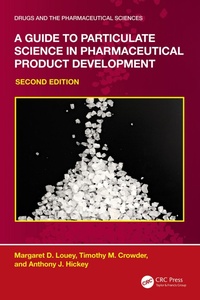
A Guide to Particulate Science in Pharmaceutical Product Development
2nd Edition
Published on 4. August 2025
222 pages
978-1-040-40084-5 (ISBN)
Description

The pharmaceutical applications of powder technology have long been recognized. Yet while many books focus on aspects of powder formation and behavior, there are few texts that explore the power of particulate science in the design, manufacture, and control of quality medicines. This revision discusses key principles and practical applications. The authors cover particulate material, its form and production, sampling from bodies of powder, particle size descriptors and statistics, behavior of particles and powder, instrumental analysis, particle size measurement and synergy of adopted techniques, and in vitro and in vivo performance criteria. Case studies are included in this new edition.
This fully revised edition:
Provides an essential account of particulate science including several new chapters on multicomponent particles, regulatory considerations and product development
Presents a variety of topics ranging from the quality of published data on particle size in pharmaceuticals to the future of crystal engineering
Reviews methods of particle measurement and their importance for specific applications
Discusses misconceptions and misunderstandings of particulate science together with lessons from other industries
This fully revised edition:
Provides an essential account of particulate science including several new chapters on multicomponent particles, regulatory considerations and product development
Presents a variety of topics ranging from the quality of published data on particle size in pharmaceuticals to the future of crystal engineering
Reviews methods of particle measurement and their importance for specific applications
Discusses misconceptions and misunderstandings of particulate science together with lessons from other industries
More details
Series
Edition
2nd edition
Language
English
Place of publication
London
United Kingdom
Publishing group
Taylor & Francis Ltd
Target group
College/higher education
Professional and scholarly
Illustrations
5 Tables, black and white; 25 Line drawings, black and white; 6 Halftones, black and white; 31 Illustrations, black and white
File size
8,87 MB
ISBN-13
978-1-040-40084-5 (9781040400845)
Copyright in bibliographic data and cover images is held by Nielsen Book Services Limited or by the publishers or by their respective licensors: all rights reserved.
Schweitzer Classification
Other editions
Additional editions
Margaret D. Louey | Timothy M. Crowder | Anthony J. Hickey
A Guide to Particulate Science in Pharmaceutical Product Development
Book
08/2025
2nd Edition
CRC Press
€231.60
Shipment within 10-20 days
Persons
Dr Margaret Louey is a pharmaceutical scientist with extensive experience in drug development and global health initiatives. She earned a Ph.D. from Monash University in Melbourne, Australia (2000), and then completed a post-doctoral fellowship at the University of North Carolina in Chapel Hill. Margaret entered the pharmaceutical industry and worked at GlaxoSmithKline for 15 years, primarily in product development of respiratory products. During this time, her interest evolved to increasing access to medicines in low- and middle-income countries. Margaret transitioned to the non-profit sector and joined the Clinton Health Access Initiative in 2018, where she has supported public-private partnerships to accelerate product development and regulatory submissions for high-priority pediatric products for the treatment and prevention of HIV and tuberculosis in low- and middle-income countries.
Dr Timothy "Timm" Crowder, Ph.D., is a pharmaceutical scientist and entrepreneur with deep expertise in particulate science and drug delivery, particularly in inhalation technologies. He earned his Ph.D. from the University of North Carolina at Chapel Hill, where his research focused on the design and development of innovative drug delivery systems. This work sparked a lifelong interest in the complex interplay between particle engineering, device design, and clinical outcomes.
Timm's career has spanned both industry and entrepreneurial ventures, with a particular focus on transforming cutting-edge research into practical, patient-centric therapies. As a co-founder of Oriel Therapeutics, Timm helped pioneer new approaches to dry powder inhaler technology. He went on to hold leadership roles across both large pharmaceutical companies and biotech startups, where he applied his expertise to advance inhaled therapies for respiratory diseases, rare conditions, and systemic delivery.
Throughout his career, Timm has remained passionate about bridging the gap between fundamental science and real-world product development. His work has encompassed everything from dry powder vaccine formulations to advanced inhaler technologies, always with an emphasis on delivering therapies that improve patient outcomes. In addition to his industry contributions, Timm has maintained a strong connection to academic research and training, co-authoring key publications on pharmaceutical particulate science and mentoring the next generation of scientists and innovators in the field.
Dr Anthony Hickey is Distinguished Fellow Emeritus at RTI International, Research Triangle Park, NC, Professor Emeritus of Pharmacoengineering and Molecular Pharmaceutics of the Eshelman School of Pharmacy, and Adjunct Professor of Biomedical Engineering of the School of Medicine at the University of North Carolina at Chapel Hill. He is a Fellow of the American Association for the Advancement of Science, the American Association of Pharmaceutical Scientists, the Academy of Pharmaceutical Sciences of Great Britain, the Royal Society of Biology, the Royal Society of Medicine and the National Academy of Inventors. He received the Research Achievement Award of the Particulate Presentations and Design Division of the Powder Technology Society of Japan, the David W Grant Award in Physical Pharmacy of the American Association of Pharmaceutical Scientists; Thomas T Mercer Joint Prize for Excellence in Inhaled Medicines and Pharmaceutical Aerosols of the American Association for Aerosol Research and the International Society for Aerosols in Medicine, the Ralph Shangraw Memorial Award for Excipient and Excipient Technology of the International Pharmaceutical Excipient Consortium Foundation. He is founder (and formerly President and CEO) of Cirrus Pharmaceuticals, Inc.; founder (formerly CSO) of Oriel Therapeutics, Inc,; CEO of Astartein, LLC. and; Member of the Board of First Flight Venture Center, Inspiring Pty Ltd., and; KAER Biotherapeutics; Chair of the USP Joint Sub-Committee on Nanotechnology, Member of the USP Pharmaceutical Dosage Forms Expert Committee (DFEC) and Inhalation Sub-Committee of the DFEC of the United States Pharmacopeia. He consults on multidisciplinary research programs in the field of pulmonary drug and vaccine delivery for the treatment and prevention of a variety of diseases and serves on numerous editorial and scientific advisory boards.
Dr Timothy "Timm" Crowder, Ph.D., is a pharmaceutical scientist and entrepreneur with deep expertise in particulate science and drug delivery, particularly in inhalation technologies. He earned his Ph.D. from the University of North Carolina at Chapel Hill, where his research focused on the design and development of innovative drug delivery systems. This work sparked a lifelong interest in the complex interplay between particle engineering, device design, and clinical outcomes.
Timm's career has spanned both industry and entrepreneurial ventures, with a particular focus on transforming cutting-edge research into practical, patient-centric therapies. As a co-founder of Oriel Therapeutics, Timm helped pioneer new approaches to dry powder inhaler technology. He went on to hold leadership roles across both large pharmaceutical companies and biotech startups, where he applied his expertise to advance inhaled therapies for respiratory diseases, rare conditions, and systemic delivery.
Throughout his career, Timm has remained passionate about bridging the gap between fundamental science and real-world product development. His work has encompassed everything from dry powder vaccine formulations to advanced inhaler technologies, always with an emphasis on delivering therapies that improve patient outcomes. In addition to his industry contributions, Timm has maintained a strong connection to academic research and training, co-authoring key publications on pharmaceutical particulate science and mentoring the next generation of scientists and innovators in the field.
Dr Anthony Hickey is Distinguished Fellow Emeritus at RTI International, Research Triangle Park, NC, Professor Emeritus of Pharmacoengineering and Molecular Pharmaceutics of the Eshelman School of Pharmacy, and Adjunct Professor of Biomedical Engineering of the School of Medicine at the University of North Carolina at Chapel Hill. He is a Fellow of the American Association for the Advancement of Science, the American Association of Pharmaceutical Scientists, the Academy of Pharmaceutical Sciences of Great Britain, the Royal Society of Biology, the Royal Society of Medicine and the National Academy of Inventors. He received the Research Achievement Award of the Particulate Presentations and Design Division of the Powder Technology Society of Japan, the David W Grant Award in Physical Pharmacy of the American Association of Pharmaceutical Scientists; Thomas T Mercer Joint Prize for Excellence in Inhaled Medicines and Pharmaceutical Aerosols of the American Association for Aerosol Research and the International Society for Aerosols in Medicine, the Ralph Shangraw Memorial Award for Excipient and Excipient Technology of the International Pharmaceutical Excipient Consortium Foundation. He is founder (and formerly President and CEO) of Cirrus Pharmaceuticals, Inc.; founder (formerly CSO) of Oriel Therapeutics, Inc,; CEO of Astartein, LLC. and; Member of the Board of First Flight Venture Center, Inspiring Pty Ltd., and; KAER Biotherapeutics; Chair of the USP Joint Sub-Committee on Nanotechnology, Member of the USP Pharmaceutical Dosage Forms Expert Committee (DFEC) and Inhalation Sub-Committee of the DFEC of the United States Pharmacopeia. He consults on multidisciplinary research programs in the field of pulmonary drug and vaccine delivery for the treatment and prevention of a variety of diseases and serves on numerous editorial and scientific advisory boards.
Content
i Acknowledgements
ii Preface
iii Table of Contents
1. Introduction
2. Particulate Systems: Foundational Principles
3. Primary Particle Manufacturing
4. Sampling Techniques, Errors, and Measurement Bias
5. Particle Characterization and Data Expression
6. Particle and Powder Behavior
7. Particulate Pharmaceutical Products
8. Regulatory Considerations for Pharmaceutical Development
9. Clinical Applications of Pharmaceutical Particulate Systems
10. General Conclusion
Index
ii Preface
iii Table of Contents
1. Introduction
2. Particulate Systems: Foundational Principles
3. Primary Particle Manufacturing
4. Sampling Techniques, Errors, and Measurement Bias
5. Particle Characterization and Data Expression
6. Particle and Powder Behavior
7. Particulate Pharmaceutical Products
8. Regulatory Considerations for Pharmaceutical Development
9. Clinical Applications of Pharmaceutical Particulate Systems
10. General Conclusion
Index
