

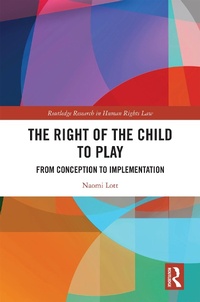
The Right of the Child to Play
From Conception to Implementation
1st Edition
Published on 19. May 2023
268 pages
978-1-000-88289-6 (ISBN)
Description

This book provides a vital and original investigation into, and critique of, the situation facing the realisation of the child's right to play. The right to play has been referred to as a forgotten right - forgotten by States implementing the Convention on the Rights of the Child, by the Committee on the Rights of the Child in monitoring and providing guidance on the Convention, and by human rights academics. Through multidisciplinary, original archival, novel doctrinal and primary empirical research, the work provides a thorough investigation of the right to play. It offers an innovative insight into its value, the challenges facing the realisation of the right, its raison d'etre and its scope, content and obligations. It also critiques the Committee's engagement with the right to play and shares lived experiences of efforts to support its implementation in the United Kingdom and Tanzania. The book highlights elements of best practice, challenges, and weaknesses, and makes recommendations for the continued and improved realisation of the right to play. The book will be a valuable resource for researchers, academics, advocates and policy-makers working in the areas of Children's Rights, International Human Rights Law, Public International Law, Child Welfare, and Education.
Reviews / Votes
'This book brings to life a human right which is often overlooked or ridiculed. The author does this through great depth of research and analysis, which is evidence-based and persuasive, as well as it being engagingly written.'Professor Robert McCorquodale
, Emeritus Professor of International Law and Human Rights, University of Nottingham and Member of the UN Working Group on Business and Human Rights
'In this book, Lott crafts a much-needed detailed critical analysis of the scope and content of the right to play, its legal history and the challenges faced and those still to overcome in realising children's right to play.'
Ben Tawil
, Director, Ludicology
'As this book is the most comprehensive and thoroughly researched study of a neglected but vital right, in my opinion, it should be essential reading for anyone in law, public policy and decision making, anyone involved in the education of children or teachers, and all those whose decision making touches the lives of children.'
Michael Follett (2024) The right of the child to play: from conception to implementation, International Journal of Play, DOI: 10.1080/21594937.2024.2305598
More details
Series
Edition
1. Auflage
Language
English
Place of publication
London
United Kingdom
Publishing group
Taylor & Francis Ltd
Target group
College/higher education
Illustrations
1 Tables, black and white
ISBN-13
978-1-000-88289-6 (9781000882896)
Copyright in bibliographic data and cover images is held by Nielsen Book Services Limited or by the publishers or by their respective licensors: all rights reserved.
Schweitzer Classification
Other editions
Additional editions
Book
04/2025
1st Edition
Routledge
€67.50
Shipment within 10-20 days
Book
05/2023
1st Edition
Routledge
€196.40
Shipment within 10-20 days
Person
Naomi Lott is an Economic and Social Research Council Postdoctoral Research Fellow of the Faculty of Law, and Early Career Fellow of the Bonavero Institute of Human Rights, University of Oxford, UK.
Content
Foreword: The Right to Play - a Fundamental Children's Right of Intergenerational Concern
Acknowledgements
1 Introduction
1.1 Introduction
1.2 Monograph Structure and Methodology
1.3 Definition of Play
1.3.1 Attempts at a Definition
1.3.2 The Difficulty of a Definition
1.3.3 The Committee on the Rights of the Child's Definition
1.4 Conclusion
2 The Importance of Play
2.1 Introduction
2.2 Cognitive Development
2.2.1 Literacy
2.2.2 Mathematics
2.2.3 Problem-Solving
2.2.4 Creativity
2.3 Social Development
2.4 Emotional Development
2.5 Physical Development
2.6 Enhancing Capabilities
2.7 Conclusion
3 Challenges to Be Overcome in Realising the Right to Play
3.1 Introduction
3.2 Safe Space for Play
3.2.1 Safe Environments
3.2.2 Access to Nature
3.2.3 Children's Use of Public Space
3.3 The Scholarisation of Childhood
3.4 Humanitarian and Development Programmes
3.4.1 Crises
3.4.2 Poverty
3.5 The Girl Child
3.6 Technology and Play
3.6.1 Physical and Mental Health - Time and Space for Play
3.6.2 Online Risks
3.6.3 Exposure to Violence
3.6.4 Cognitive Ability and Cultural Development
3.6.5 Commercialisation and Marketisation
3.7 Conclusion: The Lack of Recognition of the Importance of the Right to Play
4 The Legal History of the Right to Play
4.1 Introduction
4.2 Travaux Preparatoires
4.2.1 The Drafting History of the Declaration on the Rights of the Child
4.2.2 From Declaration to Convention: The Drafting History of Article 31
4.3 The Committee on the Rights of the Child
4.3.1 The Committee's Forms of Output
4.3.2 The Legal Status of the Committee's Outputs
4.3.3 The Committee's Outputs and the Right to Play
4.4 Conclusion
5 The Scope and Content of the Right to Play
5.1 Introduction
5.2 Scope
5.3 Content
5.3.1 Indivisible, Interrelated, and Interdependent
5.3.2 "To Engage In"
5.3.3 'Appropriate to the Age of the Child'
5.3.4 AAAQ
5.4 Obligations Relating to the Right to Play
5.4.1 "To Undertake"
5.4.2 'All Appropriate Measures'
5.4.3 Maximum Extent of Available Resources
5.4.4 Progressive Realisation
5.4.5 Minimum Core
5.4.6 Non-Retrogression
5.4.7 International Cooperation
5.5 Conclusion
6 A Multiple-Case Study of the United Kingdom and Tanzania
6.1 Introduction
6.1.1 Method Choice and Justification
6.1.2 Country Choice and Justification
6.1.3 Interview Sample and Data Collection
6.2 Discussion of Findings
6.2.1 Legislation: Incorporation of the Right to Play
6.2.2 Political and Community Support
6.2.3 Education and Planning
6.3 Conclusion
7 Conclusion
7.1 A Note on the Coronavirus Pandemic
Bibliography
Index
Acknowledgements
1 Introduction
1.1 Introduction
1.2 Monograph Structure and Methodology
1.3 Definition of Play
1.3.1 Attempts at a Definition
1.3.2 The Difficulty of a Definition
1.3.3 The Committee on the Rights of the Child's Definition
1.4 Conclusion
2 The Importance of Play
2.1 Introduction
2.2 Cognitive Development
2.2.1 Literacy
2.2.2 Mathematics
2.2.3 Problem-Solving
2.2.4 Creativity
2.3 Social Development
2.4 Emotional Development
2.5 Physical Development
2.6 Enhancing Capabilities
2.7 Conclusion
3 Challenges to Be Overcome in Realising the Right to Play
3.1 Introduction
3.2 Safe Space for Play
3.2.1 Safe Environments
3.2.2 Access to Nature
3.2.3 Children's Use of Public Space
3.3 The Scholarisation of Childhood
3.4 Humanitarian and Development Programmes
3.4.1 Crises
3.4.2 Poverty
3.5 The Girl Child
3.6 Technology and Play
3.6.1 Physical and Mental Health - Time and Space for Play
3.6.2 Online Risks
3.6.3 Exposure to Violence
3.6.4 Cognitive Ability and Cultural Development
3.6.5 Commercialisation and Marketisation
3.7 Conclusion: The Lack of Recognition of the Importance of the Right to Play
4 The Legal History of the Right to Play
4.1 Introduction
4.2 Travaux Preparatoires
4.2.1 The Drafting History of the Declaration on the Rights of the Child
4.2.2 From Declaration to Convention: The Drafting History of Article 31
4.3 The Committee on the Rights of the Child
4.3.1 The Committee's Forms of Output
4.3.2 The Legal Status of the Committee's Outputs
4.3.3 The Committee's Outputs and the Right to Play
4.4 Conclusion
5 The Scope and Content of the Right to Play
5.1 Introduction
5.2 Scope
5.3 Content
5.3.1 Indivisible, Interrelated, and Interdependent
5.3.2 "To Engage In"
5.3.3 'Appropriate to the Age of the Child'
5.3.4 AAAQ
5.4 Obligations Relating to the Right to Play
5.4.1 "To Undertake"
5.4.2 'All Appropriate Measures'
5.4.3 Maximum Extent of Available Resources
5.4.4 Progressive Realisation
5.4.5 Minimum Core
5.4.6 Non-Retrogression
5.4.7 International Cooperation
5.5 Conclusion
6 A Multiple-Case Study of the United Kingdom and Tanzania
6.1 Introduction
6.1.1 Method Choice and Justification
6.1.2 Country Choice and Justification
6.1.3 Interview Sample and Data Collection
6.2 Discussion of Findings
6.2.1 Legislation: Incorporation of the Right to Play
6.2.2 Political and Community Support
6.2.3 Education and Planning
6.3 Conclusion
7 Conclusion
7.1 A Note on the Coronavirus Pandemic
Bibliography
Index
