

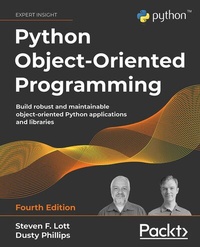
Python Object-Oriented Programming
Build robust and maintainable object-oriented Python applications and libraries
4th Edition
Published on 3. June 2024
714 pages
978-1-80107-523-7 (ISBN)
Description

Level up your Python development by exploring advanced OOP concepts in this updated edition covering the latest design patterns, OOP techniques, and real-world projects tailored for Python 3.11 and beyondKey Features - Build an intuitive understanding of object-oriented design, from introductory to mature programs
- Learn the ins and outs of Python syntax, libraries, and best practices
- Examine a machine-learning case study at the end of each chapter
Book DescriptionPython Object-Oriented Programming, Fourth Edition is a practical guide to advancing your OOP skills with modern Python. Going beyond the fundamentals, it helps you work with Python as an OOP language, explore both common and advanced design patterns, and apply these concepts to data manipulation and testing of complex OOP systems. Each chapter features newly written open-ended exercises as well as a real-world case study, aligned with the improvements in Python 3.11-bringing faster execution and memory efficiency to your applications. Authors Steven F. Lott and Dusty Phillips provide a comprehensive, illustrative tour of important OOP concepts, such as inheritance, composition, and polymorphism, showing how they integrate with Python's classes and data structures to facilitate good design. The book also introduces two powerful automated testing systems, unittest and pytest, and explores Python's concurrent programming ecosystem in depth. By the end of the book, you'll have a thorough understanding of how to think about and apply object-oriented principles using Python syntax to create robust and reliable programs.What you will learn - Implement objects in Python by creating classes and defining methods
- Extend class functionality using inheritance
- Use exceptions to handle unusual situations cleanly
- Understand when to use object-oriented features, and more importantly, when not to use them
- Discover several widely used design patterns and how they are implemented in Python
- Uncover the simplicity of unit and integration testing and understand why they are so important
- Learn to statically type check your dynamic code
- Understand concurrency with asyncio and how it speeds up programs
Who this book is forIf you are new to object-oriented programming or if you have basic Python skills and want to learn how and when to correctly apply OOP principles in Python 3.11 and beyond, this is the book for you. Mid-level Python developers, software engineers, and data scientists will benefit from its practical guidance. Complete with a solid introduction to Python, this book proves to be a useful resource for experienced object-oriented programmers transitioning from other languages or seeking a leg up in the new world of Python. Minimal previous experience with Python programming is necessary.
- Learn the ins and outs of Python syntax, libraries, and best practices
- Examine a machine-learning case study at the end of each chapter
Book DescriptionPython Object-Oriented Programming, Fourth Edition is a practical guide to advancing your OOP skills with modern Python. Going beyond the fundamentals, it helps you work with Python as an OOP language, explore both common and advanced design patterns, and apply these concepts to data manipulation and testing of complex OOP systems. Each chapter features newly written open-ended exercises as well as a real-world case study, aligned with the improvements in Python 3.11-bringing faster execution and memory efficiency to your applications. Authors Steven F. Lott and Dusty Phillips provide a comprehensive, illustrative tour of important OOP concepts, such as inheritance, composition, and polymorphism, showing how they integrate with Python's classes and data structures to facilitate good design. The book also introduces two powerful automated testing systems, unittest and pytest, and explores Python's concurrent programming ecosystem in depth. By the end of the book, you'll have a thorough understanding of how to think about and apply object-oriented principles using Python syntax to create robust and reliable programs.What you will learn - Implement objects in Python by creating classes and defining methods
- Extend class functionality using inheritance
- Use exceptions to handle unusual situations cleanly
- Understand when to use object-oriented features, and more importantly, when not to use them
- Discover several widely used design patterns and how they are implemented in Python
- Uncover the simplicity of unit and integration testing and understand why they are so important
- Learn to statically type check your dynamic code
- Understand concurrency with asyncio and how it speeds up programs
Who this book is forIf you are new to object-oriented programming or if you have basic Python skills and want to learn how and when to correctly apply OOP principles in Python 3.11 and beyond, this is the book for you. Mid-level Python developers, software engineers, and data scientists will benefit from its practical guidance. Complete with a solid introduction to Python, this book proves to be a useful resource for experienced object-oriented programmers transitioning from other languages or seeking a leg up in the new world of Python. Minimal previous experience with Python programming is necessary.
All prices
More details
Other editions
New editions
Steven F. Lott Lott, Steven F. | Dusty Phillips Phillips, Dusty
Python Object-Oriented Programming
Learn how and when to apply OOP principles to build scalable and maintainable Python applications
E-Book
11/2025
5th Edition
Packt Publishing
from
€29.99
Available for download
Additional editions
Steven F. Lott | Dusty Phillips
Python Object-Oriented Programming
Build robust and maintainable object-oriented Python applications and libraries
Book
07/2021
4th Edition
Packt Publishing
€88.70
Shipment within 3-4 weeks
Previous edition
Steven F. Lott Lott, Steven F. | Dusty Phillips Phillips, Dusty
Python Object-Oriented Programming
Learn how and when to apply OOP principles to build scalable and maintainable Python applications
E-Book
11/2025
5th Edition
Packt Publishing
from
€29.99
Available for download
Persons
Lott Steven F. :
Steven Lott has been programming since computers were large, expensive, and rare. Working for decades in high tech has given him exposure to a lot of ideas and techniques, some bad, but most are helpful to others. Since the 1990s, Steven has been engaged with Python, crafting an array of indispensable tools and applications. His profound expertise has led him to contribute significantly to Packt Publishing, penning notable titles like "Mastering Object-Oriented," "The Modern Python Cookbook," and "Functional Python Programming." A self-proclaimed technomad, Steven's unconventional lifestyle sees him residing on a boat, often anchored along the vibrant east coast of the US. He tries to live by the words "Don't come home until you have a story."Phillips Dusty :
Dusty Phillips is a Canadian software developer and an author currently living in New Brunswick. He has been active in the open-source community for 2 decades and has been programming in Python for nearly as long. He holds a master's degree in computer science and has worked for Facebook, the United Nations, and several startups.
Steven Lott has been programming since computers were large, expensive, and rare. Working for decades in high tech has given him exposure to a lot of ideas and techniques, some bad, but most are helpful to others. Since the 1990s, Steven has been engaged with Python, crafting an array of indispensable tools and applications. His profound expertise has led him to contribute significantly to Packt Publishing, penning notable titles like "Mastering Object-Oriented," "The Modern Python Cookbook," and "Functional Python Programming." A self-proclaimed technomad, Steven's unconventional lifestyle sees him residing on a boat, often anchored along the vibrant east coast of the US. He tries to live by the words "Don't come home until you have a story."Phillips Dusty :
Dusty Phillips is a Canadian software developer and an author currently living in New Brunswick. He has been active in the open-source community for 2 decades and has been programming in Python for nearly as long. He holds a master's degree in computer science and has worked for Facebook, the United Nations, and several startups.
Content
Table of Contents - Object-Oriented Design
- Objects in Python
- When Objects Are Alike
- Expecting the Unexpected
- When to Use Object-Oriented Programming
- Abstract Base Classes and Operator Overloading
- Python Data Structures
- The Intersection of Object-Oriented and Functional Programming
- Strings, Serialization, and File Paths
- The Iterator Pattern
- Common Design Patterns
- Advanced Design Patterns
- Testing Object-Oriented Programs
- Concurrency
- Objects in Python
- When Objects Are Alike
- Expecting the Unexpected
- When to Use Object-Oriented Programming
- Abstract Base Classes and Operator Overloading
- Python Data Structures
- The Intersection of Object-Oriented and Functional Programming
- Strings, Serialization, and File Paths
- The Iterator Pattern
- Common Design Patterns
- Advanced Design Patterns
- Testing Object-Oriented Programs
- Concurrency
