

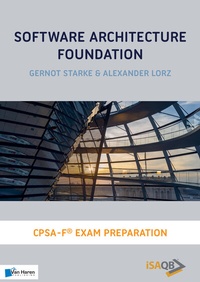
Software Architecture Foundation
CPSA Foundation® Exam Preparation
1st Edition
Published on 25. May 2021
300 pages
978-94-018-0742-5 (ISBN)
Description

This book covers everything you need to master the iSAQB© Certified Professional for Software Architecture - Foundation Level (CPSA-F) certification.
This internationally renowned education and certification schema defines various learning path for practical software architects. This book concentrates on the foundation level examination.
It explains and clarifies all 40+ learning goals of the CPSA-F© curriculum. In addition, you find step-by-step preparation guide for the examination.
Please beware: This book is not meant as a replacement for existing software architecture books and courses, but strongly focusses on explaining and clarifying the iSAQB CPSA-F foundation.
More details
Other editions
Additional editions
Book
07/2021
Van Haren Publishing
€49.00
Article exhausted; check different version
E-Book
05/2021
1st Edition
Van Haren Publishing
€47.99
Available for download
Content
- Cover
- Title
- Colophon
- Contents
- Quick overview
- Foreword by mirko hillert
- Foreword by stefan tilkov
- Foreword by peter hruschka
- Part I: Introduction
- About Software Architecture
- About this book
- About iSAQB
- About certification
- iSAQB Foundation
- iSAQB examination overview
- Preparation for the Foundation Level examination
- Part II: CPSA-F Learning goals explained
- How learning goals are explained
- List of learning goals
- CPSA-F Chapter 1: Basic concepts of software architecture
- LG 1-1: Definitions of software architecture
- LG 1-2: Goals and benefits of software architecture
- LG 1-3: Software architecture in the software lifecycle
- LG 1-4: Software architects' tasks and responsibilities
- LG 1-5: Software architects and other stakeholders
- LG 1-6: Development approach and software architecture
- LG 1-7: Short- and long-term goals
- LG 1-8: Explicit statements versus implicit assumptions
- LG 1-9: Software architects in the greater architectural context
- LG 1-10: Types of IT systems
- LG 1-11: Distributed systems
- CPSA-F Chapter 2: Design and development of software architectures
- LG 2-1: Approaches and heuristics for architecture development
- LG 2-2: Design software architectures
- LG 2-3: Influencing factors and constraints
- LG 2-4: Cross-cutting concepts
- LG 2-5: Patterns
- LG 2-6: Design principles
- LG 2-7: Managing dependencies
- LG 2-8: Achieve quality requirements
- LG 2-9: Design and define interfaces
- CPSA-F Chapter 3: Specification and communication of software architectures
- LG 3-1: Quality requirements for technical documentation
- LG 3-2: Describe and communicate software architectures
- LG 3-3: Models and notations to describe software architectures
- LG 3-4: Architectural views
- LG 3-5: Context view
- LG 3-6: Document cross-cutting concepts
- LG 3-7: Describe interfaces
- LG 3-8: Document architectural decisions
- LG 3-9: Documentation as written communication
- LG 3-10: Resources and tools for documentation
- CPSA-F Chapter 4: Software architecture and quality
- LG 4-1: Quality models and quality characteristics
- LG 4-2: Clarify quality requirements
- LG 4-3: Qualitative analysis
- LG 4-4: Quantitative evaluation
- CPSA-F Chapter 5: Examples of software architecture
- LG 5-1: From requirements to solution
- LG 5-2: Rationale of a technical implementation
- Part III: Background
- Additional patterns
- Appropriateness: it always depends. . .
- Part IV: Moving on
- Advanced Level modules
- Advanced Level certification
- Part V: Appendices
- Appendix A: About the authors
- Appendix B: Glossary of terms
- Appendix C: References and further reading
- Index
