

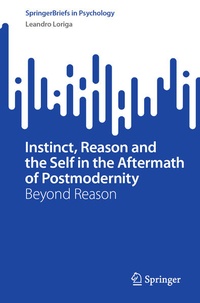
Instinct, Reason and the Self in the Aftermath of Postmodernity
Description

This book confronts the fragmentation of meaning and the exhaustion of reason in the aftermath of postmodernity. Instinct, Reason and the Self in the Aftermath of Postmodernity: Beyond Reason argues that meaningful orientation cannot be restored through propositional reasoning alone. What must be recovered is instinct: embodied attunement to the world prior to deliberative thought.
Following the collapse of grand narratives, we navigate a liquid terrain with conceptual tools designed for solid ground, one increasingly shaped by digital infrastructures and AI-driven systems of engineered salience, which together form the Sensorial Nexus: a state in which algorithmic mediation pre-organises perception, narrowing the space for reflective judgement and originality.
Drawing on Arnold van Gennep's tripartite ritual schema, the book proposes the reawakening of instinct and introduces the DIEM Method, a practical framework for disengaging from the Sensorial Nexus and restoring interior coherence.
More details
Other editions
Additional editions
Person
Leandro Loriga Ph.D., Department of Medical Psychology and Ethics, Faculty of Medicine, Masaryk University, Brno, Czech Republic.
Content
Chapter 1 From Tradition to Doubt.- Chapter 2 The Postmodern Era.- Chapter 3 Posthumans, Transhumans and the Sensorial Nexus.- Chapter 4 Beyond Rationalism: Intuition, Habit, and Tacit Orientation.- Chapter 5 From Van Gennep to the DIEM Method: A Contemporary Model of Transformation.- Chapter 6 The Future After Collapse.
