

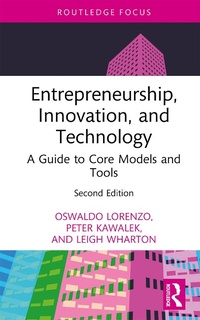
Entrepreneurship, Innovation, and Technology
A Guide to Core Models and Tools
2nd Edition
Published on 8. August 2023
150 pages
978-1-000-98693-8 (ISBN)
Description

The combination of entrepreneurship, innovation, and technology has become the source of disruptive business models that transform industries and markets. The integrative understanding of these three drivers of today's economy is fundamental to business.
Entrepreneurship, Innovation, and Technology aims to connect core models and tools that are already created by well-known authors and scholars in order to deliver a unique guide for building successful business models through the adoption of new technologies and the use of effective innovation methods. The book goes through the entrepreneurial lifecycle, describing and applying core innovation models and tools such as the business model canvas, lean startup, design thinking, customer development, and open innovation, while taking into consideration disruptive technologies such as mobile internet, cloud computing, internet of things, and blockchain. Finally, the book describes and analyzes how successful cases have been applying those models and technologies. With the mix of an academic and practitioner team, this book aims to go against the grain by its positioning of entrepreneurship in the modern technology economy.
This book will prove to be a vital text for any student, specialist, or practitioner looking to succeed in the field.
Entrepreneurship, Innovation, and Technology aims to connect core models and tools that are already created by well-known authors and scholars in order to deliver a unique guide for building successful business models through the adoption of new technologies and the use of effective innovation methods. The book goes through the entrepreneurial lifecycle, describing and applying core innovation models and tools such as the business model canvas, lean startup, design thinking, customer development, and open innovation, while taking into consideration disruptive technologies such as mobile internet, cloud computing, internet of things, and blockchain. Finally, the book describes and analyzes how successful cases have been applying those models and technologies. With the mix of an academic and practitioner team, this book aims to go against the grain by its positioning of entrepreneurship in the modern technology economy.
This book will prove to be a vital text for any student, specialist, or practitioner looking to succeed in the field.
More details
Edition
2nd edition
Language
English
Place of publication
London
United Kingdom
Publishing group
Taylor & Francis Ltd
Target group
College/higher education
Illustrations
14 Tables, black and white; 28 Line drawings, black and white; 4 Halftones, black and white; 32 Illustrations, black and white
ISBN-13
978-1-000-98693-8 (9781000986938)
Copyright in bibliographic data and cover images is held by Nielsen Book Services Limited or by the publishers or by their respective licensors: all rights reserved.
Schweitzer Classification
Other editions
Additional editions
Oswaldo Lorenzo | Peter Kawalek | Leigh Wharton
Entrepreneurship, Innovation, and Technology
A Guide to Core Models and Tools
Book
08/2025
2nd Edition
Routledge
€33.40
Shipment within 10-20 days
Oswaldo Lorenzo | Peter Kawalek | Leigh Wharton
Entrepreneurship, Innovation, and Technology
A Guide to Core Models and Tools
Book
08/2023
2nd Edition
Routledge
€73.60
Shipment within 10-20 days
Persons
Oswaldo Lorenzo is Professor of Management at Deusto Business School. He is also Visiting Professor in Alliance Manchester Business School. He was previously Professor at IE Business School. He received his PhD from Warwick Business School. His articles have been published in California Management Review, Information & Management, and Journal of Business Ethics.
Peter Kawalek is Professor at the School of Business and Economics, Loughborough University, United Kingdom. He has visiting positions at Alliance Manchester Business School, UK, at Deusto Business School, Spain, and Letterkenny Institute of Technology in Ireland. He is widely published, including in California Management Review and the Journal of Strategic Information Systems.
Leigh Wharton is an entrepreneur, consultant, and lecturer. He has run his own successful businesses for more than 16 years. He is a visiting lecturer and module coordinator at the Alliance Manchester Business School. Leigh's DBA from Manchester Business School is in Investment Readiness of early stage businesses.
Peter Kawalek is Professor at the School of Business and Economics, Loughborough University, United Kingdom. He has visiting positions at Alliance Manchester Business School, UK, at Deusto Business School, Spain, and Letterkenny Institute of Technology in Ireland. He is widely published, including in California Management Review and the Journal of Strategic Information Systems.
Leigh Wharton is an entrepreneur, consultant, and lecturer. He has run his own successful businesses for more than 16 years. He is a visiting lecturer and module coordinator at the Alliance Manchester Business School. Leigh's DBA from Manchester Business School is in Investment Readiness of early stage businesses.
Content
Acknowledgements
Chapter 1: Stages of the Entrepreneurial Lifecycle
1.1 Introduction
1.2 Business Opportunities
1.3 Ideation and Testing: Ideas, Products, and Customers
1.4 Business Model Generation
1.5 Resource Acquisition
1.6 Management and Execution
Case Study N?1 The McDonald's Story: The Founder
Case Study N?2 Data-Driven Innovation: The Case of Luko
1.7 Essential and Additional Resources
Chapter 2: Business Model Innovation Processes
2.1 Introduction
2.2 Business Models
2.3 The Technological Basis of Disruption
2.4 Disruptive Innovation
2.5 Business Model Innovation
2.6 Application of Information Technology into the Innovation of Business Models
Case Study N?3 Disruptive Innovation of the Automotive Industry
Case Study N?4 Tesla's High-End Disruption Model
2.7 Essential and Additional Resources
Chapter 3: Methods and Tools for Innovation
3.1 Introduction
3.2 Methods of Innovation
3.3 Theories of Innovation
3.4 Tools for Innovation
Case Study N? 5 Disruptive Innovation in the Education Sector
Case Study N? 6 Insurtech Community Hub (ICH) and Bdeo
3.5 Essential and Additional Resources
Chapter 4: Entrepreneurial Skills
4.1 Introduction
4.2 Adaptability
4.3 Find and Manage People
4.4 Managing Cash Effectively
4.5 Focus on Customers
4.6 Selling
4.7 Humility
4.8 Creating and Managing Alliances
4.9 Creativity and Innovation
4.10 Optimism and Inspiration
Case Study N? 7: Imogen Heap - Will There Be a Blockchain Revolution?
Case Study N? 8: New Methods for Digital Skills Education in Developing Countries
4.11 Essential and Additional Resources
Chapter 5: Entrepreneurship and Innovation Management, an Integrative Approach
5.1 Introduction
5.2 Managing the Entrepreneurial Journey
5.3 Business Model Innovation
5.4 Innovation Methods and Tools
5.5 Becoming a Successful Entrepreneur
5.6 Final Reflection
Case Study N? 9: The Entrepreneurial Journey of Airbnb
Case Study N? 10: Deki - A Charity, Evolving Over Time
5.7 Essential and Additional Resources
Index
Chapter 1: Stages of the Entrepreneurial Lifecycle
1.1 Introduction
1.2 Business Opportunities
1.3 Ideation and Testing: Ideas, Products, and Customers
1.4 Business Model Generation
1.5 Resource Acquisition
1.6 Management and Execution
Case Study N?1 The McDonald's Story: The Founder
Case Study N?2 Data-Driven Innovation: The Case of Luko
1.7 Essential and Additional Resources
Chapter 2: Business Model Innovation Processes
2.1 Introduction
2.2 Business Models
2.3 The Technological Basis of Disruption
2.4 Disruptive Innovation
2.5 Business Model Innovation
2.6 Application of Information Technology into the Innovation of Business Models
Case Study N?3 Disruptive Innovation of the Automotive Industry
Case Study N?4 Tesla's High-End Disruption Model
2.7 Essential and Additional Resources
Chapter 3: Methods and Tools for Innovation
3.1 Introduction
3.2 Methods of Innovation
3.3 Theories of Innovation
3.4 Tools for Innovation
Case Study N? 5 Disruptive Innovation in the Education Sector
Case Study N? 6 Insurtech Community Hub (ICH) and Bdeo
3.5 Essential and Additional Resources
Chapter 4: Entrepreneurial Skills
4.1 Introduction
4.2 Adaptability
4.3 Find and Manage People
4.4 Managing Cash Effectively
4.5 Focus on Customers
4.6 Selling
4.7 Humility
4.8 Creating and Managing Alliances
4.9 Creativity and Innovation
4.10 Optimism and Inspiration
Case Study N? 7: Imogen Heap - Will There Be a Blockchain Revolution?
Case Study N? 8: New Methods for Digital Skills Education in Developing Countries
4.11 Essential and Additional Resources
Chapter 5: Entrepreneurship and Innovation Management, an Integrative Approach
5.1 Introduction
5.2 Managing the Entrepreneurial Journey
5.3 Business Model Innovation
5.4 Innovation Methods and Tools
5.5 Becoming a Successful Entrepreneur
5.6 Final Reflection
Case Study N? 9: The Entrepreneurial Journey of Airbnb
Case Study N? 10: Deki - A Charity, Evolving Over Time
5.7 Essential and Additional Resources
Index
