

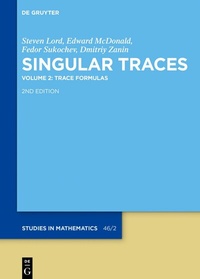
Trace Formulas
Description

This volume introduces noncommutative integration theory on semifinite von Neumann algebras and the theory of singular traces for symmetric operator spaces. Deeper aspects of the association between measurability, poles and residues of spectral zeta functions, and asymptotics of heat traces are studied. Applications in Connes' noncommutative geometry that are detailed include integration of quantum differentials, measures on fractals, and Connes' character formula concerning the Hochschild class of the Chern character.
More details
Other editions
Additional editions
Persons
Content
Part I Trace and integral formulas
1 Bounded operators and pseudodifferential operators
This chapter introduces bounded and compact operators from a separable Hilbert space to itself, and the eigenvalues and singular values of compact operators. Pseudodifferential operators on the Euclidean plane are introduced. Technical results on double operator integration of bounded operators and estimates for product-convolution operators required for later chapters are derived or referenced.
In this book, we assume a graduate level knowledge of functional analysis. The introduction to operators and traces is brief; Chapter 2 in Volume I provides more detail. Some results from Volume I concerning traces on the weak trace class ideal of bounded operators are recalled in Theorems 1.1.10 and 1.1.13. We provide only the results, some without proof, required for applications of singular traces in Alain Connes' noncommutative geometry studied in later chapters. Notation is also established.
1.1 Bounded operators on Hilbert space and traces
Let H be a separable complex infinite-dimensional Hilbert space. If ?·,·? denotes the inner product on H with associated norm ?·?, then a linear operator A:HH is bounded if
?A?8:=sup??H,???=1?A??<8.Denote by L(H) the algebra of bounded linear operators of H to itself. The rank of a bounded linear operator A, denoted by rank(A), is the dimension of the range AH. The operator A is compact if there is a sequence {Rk}k=08 of finite-rank operators on H such that
limk8?A-Rk?8=0.The set of compact linear operators within L(H) is denoted by C0(H).
An operator A?L(H) is positive, denoted A=0, if ?A?,??=0 for all ??H. The adjoint of A?L(H) is the operator A*?L(H) defined by ?A*?,??=??,A?? for all ?,??H. An operator A?L(H) is self-adjoint if A is equal to its own adjoint A*. An operator U?L(H) is called unitary if
U*U=UU*=1,where U* is the adjoint of U. Unitary operators are the isometries mapping the Hilbert space H to itself. Bounded operators A,B?L(H) are unitarily equivalent if
A=U*BUfor some unitary operator U?L(H).
If x?l8 is a complex-valued bounded sequence and {en}n=08 is an orthonormal basis of H, then x can be associated with the diagonal operator diag(x)?L(H) acting by
diag(x)?:=Sn=08x(n)??,en?en,??H.The diagonal operator depends on the orthonormal basis; diagonal operators for different orthonormal bases are unitarily equivalent. Many results for traces hold up to unitary equivalence, so the basis used to define the embedding diag of l8 in L(H) is specified only when necessary.
1.1.1 Singular values and ideals
A compact operator A?C0(H) has a sequence of singular values defined in the same way as the singular values of a matrix of complex numbers in linear algebra. Recall that the spectrum of a compact operator is a discrete set composed of eigenvalues, each associated with a finite-dimensional eigenspace of eigenvectors, and with 0 as the only limit point; see Chapter 2 in Volume I. The dimension of an eigenspace is called the multiplicity of the associated eigenvalue.
Definition 1.1.1.
An eigenvalue sequence of A?C0(H) is a sequence
?(A)={?(n,A)}n=08?c0of the eigenvalues of A listed with multiplicity, with zeros appended if A has only a finite number of eigenvalues, and such that the sequence |?(n,A)|, n?Z+, is nonincreasing.
A positive operator 0=A?C0(H) has a unique eigenvalue sequence. For a general operator A?C0(H), given two eigenvalue sequences ?(A)´ and ?(A) of A, the operators diag(?(A)´) and diag(?(A)) are unitarily equivalent.
The absolute value |A| of a bounded operator A?L(H) can be obtained from the product A*A of A and its adjoint A* by using the spectral theorem to take the square root of the positive operator A*A. The singular value sequence {µ(n,A)}n=08 of a compact operator A?C0(H) is defined by the eigenvalue sequence of |A|,
µ(n,A):=?(n,|A|),n?Z+.The notion of the singular value sequence of a compact operator is extended to a bounded operator by the singular value function. The singular value function of a bounded operator on a separable Hilbert space H is discussed in Chapter 2 of Volume I.
Definition 1.1.2.
The singular value function µ(A) of A?L(H) is defined by
µ(t,A):=inf{?A-R?8:rank(R)=t},t=0.Note that µ(diag({µ(n,A)}n=08))=µ(A) for all A?L(H) and that µ(t,A), t>0, is a step function. The values µ(n,A), n?Z+, will be referred to as the singular values of A?L(H). When it is clear that a sequence is referred to, µ(A) also denotes the singular values. When A?C0(H) is compact, the singular values are the ordered eigenvalues of |A| as above. When x?l8, the sequence
µ(n,x):=µ(n,diag(x)),x?l8,n=0,is the decreasing rearrangement of x.
Singular values characterize the ideal structure of the algebra L(H).
Definition 1.1.3.
A two-sided ideal of the algebra L(H) is a subspace J(H) such that
AB,BA?J(H),A?J(H),B?L(H).We discuss only two-sided ideals. The space of compact operators of H to itself forms an ideal inside L(H).
Definition 1.1.4.
A linear subspace J of l8 is called a symmetric sequence space if
µ(n,y)=µ(n,x),n=0,for y?l8 and x?J implies that y?J.
John Williams Calkin proved that the singular value function provides a bijective correspondence between the ideals of L(H) and the symmetric sequence spaces within l8.
Theorem 1.1.5 (Calkin correspondence). Let J be a symmetric sequence space. Then the subspace J(H) of...