

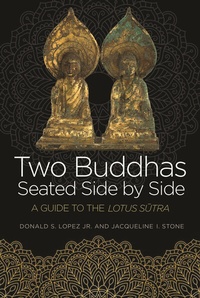
Two Buddhas Seated Side by Side
A Guide to the Lotus Sutra
1st Edition
Published on 21. October 2019
312 pages
978-0-691-18980-2 (ISBN)
Description

An essential companion to a timeless spiritual classic
The Lotus Sutra is among the most venerated scriptures of Buddhism. Composed in India some two millennia ago, it asserts the potential for all beings to attain supreme enlightenment. Donald Lopez and Jacqueline Stone provide an essential reading companion to this inspiring yet enigmatic masterpiece, explaining how it was understood by its compilers in India and, centuries later in medieval Japan, by one of its most influential proponents.
In this illuminating chapter-by-chapter guide, Lopez and Stone show how the sutra's anonymous authors skillfully reframed the mainstream Buddhist tradition in light of a new vision of the path and the person of the Buddha himself, and examine how the sutra's metaphors, parables, and other literary devices worked to legitimate that vision. They go on to explore how the Lotus was interpreted by the Japanese Buddhist master Nichiren (1222-1282), whose inspired reading of the book helped to redefine modern Buddhism. In doing so, Lopez and Stone demonstrate how readers of sacred works continually reinterpret them in light of their own unique circumstances.
An invaluable guide to an incomparable spiritual classic, this book unlocks the teachings of the Lotus for modern readers while providing insights into the central importance of commentary as the vehicle by which ancient writings are given contemporary meaning.
The Lotus Sutra is among the most venerated scriptures of Buddhism. Composed in India some two millennia ago, it asserts the potential for all beings to attain supreme enlightenment. Donald Lopez and Jacqueline Stone provide an essential reading companion to this inspiring yet enigmatic masterpiece, explaining how it was understood by its compilers in India and, centuries later in medieval Japan, by one of its most influential proponents.
In this illuminating chapter-by-chapter guide, Lopez and Stone show how the sutra's anonymous authors skillfully reframed the mainstream Buddhist tradition in light of a new vision of the path and the person of the Buddha himself, and examine how the sutra's metaphors, parables, and other literary devices worked to legitimate that vision. They go on to explore how the Lotus was interpreted by the Japanese Buddhist master Nichiren (1222-1282), whose inspired reading of the book helped to redefine modern Buddhism. In doing so, Lopez and Stone demonstrate how readers of sacred works continually reinterpret them in light of their own unique circumstances.
An invaluable guide to an incomparable spiritual classic, this book unlocks the teachings of the Lotus for modern readers while providing insights into the central importance of commentary as the vehicle by which ancient writings are given contemporary meaning.
More details
Other editions
Additional editions
Book
01/2022
Princeton University Press
€24.00
Shipment within 10-20 days
Book
10/2019
Princeton University Press
€30.95
Shipment within 10-20 days
Persons
Donald S. Lopez Jr. is the Arthur E. Link Distinguished University Professor of Buddhist and Tibetan Studies at the University of Michigan. His books include The "Lotus Sutra": A Biography (Princeton). He lives in Ann Arbor, Michigan. Jacqueline I. Stone is professor of religion at Princeton University. Her books include Original Enlightenment and the Transformation of Medieval Japanese Buddhism. She lives in Kingston, New Jersey.
Content
- Cover
- Contents
- Acknowledgments
- A Note on Sources
- Authors' Introduction
- Chapter One: Introduction
- Chapter Two: Skillful Means
- Chapter Three: A Parable
- Chapter Four: Willing Acceptance
- Chapter Five: Herbs
- Chapter Six: Prediction
- Chapter Seven: The Apparitional City
- Chapters Eight and Nine: The Five Hundred Disciples Receive Their Predictions and The Predictions for Those Who Still Have More to Learn and for Those Who Do Not
- Chapter Ten: Expounder of the Dharma
- Chapter Eleven: The Appearance of the Jeweled Stupa
- Chapter Twelve: Devadatta
- Chapter Thirteen: Perseverance
- Chapter Fourteen: Ease in Practice
- Chapter Fifteen: Bodhisattvas Emerging from the Earth
- Chapter Sixteen: The Lifespan of the Tathagata
- Chapters Seventeen and Eighteen: Description of Merits and The Merits of Joyful Acceptance
- Chapter Nineteen: The Benefits Obtained by an Expounder of the Dharma
- Chapter Twenty: Bodhisattva Sadaparibhuta
- Chapters Twenty-One and Twenty-Two: The Transcendent Powers of the Tathagata and Entrustment
- Chapter Twenty-Three: Ancient Accounts of Bodhisattva Bhai?ajyaraja
- Chapters Twenty-Four and Twenty-Five: Bodhisattva Gadgadasvara and The Gateway to Every Direction
- Chapter Twenty-Six: Dhara?i
- Chapter Twenty-Seven: Ancient Accounts of King Subhavyuha
- Chapter Twenty-Eight: Encouragement of Bodhisattva Samantabhadra
- Conclusion
- Notes
- Index
