

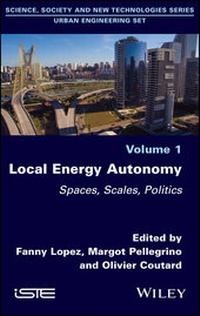
Local Energy Autonomy
Spaces, Scales, Politics
1st Edition
Published on 26. April 2019
400 pages
978-1-119-61625-2 (ISBN)
Description

In recent years, interest for local energy production, supply and consumption has increased in academic and public debates. In particular, contemporary energy transition discourses and strategies often emphasize the search for increased local energy autonomy, a phrase which can refer to a diverse range of configurations, both in terms of the spaces and scales of the local territory considered and in terms of what is meant by energy autonomy.
This book explores policies, projects and processes aimed at increased local energy autonomy, with a particular focus on their spatial, infrastructural and political dimensions. In doing so, the authors - Sabine Barles, Bruno Barroca, Guilhem Blanchard, Benoit Boutaud, Arwen Colell, Gilles Debizet, Ariane Debourdeau, Laure Dobigny, Florian Dupont, Zélia Hampikian, Sylvy Jaglin, Allan Jones, Raphael Ménard, Alain Nadaï, Angela Pohlmann, Cyril Roger-Lacan, Eric Vidalenc - improve our understanding of the always partial and controversial processes of energy relocation that articulate forms of local metabolic self-sufficiency, socio-technical decentralization and political empowerment.
Comprising fifteen chapters, the book is divided into four parts: Governance and Actors; Urban Projects and Energy Systems; Energy Communities; and The Challenges of Energy Autonomy.
More details
Other editions
Additional editions
Book
05/2019
1st Edition
Wiley-ISTE
€164.50
Shipment within 3-4 weeks
Content
- Cover
- Half-Title Page
- Title Page
- Copyright Page
- Contents
- Foreword
- Introduction
- Energy and territories: towards new configurations
- Figures of local energy autonomy
- Metabolic, socio-technical and political empowerment: congruences and tensions
- The structuring of network spaces: new logics and new scales
- Infrastructure diversification, redistribution of skills and reconstruction of stakeholder systems
- At the crossroads of innovation, experimentation and diversion
- Perspectives
- Book structure
- References
- PART 1: Governance and Actors
- 1. Urban Planning and Energy: New Relationships, New Local Governance
- 1.1. Distributed energy: the constant adaptation of urban areas
- 1.2. "Sustainable cities" and new energy systems: from harmonization to a common origin
- 1.3. Reshaping local governance
- 1.4. References
- 2. Decentralized Energy and Cities: Tools and Levers for Urban Energy Decentralization
- 2.1. Introduction
- 2.2. Background
- 2.3. Woking, UK
- 2.4. London, UK
- 2.5. Sydney, Australia
- 2.5.1. Background
- 2.5.2. Sustainable Sydney 2030
- 2.5.3. Green Infrastructure Plan
- 2.5.4. Trigeneration Master Plan
- 2.5.5. Renewable Energy Master Plan
- 2.5.6. Advanced Waste Treatment Master Plan
- 2.5.7. CitySwitch Green Office Program
- 2.5.8. Better Buildings Partnership
- 2.5.9. Environmental Upgrade Agreements
- 2.5.10. City of Sydney Projects
- 2.5.11. Carbon-neutral Sydney
- 2.5.12. Conclusion
- 2.6. Seoul, South Korea
- 2.6.1. Background
- 2.6.2. Fukushima nuclear disaster
- 2.6.3. One Less Nuclear Power Plant
- 2.6.4. Seoul International Energy Advisory Council
- 2.6.5. International Energy Advisory Council
- 2.6.6. One Less Nuclear Power Plant, Phase 2 - Seoul Sustainable Energy Action Plan
- 2.6.7. Seoul Energy Corporation
- 2.6.8. Interregional cooperation
- 2.6.9. Conclusion
- 2.7. Overall conclusions
- 2.8. References
- 3. The Third Industrial Revolution in Hauts-de-France: Moving Toward Energy Autonomy?
- 3.1. The industrial revolutions in the region
- 3.1.1. The cornerstones of the first industrial revolution
- 3.1.2. The successors of the second industrial revolution: the automotive industry and electricity
- 3.2. The TIR's resources in Hauts-de-France
- 3.2.1. An expanded view of some of the local expertise
- 3.2.2. The basis of local ecosystems
- 3.2.3. Strong political backing
- 3.2.4. The expansion of the TRI/REV3 brand
- 3.2.5. Multiple financial tools
- 3.2.6. Subregional territorialization: energy subsidiarity
- 3.2.7. Network managers are changing their views
- 3.3. Initial assessments and analyses
- 3.3.1. Late, but still a strong objective
- 3.3.2. An update on the TRI/REV3 trajectories
- 3.3.3. A techno-centered vision
- 3.3.4. Tensions regarding the priorities and temporalities
- 3.3.5. From solidarity to regional autonomy through energy subsidiarity
- 3.4. References
- 4. Rethinking Reliability and Solidarity through the Prism of Interconnected Autonomies
- 4.1. Introduction
- 4.2. Four prospective scenarios for urbanized spaces
- 4.2.1. Large companies
- 4.2.2. Local authorities
- 4.2.3. Cooperative stakeholders
- 4.2.4. Regulating state
- 4.3. Intermediaries with new energy autonomies
- 4.3.1. Energy storage as an essential factor of autonomy
- 4.3.2. Energy autonomies as organizations
- 4.3.3. A combination of different energy scenarios according to the regions
- 4.4. A variety of decision-making scales relating to energy infrastructure
- 4.4.1. The country and the continent
- 4.4.2. Housing
- 4.4.3. The building
- 4.4.4. The district
- 4.4.5. The city or metropolis
- 4.5. Conclusion: solidarities must be reinvented in the era of connected energy autonomies
- 4.6. Acknowledgments
- 4.7. References
- PART 2: Urban Projects and Energy Systems
- 5. Critical Densities of Energy Self-sufficiency and Carbon Neutrality
- 5.1. Introduction
- 5.1.1. What can environmental measures be related to?
- 5.1.2. Critical densities and catchment areas
- 5.2. Energy consumption density
- 5.2.1. Differences regarding the 2,000 watts
- 5.2.2. 0.1 watts per square meter as average for mainland France
- 5.3. Renewable erergy Production density
- 5.3.1. Renewable energy production is Eulerian
- 5.3.2. Energy harvesting plans
- 5.3.3. Quantification of the production flow of a gegion
- 5.4. Self-sufficiency, convergence: 1-W regions
- 5.4.1. The 7 hectares, surface area per person in the world garden
- 5.4.2. The story of urban transition in cities
- 5.4.3. The fundamental equality of self-sufficiency
- 5.4.4. Some self-sufficiency paths according to density
- 5.5. Emission density and carbon neutrality
- 5.5.1. Post-COP21 and carbon neutrality
- 5.5.2. Equivalent emission densities
- 5.5.3. Carbon sequestration density
- 5.5.4. The fundamental equation of carbon neutrality
- 5.6. Conclusion
- 5.6.1. Continent-sea balance
- 5.6.2. The city-countryside dichotomy
- 5.6.3. The city, an energy-carbon monster
- 5.6.4. The mathematics of density, relocating according to the right productions
- 5.6.5. The scales in question
- 5.7. References
- 6. What Autonomy is Available in the Design of Energy Solutions within French Urban Development Projects? The Example of District Heating
- 6.1. Introduction
- 6.2. Urban heating within development projects: an opportunity for local monitoring of the energy system
- 6.2.1. Windows of opportunity for local players
- 6.2.2. Urban development and district heating projects still remain subject to numerous external constraints
- 6.3. The decision-based autonomy of urban heating projects from the perspective of urban development projects' technical management
- 6.3.1. Design of the supply infrastructure: a weakly structured coordination between design arenas
- 6.3.2. Coordination of supply and demand: an even more significant division
- 6.4. Conclusions and final thoughts
- 6.5. References
- 7. Positive Energy and Networks: Local Energy Autonomy as a Vector for Controlling Flows
- 7.1. Positive energy, autonomy and flow dynamics
- 7.2. The case of Lyon confluence and the Hikari block: a rhetoric of mutualization for achieving partial self-sufficiency
- 7.3. The "right" scale of autonomy and control over flows
- 7.4. From autonomy to flow management: who is in charge?
- 7.5. Conclusion
- 7.6. References
- 8. From Energy Self-sufficiency to Trans-scalar Energy
- 8.1. Self-sufficiency or sharing of the heat supply
- 8.1.1. Four examples of scale jumping that question self-sufficiency
- 8.1.2. Assess the strategic contribution of each operation to the networks
- 8.2. Redefining the goal of self-sufficiency
- 8.2.1. Using the cost-benefit analysis?
- 8.2.2. Using a new financial paradigm including the old one?
- 8.2.3. First achievement: 1,000 trees
- 8.2.4. From self-sufficiency to synergies
- 8.3. The improtance of strategic planning using project levers
- 8.3.1. Electricity networks redefine their mesh
- 8.3.2. Liège: valorizing the electrical infrastructures of the industrial valley
- 8.3.3. Mains gas seeks its revival
- 8.3.4. From data to planning: cities think about energy
- 8.4. Conclusion
- PART 3: Energy Communities
- 9. Sociotechnical Morphologies of Rural Energy Autonomy in Germany, Austria and France
- 9.1. Introduction
- 9.2. Technical choices and autonomy processes
- 9.3. Actors of local energy autonomy
- 9.4. Spatial and autonomy temporalities
- 9.4.1. Bringing the relevant techniques into existence
- 9.4.2. Social and geographical morphologies
- 9.4.3. The influence of regulatory and legislative frameworks
- 9.4.4. The role of energy policies and political structures
- 9.4.5. Pioneer towns: "was it easier before?"
- 9.5. From the construction to the transferability of "models" of autonomy: what impasses and issue are there?
- 9.6. References
- 10. Community Energy Projects Redefining Energy Distribution Systems: Examples from Berlin and Hamburg
- 10.1. Introduction
- 10.1.1. Rethinking networked infrastructures beyond "public versus private"
- 10.1.2. Citizens claiming networked infrastructures in Germany's largest cities
- 10.2. Situational analyses of urban energy system transformation
- 10.3. People have the power? Citizens claiming energy infrastructure grid: the case of BEB
- 10.3.1. (Re)negotiating infrastructures of decision-making on the power grid: the case of BEB
- 10.3.2. From protest to empowerment: civil society engagement in Hamburg's energy distribution systems
- 10.4. Discussion: reconfiguring the social in sociotechnical?
- 10.5. Conclusion
- 10.6. References
- 11. Autonomy and Energy Community: Realities to Reconsider?
- 11.1. Introduction
- 11.2. Mapping and genealogy of energy community approaches
- 11.2.1. Technological element: innovation at the heart of energy communities
- 11.2.2. The collective element: which communitie(s) favor energy issues?
- 11.2.3. Institutional element: framing and empowering communities
- 11.2.4. Discussion
- 11.3. Scope and limits of existing works
- 11.3.1. A high presence of instrumental and normative approaches
- 11.3.2. The singularity of English language "critical localism"
- 11.3.3. The locational nature of analytical frameworks
- 11.3.4. The minimalist and shifting contents for the notion of community
- 11.3.5. Discussion
- 11.4. Conclusion
- 11.5. References
- PART 4: The Challenges of Energy Autonomy
- 12. Regional Energy Self-sufficiency: a Legal Issue
- 12.1. Self-sufficiency analyzed through the prism of the territory
- 12.1.1. A reality far from clichés
- 12.1.2. Going beyond the productive aspect
- 12.2. Regional energy self-sufficiency: a legal issue
- 12.2.1. Municipalities that become legally self-sufficient
- 12.2.2. The energy self-sufficiency of municipalities: an organizational challenge
- 12.3. Conclusion
- 12.4. References
- 13. Electricity Autonomy and Power Grids in Africa: from Rural Experiments to Urban Hybridizations
- 13.1. Introduction
- 13.2. From the "crisis" to electrical experiments
- 13.2.1. Electric disasters and riots
- 13.2.2. Huge investment needs
- 13.2.3. Renewables and decentralized systems: a third way for subSaharan Africa?
- 13.3. Electrical hybridizations between pragmatic autonomy and new dependencies
- 13.3.1. Rural experiments....
- 13.3.2. ... and urban hybridizations
- 13.3.3. Off-grid under constraints
- 13.4. Conclusion
- 13.5. References
- 14. Energy Self-sufficiency: an Ambition or a Condition for Urban Resilience?
- 14.1. Introduction
- 14.2. A matter of definitions
- 14.3. Technical systems and resilience
- 14.4. Self-sufficiency and functional resilience
- 14.4.1. Functional resilience and system modeling
- 14.4.2. Can self-sufficiency be achieved by managing failures of technical systems?
- 14.5. Self-sufficiency and the meta-system: toward spatial resilience?
- 14.5.1. Meta population, meta-system and self-sufficiency
- 14.6. Conclusion
- 14.7. References
- 15. Urban Metabolic Self-sufficiency: an Oxymoron or a Challenge?
- 15.1. Introduction
- 15.2. Energy and matter: urban metabolism
- 15.3. The city and its hinterlands: the lack of physical autonomy
- 15.4. Decision-making self-sufficiency: a challange ?
- 15.5. Conclusion
- 15.6. References
- List of Authors
- Index
- Other titles from iSTE in Science, Society and New Technologies
- EULA
