

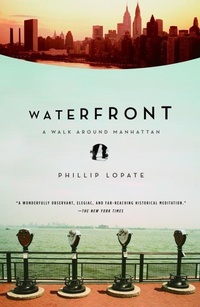
Waterfront
A Walk Around Manhattan
Published on 18. December 2008
448 pages
978-0-307-49296-8 (ISBN)
Description

Fusing history, lore, politics, culture, and on-site adventures, esteemed essayist and author Phillip Lopate takes us on an exuberant, affectionate, and eye-opening excursion around Manhattan's shoreline. Waterfront captures the ever-changing character of New York in the best way possible: on a series of exploratory walks conducted by one of the city's most engaging and knowledgeable guides. Starting at the Battery and moving at a leisurely pace along the banks of the Hudson and East Rivers, Lopate describes the infrastructures, public spaces, and landmarks he encounters, along with fascinating insights into how they came to be. Unpeeling layers of myth and history, he reveals the economic, ecological, and political concerns that influenced the city's development, reporting on everything from the building of the Brooklyn Bridge to the latest projects dotting the shorelines.
New York's waterfront has undergone a three-stage revaluation—from the world's largest port to an abandoned, seedy no-man's land to a highly desirable zone of parks and upscale retail and residential properties—each metamorphosis only incompletely shedding earlier associations. Physically, no area of New York City has changed as dramatically as the shoreline, thanks to natural processes and the use of landfill, dredging, and other interventions. Everywhere Phillip Lopate walked on the waterfront, he saw the present as a layered accumulation of older narratives. He set about his task by trying to read the city like a text. One textual layer is the past, going back to the Lenape Indians, Captain Kidd, and Melville's sailors; another is the present—whatever or whoever was popping up in his view at the moment; a third layer contains the constructed environment, the architecture or piers or parks currently along the shore; another layer still is his personal history, the memories recalled by visiting certain spots; yet another consists of the city's incredibly rich cultural record—the literature, films, and artwork that threw a reflecting light on the matter at hand; and finally, there is the invisible or imagined layer—what he thinks should be on the waterfront but is not.
Waterfront is studded with short diversions where Lopate expounds on some of the greater issues, characters, and sites of Manhattan's shoreline. Be it a revisionist examination of Robert Moses, the effect of shipworms on the city's piers and foundations, the battle over Westway, the dream of public housing, the legacy of Joseph Mitchell, a wonderful passage about the longshoremen and Elia Kazan's On the Waterfront, or the meaning of the World Trade Center, Lopate punctuates this marvelous journey with the sights and sounds and words of a world like no other.
A rich and impressive work by an undisputed master stylist, Waterfront takes its rightful place next to other literary classics of New York, such as E. B. White's Here Is New York and Joseph Mitchell's Up in the Old Hotel. It is an unparalleled look at New York's landscape and history and an irresistible invitation to meander along its outermost edges.
New York's waterfront has undergone a three-stage revaluation—from the world's largest port to an abandoned, seedy no-man's land to a highly desirable zone of parks and upscale retail and residential properties—each metamorphosis only incompletely shedding earlier associations. Physically, no area of New York City has changed as dramatically as the shoreline, thanks to natural processes and the use of landfill, dredging, and other interventions. Everywhere Phillip Lopate walked on the waterfront, he saw the present as a layered accumulation of older narratives. He set about his task by trying to read the city like a text. One textual layer is the past, going back to the Lenape Indians, Captain Kidd, and Melville's sailors; another is the present—whatever or whoever was popping up in his view at the moment; a third layer contains the constructed environment, the architecture or piers or parks currently along the shore; another layer still is his personal history, the memories recalled by visiting certain spots; yet another consists of the city's incredibly rich cultural record—the literature, films, and artwork that threw a reflecting light on the matter at hand; and finally, there is the invisible or imagined layer—what he thinks should be on the waterfront but is not.
Waterfront is studded with short diversions where Lopate expounds on some of the greater issues, characters, and sites of Manhattan's shoreline. Be it a revisionist examination of Robert Moses, the effect of shipworms on the city's piers and foundations, the battle over Westway, the dream of public housing, the legacy of Joseph Mitchell, a wonderful passage about the longshoremen and Elia Kazan's On the Waterfront, or the meaning of the World Trade Center, Lopate punctuates this marvelous journey with the sights and sounds and words of a world like no other.
A rich and impressive work by an undisputed master stylist, Waterfront takes its rightful place next to other literary classics of New York, such as E. B. White's Here Is New York and Joseph Mitchell's Up in the Old Hotel. It is an unparalleled look at New York's landscape and history and an irresistible invitation to meander along its outermost edges.
More details
Other editions
Additional editions
Book
05/2005
Bantam Books
€19.40
Article exhausted; check different version

Book
02/2004
Crown Publishing Group (NY)
€43.88
Article exhausted; check different version
Person
PHILLIP LOPATE is the author of eight books. A lifelong resident of New York City, he lives in Brooklyn.
Content
- Intro
- About the Author
- Other Books By This Author
- Title Page
- Dedication
- Contents
- Introduction
- Part 1 - The West Side
- Chapter 1 - The Battery
- Chapter 2 - Battery Park City
- Chapter 3 - The World Trade Center
- Chapter 4 - Excursus the Harbor and the Old Port
- Chapter 5 - Tribeca: The River Project
- Chapter 6 - The Soho/Greenwich Village Corridor
- Chapter 7 - Outboard, Or The Battle of Westway and its Aftermath
- Chapter 8 - Chelsea Piers, Chelsea, and Trocchi-Land
- Chapter 9 - Excursus Shipworms
- Chapter 10 - From 42nd Street to Riverside South
- Chapter 11 - Riverside Park and Manhattanville
- Chapter 12 - Sewage Treatment Plant and Salsa Party
- Chapter 13 - Washington Heights and Inwood
- Part 2 - The East Side
- Chapter 14 - Introduction: On The Aesthetics of Urban Walking and Writing
- Chapter 15 - Captain Kidd and Pearl Street
- Chapter 16 - Excursus Sailors and Merchant Seamen in New York
- Chapter 17 - The South Street Seaport and the Fulton Fish Market
- Chapter 18 - Excursus The Elusive Joseph Mitchell
- Chapter 19 - The South Street Seaport (Continued)
- Chapter 20 - The Brooklyn Bridge
- Chapter 21 - Under The Bridges
- Chapter 22 - Con Edisonland: From One Power Plant to Another
- Chapter 23 - Excursus Robert Moses, A Revisionist Take
- Chapter 24 - Tudor City, The United Nations, and the Upper East Side
- Chapter 25 - East Harlem and Points North
- Chapter 26 - Excursus Ode to the Projects
- Chapter 27 - North Brother Island
- Chapter 28 - Highbridge Park
- Chapter 29 - The Dilemma of Waterfront Development
- Acknowledgments
- Credits
- Copyright
