

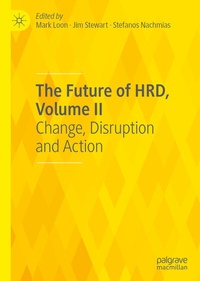
The Future of HRD, Volume II
Description

This edited collection captures current thinking about and future practices and strategies for human resource development (HRD). It brings together contributions from a number of leading academics, practitioners and consultants who are active in the debate about the future of HRD. As the world of work grows ever more complex, diverse and ambiguous, there is growing interest in how technology, globalisation, changing workforce demographics and talent development can play a greater role in developing organisations for the future. In this context, HRD is a critical tool to address current complexity and offer solutions to organisational learning needs. Split into two volumes covering technology and innovation as well as the role of HRD in disrupting management and organisational thinking, these books provide analyses of the role of HRD in addressing the needs of the digital revolution.
Volume II offers a practical assessment of how HRD can drive change at an individual and organisational level through the adoption of various best practices. It provides the reader key insights into the HRD response to current issues and whether modern organisations should change their approach to learning and development. Together the two volumes offer a highly reflective, critical and insightful assessment on the foundations of HRD in the workplace.
More details
Other editions
Additional editions
Persons
Mark Loon is Deputy Pro-Vice Chancellor for Research and Enterprise at Bath Spa University, UK. He is a co-Editor-in-Chief of the International Journal of Human Resource Development: Practice, Policy and Research and an incoming Vice Chair in the British Academy of Management, co-leading the Management Knowledge and Education Committee.
Jim Stewart is Professor of Human Resource Development in Liverpool Business School, Liverpool John Moores University, UK, where his role is to provide mentoring support and research leadership for colleagues teaching and researching Human Resource Management. He has authored and co-edited over 20 books on HRD as well as of numerous articles in academic and professional journals.
Stefanos Nachmias is Principal Lecturer at Nottingham Trent University, Nottingham Business School, UK. His research interests include an assessment of line managers' diversity needs, gender in the workplace andemployment practices. He has co-edited several books, including Inequality and Organizational Practice, Volumes I and II , and Hidden Inequalities in the Workplace (Palgrave Macmillan).
