

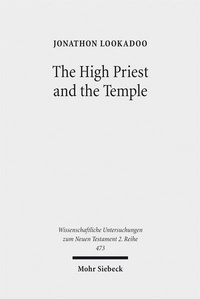
The High Priest and the Temple
Metaphorical Depictions of Jesus in the Letters of Ignatius of Antioch
1st Edition
Published on 21. November 2018
355 pages
978-3-16-156072-9 (ISBN)
Description

Jonathon Lookadoo untersucht die Metaphern des Ignatius von Antiochien vom Hohepriester und dem Tempel, um besser zu verstehen, wie Ignatius Jesus und die Kirche betrachtete. Die Metaphern vom Hohepriester und dem Tempel sind in drei der Ignatiusbriefe eng miteinander verbunden. Die vorliegende Untersuchung hilft dem Leser, Ignatius' Darstellung von Jesus' Identität und Heilswerk zu verstehen. Der Autor beleuchtet auch, wie manche in der Leserschaft des Ignatius ihre Einigkeit unter Beweis stellen sollten. Indem er jede der Metaphern im Hinblick auf ihre rhetorische Funktion in einem bestimmten Brief sowie auf ähnliche Metaphorik in früher jüdischer und christlicher Literatur untersucht, analysiert Jonathon Lookadoo die Ignatiusbriefe in einer Weise, die nicht nur für Experten auf dem Gebiet der Ignatiusbriefe von Interesse ist, sondern auch für alle, die sich mit frühchristlichen Briefen sowie der Rhetorik und Theologie der ersten beiden Jahrhunderte n. Chr. befassen.
More details
Other editions
Additional editions
Jonathon Lookadoo
The High Priest and the Temple
Metaphorical Depictions of Jesus in the Letters of Ignatius of Antioch
Book
10/2018
1st Edition
Mohr Siebeck
€104.00
Article exhausted; check different version
Person
Content
- Cover
- Titel
- Table of Contents
- Acknowledgments
- List of Abbreviations
- Chapter 1: Points of Departure
- 1.1. Introduction
- 1.2. Literature Review
- 1.2.1. High Priestly Metaphors
- 1.2.1.1. Ferdinando Bergmalli
- 1.2.1.2. Ole Jakob Filtvedt and Martin Wessbrandt
- 1.2.2. Temple Metaphors
- 1.2.2.1. Peter Legarth
- 1.2.2.2. René Kieffer
- 1.3. Methodology
- 1.3.1. History, Theology, and Philology
- 1.3.2. Metaphor
- 1.4. Further Preliminary Considerations
- 1.4.1. Dating Ignatius
- 1.4.2. Occasional Letters
- 1.5. Looking Ahead
- Chapter 2: A Brief Outline of Ignatius's Opponents
- 2.1. Introduction
- 2.2. Recent Scholarship
- 2.3. Ignatius's Opponents in Philadelphia
- 2.4. Ignatius's Opponents in Ephesus
- 2.5. Ignatius's Opponents in Magnesia
- 2.6. Conclusion
- Chapter 3: Jesus as High Priest in Philadelphians
- 3.1. Introduction
- 3.2. The Theme of Unity in Philadelphians
- 3.3. The Identity of the Priests and High Priest in Phld. 9.1
- 3.4. Jesus as High Priest in Phld. 9.1
- 3.4.1. The Role of the High Priest
- 3.4.2. Ignatius's High Priestly Jesus alongside Other Early Christian Texts
- 3.4.2.1. Ignatius and Hebrews
- 3.4.2.2. Ignatius, 1 Clement, and Polycarp
- 3.4.3. The Ignatian High Priestly Jesus alongside Other Early Jewish Texts
- 3.5. Jesus as Door in Phld. 9.1
- 3.5.1. The Role of the Door
- 3.5.2. Other Treatments of Jesus as Door in Early Christianity
- 3.6. Jesus as High Priest and Door in Philadelphians
- 3.6.1. Jesus as High Priest and Door in Phld. 9.1-2
- 3.6.2. The Place of Phld. 9.1 in the Argument of Phld. 9.1-2
- 3.6.3. The Place of Phld. 9.1 in the Argument of Phld. 5.1-9.2
- 3.7. Conclusion
- Chapter 4: The Temple in Philadelphians
- 4.1. Introduction
- 4.2. Ignatius's Visit to Philadelphia
- 4.2.1. The Temple in Phld. 7.2: An Overview
- 4.2.2. Ignatius's Self-Quotations
- 4.3. The Temple in Phld. 7.2: A More Thorough Look..
- 4.3.1. The Temple in Ignatius's Second Quotation
- 4.3.1.1. Ignatius and Greek Rhyme
- 4.3.1.2. Ignatius and Parallelism
- 4.3.1.3. Interpreting Phld. 7.2
- 4.3.2. Philadelphian s???
- 4.3.3. God in the Temple
- 4.3.4. Phld. 7.2 and Early Christian and Early Jewish Literature
- 4.3.4.1. Phld. 7.2 in the Context of Early Christian Literature
- 4.3.4.2. Phld. 7.2 in the Context of Early Jewish Literature
- 4.3.5. The Philadelphians as the Temple of God
- 4.4. Towards a Reading of Phld. 5.1-9.2
- 4.4.1. The Temple in the Context of Phld. 6.3-8.1
- 4.4.2. Phld. 6.3-8.1 in the Argument of Phld. 5.1-9.2
- 4.4.3. The High Priest and Temple in Phld. 5.1-9.2
- 4.5. Conclusion
- Chapter 5: The Temple in Ephesians: Part I
- 5.1. Introduction
- 5.2. The Relationship between the Ephesians and God
- 5.3. The Temple and Building in Eph. 9.1
- 5.3.1. The Text and Its Structure
- 5.3.2. Stones of the Father's Temple
- 5.3.2.1. The Ephesians as Stones
- 5.3.2.2. The Temple and the Building
- 5.3.2.3. The Preparation of the Stones
- 5.3.3. The Crane and the Rope
- 5.3.3.1. The Heights and the Crane
- 5.3.3.2. The Relative Pronoun, Jesus, and the Crane
- 5.3.3.3. The Role of the Crane
- 5.3.3.4. The Rope
- 5.3.4. The Guide and the Way
- 5.3.5. Eph. 9.1 among Early Jewish and Early Christian Texts
- 5.3.5.1. Early Jewish Texts
- 5.3.5.2. Early Christian Texts
- 5.3.6. Conclusion of the Temple and Building
- 5.4. The Temple-Bearers in Eph. 9.2
- 5.4.1. The Text and Its Structure
- 5.4.2. The Background of Ignatius's Terminology
- 5.4.3. The Function of the Metaphor
- 5.5. Conclusion
- Chapter 6: The Temple in Ephesians: Part II
- 6.1. Introduction
- 6.2. The Structure of Eph. 15.3 and Its Place in the Letter
- 6.2.1. The Structure of Eph. 15.3
- 6.2.2. The Place of Eph. 15.3 in the Letter
- 6.3. The Ephesian Temples
- 6.3.1. Our Secrets
- 6.3.2. The Plural Usage of ?a??
- 6.4. The God who Dwells in the Temples
- 6.5. God's Dwelling in Early Jewish and Early Christian Texts
- 6.5.1. Early Jewish Texts
- 6.5.2. Early Christian Texts
- 6.6. Jesus in the Temple
- 6.6.1. Tension between Temple Symbolism and Christology?
- 6.6.2. Jesus in the Temples of Phld. 7.2
- Eph. 9.1-2
- 15.3
- 6.7. The Function of the Temples in Eph. 15.3 within the Letter
- 6.8. The Function of the Temple Metaphors in Eph. 9.1-2
- 15.3
- 6.8.1. Two Metaphors Compared
- 6.8.2. The Temples in Polemic against the Opponents
- 6.9. Conclusion
- Chapter 7: The Temple in Magnesians
- 7.1. Introduction
- 7.2. The Argument and Role of Unity in Magnesians
- 7.2.1. The Structure of the Two Central Sections
- 7.2.2. The Role of Unity and Harmony
- 7.3. The Text and Structure of Magn. 7
- 7.4. One Temple of God
- 7.4.1. The Temple in Magn. 7.2
- 7.4.2. The One Temple in Early Jewish and Early Christian Texts
- 7.4.2.1. Early Jewish Texts
- 7.4.2.2. Early Christian Texts
- 7.5. One Altar
- 7.6. One Jesus Christ
- 7.7. Magn. 7.2 in the Argument of the Letter
- 7.8. Conclusion
- Chapter 8: Temple Fragments and Priestly Shadows
- 8.1. Introduction
- 8.2. Temple Fragments and Cultic Terminology
- 8.2.1. Altar
- 8.2.2. Sanctuary
- 8.2.3. Sacrificial Terminology
- 8.2.4. Household
- 8.3. Priestly Shadows
- 8.3.1. Priestly Activity in Cultic Metaphors
- 8.3.2. Mediatorial Activity Elsewhere in Ignatius's Letters
- 8.4. The Relationship between Jesus and the Temple
- 8.5. Conclusion
- Chapter 9: The Vistas We Have Reached
- 9.1. Introduction
- 9.2. What We Have Seen
- 9.3. Major Conclusions and Implications
- 9.4. Looking Ahead, Again
- Bibliography
- Index of References
- Index of Modern Authors
- Index of Subjects
