

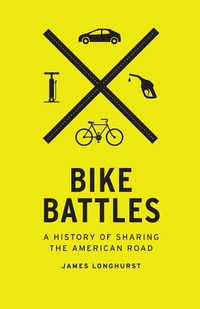
Bike Battles
Description

Americans have been riding bikes for more than a century now. So why are most American cities still so ill-prepared to handle cyclists? James Longhurst, a historian and avid cyclist, tackles that question by tracing the contentious debates between American bike riders, motorists, and pedestrians over the shared road.
Bike Battles explores the different ways that Americans have thought about the bicycle through popular songs, merit badge pamphlets, advertising, films, newspapers and sitcoms. Those associations shaped the actions of government and the courts when they intervened in bike policy through lawsuits, traffic control, road building, taxation, rationing, import tariffs, safety education and bike lanes from the 1870s to the 1970s.
Today, cycling in American urban centers remains a challenge as city planners, political pundits, and residents continue to argue over bike lanes, bike-share programs, law enforcement, sustainability, and public safety. Combining fascinating new research from a wide range of sources with a true passion for the topic, Longhurst shows us that these battles are nothing new; in fact they're simply a continuation of the original battle over who is - and isn't - welcome on our roads.
Watch the trailer: https://www.youtube.com/watch?v=WNleJ0tDvqg
More details
Other editions
Additional editions
Person
James Longhurst is associate professor of history at the University of Wisconsin?La Crosse and author of Citizen Environmentalists.
Content
Preface
Introduction
1. Get Out of the Road!
2. The Right Sort of People
3. The Rules of the Road
4. Victory Bike Battles
5. 1950's Syndrome
6. Bikes Are Beautiful
Conclusion
Acknowledgments
Note on Citations and Sources
Abbreviations
Notes
Select Bibliography
Index
