

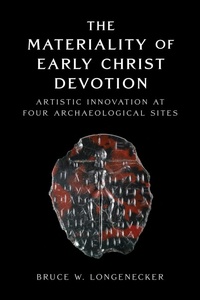
The Materiality of Early Christ Devotion
Description

In the fourth and fifth centuries CE, Christian artistry began to flourish, as elite patrons sponsored decorative initiatives for basilica churches throughout the Mediterranean basin. But what about the first three centuries? Living prior to the Constantinian age of tolerance, did Christ followers of that period engage in artistic expressions that externalized their theological hopes and convictions?
The question can best be answered by consulting the ancient material record itself. The study of the Greco-Roman world has increasingly taken a "material turn" with the recognition that the archaeological record is integral in shaping our understanding of ancient cultures and civilizations. Foregrounding the material data reanimates the lived experience of people on the ground. To what extent did early Christ followers leave their mark on the material record of the Roman world?
This is the question Bruce Longenecker explores in The Materiality of Early Christ Devotion. An array of evidence from around the Mediterranean basin testifies to some fascinating ways that Christ followers expressed themselves in artistic media-gravestones, rings and gemstones, amulets, wall plaster, and mosaics. In particular, four archaeological sites allow us to see Christ followers giving life to their theological convictions in ways shaped by their localized situations.
In Ostia and the aftermath of persecution, we glimpse a cautious but hopeful Christ devotion, with Christ followers creating cryptic artistic symbols within a public space.
In Dura-Europos and the context of international embattlement, we encounter an ambitious and impassioned Christ devotion, as Christ followers used art to enhance their experiences of empowerment, illumination, and union with the divine.
In Smyrna where numerical mysticism was fashionable, we discover a savvy and sapiential Christ devotion, with Christ followers embedding their devotion in artistic puzzles that exhibited the mystical and mathematical dimensions of their beliefs.
In Pompeii, we catch sight of an embryonic Christ devotion that, like countless artistic artifacts from the town, displayed a simple hope for protection from evil forces and the insecurities of life.
Building on the findings of archaeologists and historians, Longenecker's innovative interpretations offer fresh opportunities to see the diversity of localized forms of Christ devotion through the artistic ingenuity of pre-Constantinian Christ followers.
More details
Other editions
Additional editions
Person
Bruce W. Longenecker is Professor of Early Christianity and W. W. Melton Chair of Religion, Department of Religion, Baylor University.
Content
1 Introducing the Project2 Depicting the Pre-Constantinian CrossPart 1 Christ Followers in Ostia3 Embedding Symbols4 Securing Premises and PatronagePart 2 Christ Followers in Dura-Europos5 Surveying the Christian Building6 Interpreting the Frescos7 Populating the Christ Assembly8 Experiencing a Baptismal ServicePart 3 Christ Followers in Smyrna9 Puzzling the Word SquarePart 4 Christ Followers in Pompeii10 Devising Protection11 Wanting More Life12 Positioning Christ Devotion13 Outlining the ResultsAppendix 1 Crossing the CurbstoneAppendix 2 Setting the Record StraightAppendix 3 Pre-Dating Pompeii?
