

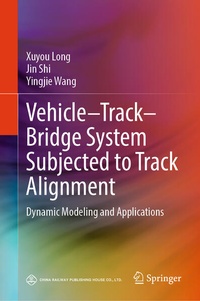
Vehicle-Track-Bridge System Subjected to Track Alignment
Description

This book delves into the dynamic issues of railway vehicles and track/bridge structures. This area has been a focus of railway engineering since the 1990s, driven by the speed-increasing of existing railway and the development of high-speed railway research in China. The book critically examines the dynamical interactions within the railway vehicle-track-bridge system subjected to track alignment, transcending the limitations of traditional quasi-static methods and offering a novel perspective for analyzing track alignment design parameters with respect to safety and comfort. Introducing a novel approach, this book applies railway vehicle-track/bridge system dynamics to track alignment studies, tackling unique challenges such as non-linear wheel-rail relationships and spatial geometric conditions of track curves. It also addresses the challenge of long track lengths (typically spanning tens of kilometers) and presents innovative modeling and solution methods, making it a valuable reference in railway system dynamics. The content covers foundational dynamic principles, comprehensive modeling of railway vehicles, track, and bridge structures, and practical engineering applications. Through detailed case studies, readers will gain insights into the real-world application and optimization of track alignment using dynamic evaluation methods. Intended for researchers and practitioners with a background in railway engineering, this book bridges the gap between theoretical research and practical implementation. It is especially valuable for those involved in high-speed and heavy-haul railway projects.
More details
Other editions
Additional editions
Persons
Dr. Xuyou Long, a Ph.D. and Professorate Senior Engineer, serves as Chief Engineer at the Railway Line and Station Institute of China Railway Design Corporation and a professional leader of the "Hundred, Thousand and Ten Thousand Talents" Project under China State Railway Group Co., Ltd. His research focuses on railway vehicle-track-bridge dynamics, as well as railway route design theory and technology. Dr. Long has led over 10 national, provincial, and ministerial-level research projects, as well as the survey and design of over 10 engineering projects such as Jinan-Qingdao high-speed railway and the second Beijing-Shanghai corridor high-speed railway. He has received the Youth Award of the "Zhan Tianyou Railway Science and Technology Award" and the Railway Engineer Award of the "Mao Yisheng Science and Technology Award," as well as over 10 science and technology progress awards (including three Special Prizes and three First Prizes) from Tianjin Municipality, the China Railway Society, and the China Communications and Transportation Association. Additionally, he has earned several provincial and ministerial-level awards for excellent survey and design, engineering consulting, and software development. He has also published 4 monographs and over 30 academic papers.
Dr. Jin Shi is a Professor and Ph.D. Supervisor at the School of Civil Engineering, Beijing Jiaotong University. His research focuses on the optimization of spatial alignment and smoothness control of rail transit, as well as the dynamics and engineering applications of railway systems. He has led over 20 national and provincial projects, published over 20 SCI/EI indexed papers in the past five years, and holds 8 authorized invention patents. He has received multiple awards, including the Special Prize and First Prize of the Science and Technology Progress Award from the China Railway Society. Dr. Shi serves as a Director of the Rail Transit Branch of the China Exploration and Design Association, a Member of the Standardization Committee of the China Railway Society, and the Chair of the Technical Subcommittee of the World Transport Convention.
Dr. Yingjie Wang is an Associate Professor and Ph.D. Supervisor at the School of Civil Engineering, Beijing Jiaotong University. His research focuses on Structural Health Monitoring of Railway Infrastructures and Indirect Damage Detection of Bridge and Track Structures. He has led multiple national and provincial projects and published over 20 academic papers. Dr. Wang has received prestigious awards, including the Special Prize of the China Communications and Transportation Association Science Progress Award and the First Prize of the China Railway Engineering Corporation Science and Technology Award. He is also an expert in the National Railway Administration Expert Database and serves on the World Transport Convention Rail Transit Civil Engineering Technical Committee.
Content
Introduction.- Vehicle System Dynamics Model.- Vehicle-track System Dynamics Modeling.- Evaluation Criteria and Methods for Dynamic Performance.- On-Site testing and Analysis of Track System Dynamics.
