
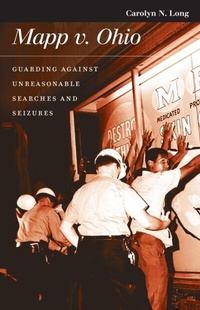
Mapp v. Ohio
Description
Alles über E-Books | Antworten auf Fragen rund um E-Books, Kopierschutz und Dateiformate finden Sie in unserem Info- & Hilfebereich.
Although she came to be known as merely ?that girl with the dirty books,? Dollree Mapp was a poor but proud black woman who defied a predominantly white police force by challenging the legality of its search-and-seizure methods. Her case, which went all the way to the Supreme Court, remains hotly debated and highly controversial today.
In 1957, Cleveland police raided Mapp's home on a tip?from future fight promoter Don ?the Kid? King?that they'd find evidence linked to a recent bombing. What they confiscated instead was sexually explicit material that led to Mapp's conviction for possessing ?lewd and lascivious books??a conviction that initially pitted Ohio police and judges against Mapp and the American Civil Liberties Union. At stake was not only the search-and-seizure question but also the ?exclusionary rule? concerning the use of evidence not specified in a search warrant.
Carolyn Long follows the police raid into Mapp's home and then chronicles the events that led to the Court's 5-4 ruling in Mapp v. Ohio (1961), which redefined the rights of the accused and set strict limits on how police could obtain and use evidence. Long traces the case through the legal labyrinth, discusses the controversies it created, and assesses its impact on police behavior, as well as subsequent prosecutions and convictions of the accused. She also analyzes Justice Tom Clark's creative use of Mapp's case to overturn Wolf v. Colorado, which had ruled that the Fourth Amendment's protection against unreasonable searches applied only to federal law, and presents Justice John Harlan's strong federalist-based dissent.
As entertaining as it is informative, Long's book features a host of intriguing characters: Mapp, her seasoned and determined attorney, A. L. Kearns, and police sergeant Carl Delau, among others. Combined with her concise and insightful explanations of key legal principles?including the exclusionary rule itself?Long's deft narrative provides an ideal format for teachers and students in criminology, legal history, constitutional law, and political science, as well as anyone who loves a good story.
The Mapp case is still much debated, especially in light of the recent reauthorization of the U.S. Patriot Act and the free rein given to law enforcement officers in matters of search and seizure. Long's compelling study thus poses important questions regarding privacy and individual rights that still matter today, even as it also illuminates one of the keystones of the Warren Court's criminal procedure revolution.
All prices
More details
Other editions
Additional editions

Person
Carolyn N. Long is associate professor of political science at Washington State University Vancouver and author of Religious Freedom and Indian Rights: The Case of Oregon v. Smith.
Content
Editors' Preface
Acknowledgments
Prologue
1. The Ohio Battle
2. The History of the Fourth Amendment and the Federal Exclusionary Rule
3. One Final Appeal
4. The Supreme Court Deliberates
5. Mapp Goes Public
6. ?Is the Criminal to Go Free Because the Constable Has Blundered??
7. The Warren Court's Criminal Procedure Revolution and the Political Aftermath
8. The Judicial and Political Effort to Undermine Mapp v. Ohio and the Future of the Exclusionary Rule
Epilogue
Chronology
Relevant Cases
Bibliographical Essay
Index

System requirements
File format: ePUB
Copy protection: Adobe-DRM (Digital Rights Management)
System requirements:
- Computer (Windows; MacOS X; Linux): Install the free reader Adobe Digital Editions prior to download (see eBook Help).
- Tablet/smartphone (Android; iOS): Install the free app Adobe Digital Editions or the app PocketBook before downloading (see eBook Help).
- E-reader: Bookeen, Kobo, Pocketbook, Sony, Tolino and many more (not Kindle).
The file format ePub works well for novels and non-fiction books – i.e., „flowing” text without complex layout. On an e-reader or smartphone, line and page breaks automatically adjust to fit the small displays.
This eBook uses Adobe-DRM, a „hard” copy protection. If the necessary requirements are not met, unfortunately you will not be able to open the eBook. You will therefore need to prepare your reading hardware before downloading.
Please note: We strongly recommend that you authorise using your personal Adobe ID after installation of any reading software.
For more information, see our ebook Help page.
File format: PDF
Copy-Protection: Adobe-DRM (Digital Rights Management)
System requirements:
- Computer (Windows; MacOS X; Linux): Install the free reader Adobe Digital Editions prior to download (see eBook Help).
- Tablet/smartphone (Android; iOS): Install the free app Adobe Digital Editions or the app PocketBook before downloading (see eBook Help).
- E-reader: Bookeen, Kobo, Pocketbook, Sony, Tolino and many more (only limited: Kindle).
The file format PDF always displays a book page identically on any hardware. This makes PDF suitable for complex layouts such as those used in textbooks and reference books (images, tables, columns, footnotes). Unfortunately, on the small screens of e-readers or smartphones, PDFs are rather annoying, requiring too much scrolling.
This eBook uses Adobe-DRM, a „hard” copy protection. If the necessary requirements are not met, unfortunately you will not be able to open the eBook. You will therefore need to prepare your reading hardware before downloading.
Please note: We strongly recommend that you authorise using your personal Adobe ID after installation of any reading software.
For more information, see our eBook Help page.
File format: ePUB
Copy protection: Watermark-DRM (Digital Rights Management)
System requirements:
- Computer (Windows; MacOS X; Linux): Use a reading software that can process the file format ePUB: e.g., Adobe Digital Editions or FBReader – both free (see eBook Help).
- Tablet/Smartphone (Android; iOS): Before downloading, install the free app Adobe Digital Editions (see eBook Help).
- E-reader: Bookeen, Kobo, Pocketbook, Sony, Tolino and many more (not Kindle).
The file format ePUB works well for novels and non-fiction books – i.e., „flowing” text without complex layout. On an e-reader or smartphone, line and page breaks automatically adjust to fit the small displays.
This eBook uses Watermark-DRM, a „soft” copy protection. This means that there are no technical restrictions to prevent illegal distribution. However, there is a personalised watermark embedded in the eBook that can be used to identify the purchaser of the eBook in the event of misuse and to provide evidence for legal purposes.
For more information, see our eBook Help page.
